
Choosing between single-tenant vs multi-tenant SaaS is rarely just an architecture decision. It shapes how you sell, onboard, deploy, support, secure, price, audit, and scale your product. AWS frames tenant isolation as a foundational SaaS concern, while Microsoft’s multitenant architecture guidance explicitly covers not only compute and data but also identity, deployment, governance, compliance, and cost management. In other words, tenancy is a product and operating model decision as much as a technical one.
The direct answer is this: multi-tenant SaaS usually wins when you need scalable economics, repeatable onboarding, centralized releases, and efficient growth. Single-tenant SaaS can win when buyers need dedicated environments, stricter isolation, custom deployment control, or stronger compliance evidence. And at later stages, many B2B SaaS companies land on a hybrid or tier-based model, mixing pooled and isolated components by customer tier, workload, or regulatory profile. AWS explicitly describes this mixed reality as the bridge model, and Azure’s deployment stamp guidance reflects the same pattern in practice.
The most useful way to make the decision is not to ask, “Which model is best in theory?” The better question is: Which model best supports the next 12 to 24 months of your product, customers, and revenue motion? Azure’s guidance makes a similar point: your tenancy model depends on business drivers, tenant definitions, and how you plan to scale, not on a single universal best practice.
Single-Tenant vs Multi-Tenant SaaS Explained
Before comparing architecture models, it helps to define the terms carefully. In cloud computing broadly, NIST describes resource pooling as a multi-tenant model where physical and virtual resources are dynamically assigned and reassigned according to consumer demand. That is the cloud baseline. SaaS then adds product-level tenant identity, isolation logic, onboarding, billing, and operations on top of that baseline.
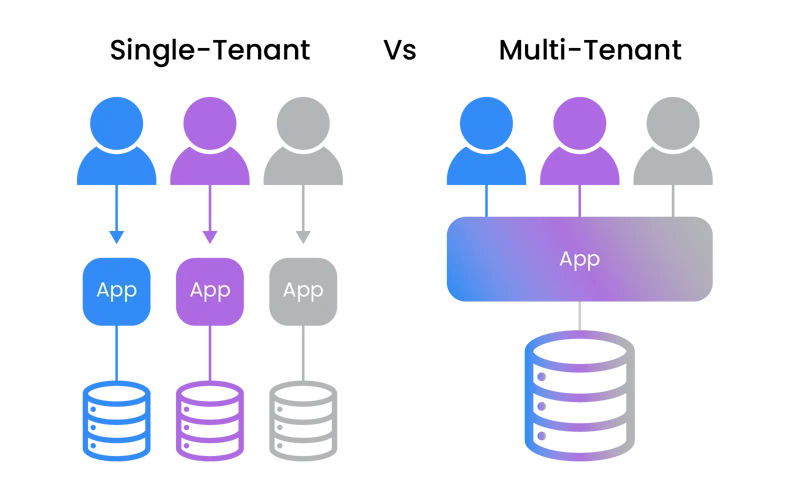
What is single-tenant SaaS
In single tenant SaaS, each customer gets some form of dedicated footprint. That dedicated footprint might be a database, an application instance, a deployment stamp, a Kubernetes namespace with reserved resources, a separate cloud subscription or account, or even a private deployment controlled by the customer. AWS calls these dedicated-resource patterns silo models. Azure similarly treats dedicated infrastructure or dedicated data components as valid multitenant design options when isolation requirements are stronger.
In practice, “single-tenant” can mean several different things:
- a dedicated database per customer with a shared application tier;
- a dedicated app plus dedicated database for each customer;
- a dedicated deployment stamp per tenant or per small tenant group;
- a customer-specific cloud environment, subscription, or region;
- a customer-hosted or private SaaS deployment in the buyer’s infrastructure.
Those are not identical operating models. A shared app with a database-per-tenant pattern is far easier to run than a fully isolated stack per customer. Azure SQL’s tenancy patterns show this clearly: a multitenant application can still use single-tenant databases for each customer, retaining stronger isolation while sharing the application tier.
Single-tenancy is common in products selling into enterprise IT, healthcare, fintech, legaltech, public sector, cybersecurity, and other markets where customers ask for dedicated backups, stronger isolation narratives, private networking, regional deployments, or customer-managed encryption arrangements. That preference is not arbitrary. Azure notes that dedicated stamps provide the highest isolation level, avoid many noisy-neighbor effects, and allow configuration or customization for specific needs such as geopolitical region or availability requirements. Google Cloud guidance on GKE shows a similar trade-off: namespace- or node-isolated customer environments can increase isolation, but they use more infrastructure and still share some control-plane concerns.
Enterprise buyers often prefer single-tenancy because it is easier to explain in a security review. A dedicated database is tangible. A dedicated region is tangible. Dedicated encryption keys are tangible. Dedicated backups and recovery procedures are tangible. Even when these choices are not strictly required by regulation, they can reduce procurement friction in larger deals. Azure and Google Cloud both explicitly tie stronger isolation patterns to compliance, regulatory, or tenant-specific requirements.
What is multi-tenant SaaS
In multi tenant SaaS architecture, multiple customers share the same application environment while data, permissions, configurations, and usage are logically separated. AWS describes the pooled model as the classic notion of multi-tenancy: tenants rely on shared, scalable infrastructure to achieve economies of scale, manageability, and agility. Azure’s multitenant guidance covers multitenancy across compute, networking, storage, messaging, identity, AI, governance, and cost management, which is a useful reminder that multitenancy is rarely just about the database.
A multi tenant SaaS architecture can be shared at many layers:
- application layer, where one app instance serves many tenants;
- database layer, with shared tables, shared schemas, or tenant-distributed shards;
- compute layer, with shared clusters, functions, or app servers;
- storage layer, with shared buckets, accounts, or containers plus tenant scoping;
- cache and queue layer, where tenancy has to be enforced in keys, topics, partitions, and jobs;
- analytics layer, where events must remain tenant-aware;
- AI layer, where shared models may coexist with tenant-specific deployments.
That breadth matters. Google Cloud’s GKE and Spanner guidance repeatedly shows that multitenancy is not a single switch. You can share clusters but isolate namespaces. You can share instances but isolate databases. You can share a model deployment or create dedicated model deployments for selected tenants.
At the data level, common multi-tenant database patterns include:
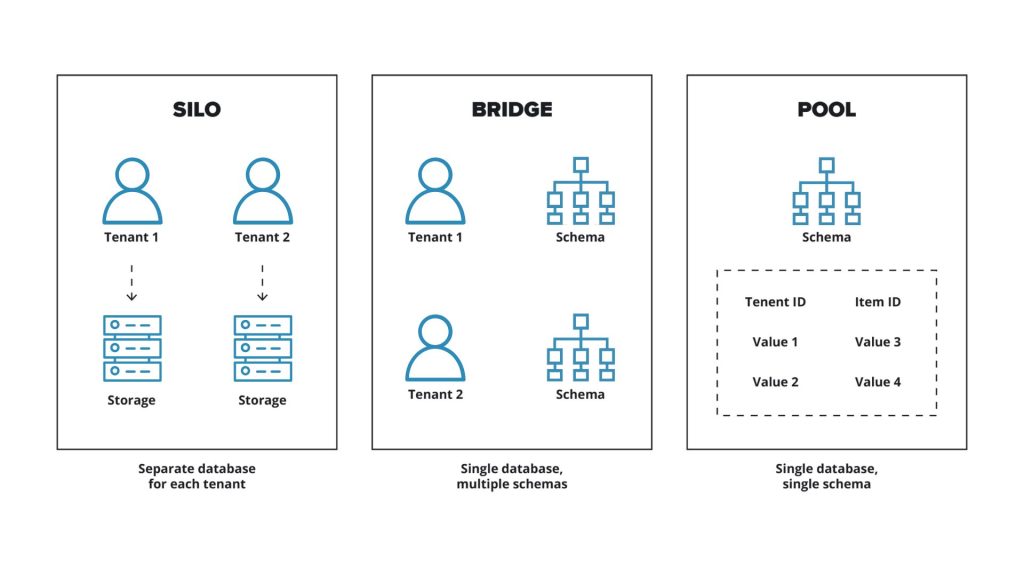
- shared database, shared schema, where all tenants use the same tables and are separated by a tenant identifier;
- shared database, separate schema, a middle ground between cost efficiency and isolation;
- separate database per tenant, still often run under a common control plane;
- sharded or hybrid models, where some tenants stay in pooled databases while others move to dedicated databases or stamps.
AWS maps these patterns conceptually as pool, bridge, and silo. Azure SQL documents single multitenant databases, sharded multitenant databases, database-per-tenant patterns, and hybrid sharded models. Google Cloud Spanner documents instance, database, table, and row patterns with clear trade-offs across isolation, agility, operations, and scale.
Why do SaaS companies choose multi-tenancy? Because it usually supports better SaaS scalability, faster standardized onboarding, easier centralized releases, lower infrastructure cost per tenant, and stronger operational visibility when you instrument the platform correctly. AWS also emphasizes that tenant-aware logs, metrics, and cost allocation matter because SaaS providers need tenant-level insights for operations and business decisions, even in pooled environments.
Single-tenant vs multi-tenant SaaS core differences
The table below is an editorial synthesis of AWS SaaS Lens, Azure multitenant architecture guidance, Google Cloud multitenancy guidance, OWASP API Security guidance, and cloud vendor documentation on data isolation, noisy neighbors, and operations.
| Criteria | Single-tenant SaaS | Multi-tenant SaaS | What it means for business |
|---|---|---|---|
| Infrastructure cost | Higher baseline cost because more resources are dedicated per tenant | Lower average cost through pooled resource sharing | Direct effect on gross margin and pricing flexibility |
| Customer isolation | Stronger, more visible isolation story | Logical isolation can be strong, but must be engineered carefully | Affects enterprise procurement and security reviews |
| Security model | Simpler blast-radius story, but still needs strong auth and tenant controls | Strong security is possible, but failures usually come from authorization gaps and weak tenant context propagation | Security depends more on implementation maturity than on marketing labels |
| Compliance readiness | Easier to package dedicated controls, backups, regions, and keys for specific customers | Can meet many compliance needs, but some buyers still demand stronger separation | Important in healthcare, fintech, legal, gov, cyber, and enterprise AI |
| Deployment speed | Slower if every tenant needs provisioning or approval | Faster when onboarding is standardized and automated | Impacts sales velocity and onboarding labor |
| Release management | Harder if customers run separate environments or versions | Easier with one main release train and centralized rollout | Major effect on roadmap speed and QA load |
| Customization | Easier to support customer-specific infrastructure and exceptions | Better when product design is configuration-first rather than code-first | Determines whether enterprise requirements stay profitable |
| Scalability | Operationally heavier as tenant count rises | Usually better for high tenant counts and repeatable growth | Critical once sales become repeatable |
| Performance predictability | Better per large tenant when resources are reserved or isolated | Can suffer from noisy neighbors if governance is weak | Matters for premium SLAs and large workloads |
| Observability | Clear tenant boundaries, but cross-customer analytics are fragmented | Stronger central analysis if logs, metrics, and events are tenant-aware | Impacts support, product analytics, and health scoring |
| Support complexity | Root-cause analysis may vary by environment and version | Easier when customers share versions and operational patterns | Affects support labor and reproducibility |
| Enterprise sales | Often easier to position for large regulated accounts | Can still win enterprise deals, especially with strong isolation controls or hybrid tiers | Sales story depends on buyer profile |
| Gross margin | Often under pressure unless customers pay for isolation | Usually better at scale thanks to resource utilization | Important for sustainable SaaS economics |
| Product velocity | Slower when releases and schema changes fragment by tenant | Faster when one platform serves many tenants | Direct effect on experimentation and roadmap throughput |
| Data analytics | Harder to aggregate across many isolated deployments | Easier to analyze fleet-wide behavior and benchmark customers | Helps with product decisions, adoption analysis, and usage-based pricing |
Single-tenant usually optimizes for control and isolation. Multi-tenant usually optimizes for scale and operating efficiency. The right answer depends less on ideology and more on product maturity, customer expectations, compliance posture, and operational automation. AWS’s bridge model exists precisely because real SaaS businesses often need both.
The real question is stage, not ideology
The most practical framing is stage-based:
MVP / pre-product-market fit, early customers / first paid pilots, growth / repeatable sales, enterprise expansion, regulated or global scale, and platform maturity.
That framing follows directly from cloud vendor guidance. Azure says tenancy models should be chosen based on business drivers, tenant needs, and scale plans. AWS and Microsoft both also stress automation, onboarding flow, observability, and cost visibility as first-class SaaS concerns, which means your tenancy decision should support the company you are becoming over the next 12 to 24 months, not an abstract architectural fantasy five years away.
The Stage-Based Decision Guide
MVP stage
At the MVP stage, the winning model is often multi-tenant-aware architecture, not necessarily full multi-tenant infrastructure.
Founders often overcomplicate this decision. An early B2B SaaS product usually needs speed of learning, not maximum isolation theater. What you need from day one is a platform that understands tenants as a first-class concept. AWS’s SaaS Lens is explicit that a SaaS identity must connect the user to the tenant and that this context must flow across the application’s services. That means tenant identity should already exist in authentication, authorization, logs, usage tracking, billing events, and core domain records, even if your first infrastructure footprint is still relatively simple.
For most MVPs, basic pooled infrastructure makes sense because it lets you iterate quickly. A single application deployment with a shared database and clear tenant identifiers can be perfectly reasonable if the product is still looking for product-market fit and is not handling highly regulated data. Azure SQL’s single multitenant database pattern and Google’s row pattern both illustrate why teams start here: onboarding overhead is low, cost efficiency is high, and scale can be large. But both vendors also warn that isolation and tenant-specific operations are weaker in the most shared models.
That warning leads to the right MVP conclusion: do not skip tenant-aware foundations, even if you postpone deeper isolation choices.
A practical MVP architecture should include:
- tenant identity in tokens or session context;
- tenant_id in core domain records where relevant;
- tenant-scoped authorization rules on the server side;
- tenant-aware logs and metrics;
- tenant-aware billing and usage events;
- feature flags or configuration objects by tenant;
- test cases that intentionally try cross-tenant access.
Those are not “enterprise extras.” They are what keep your future migration from becoming a rewrite. AWS’s onboarding guidance explicitly recommends tenant-aware logs and metrics during the onboarding flow, and AWS’s reliability guidance recommends injecting tenant context into logs to diagnose tenant health and usage patterns.
Can a single-tenant pilot be acceptable at MVP stage? Yes, sometimes. If you have one design partner, if their contract is strategic, and if the deployment is intentionally temporary, a dedicated environment may be rational. But it should be treated as a controlled exception, not as the hidden default operating model for the future platform. Azure warns that single-tenant stamps are easier to implement at small scale, but become progressively harder and more expensive as tenant count grows.
Early customer stage
The early customer stage is where sales pressure often pulls teams toward single tenant SaaS, especially when the first serious buyer is enterprise.
This is the moment when security questionnaires start arriving. Buyers ask whether data is co-mingled. They ask for private networking, regional hosting, single sign-on federation, audit logs, data retention policies, customer-managed keys, or evidence that one customer cannot affect another. Microsoft’s multitenant identity guidance notes that enterprise tenants often have strong IDP, federation, MFA, and sign-in security requirements, and those requirements are painful to add later if architecture didn’t anticipate them.
Why do early enterprise buyers push for dedicated environments?
Because they are often concerned about:
- data isolation;
- custom SLAs or reserved capacity;
- auditability and incident blast radius;
- private connectivity and networking;
- data residency by region;
- customer-specific integrations;
- custom encryption key control;
- workload predictability.
Those are all legitimate concerns. Azure’s multitenant storage/data guidance says there is no single architecture that fits every scenario, and stronger isolation may be required for regulatory or tenant-specific reasons. Google Cloud’s Spanner guidance similarly ties database-level patterns to backup needs, CMEK needs, and data residency requirements. Azure’s data residency guidance also states that customers can select the geography where customer data is stored and processed for many services.
The risk is not that dedicated environments are wrong. The risk is that they quietly create a fragmented company:
- releases stop being centralized;
- one customer gets one schema change, another gets a different one;
- DevOps becomes manual ticket work;
- support loses reproducibility;
- margins weaken because every tenant feels custom;
- migration later becomes politically and technically painful.
Azure warns that manual management becomes overwhelming when you provision individual databases per tenant without automation. It also notes that aggregating reporting across isolated tenants becomes cumbersome at scale.
Before saying yes to a single-tenant enterprise deployment, ask:
- Is this a paid strategic customer, not just a logo opportunity?
- Will the customer pay for dedicated infrastructure or reserved capacity?
- Can provisioning be fully automated with infrastructure as code?
- Can the tenant stay on the same codebase and release train?
- Can the contract include migration terms later?
- Does this become a repeatable enterprise tier instead of one-off custom work?
If the answer to most of those questions is no, then “yes” to a dedicated deployment can become “yes” to a long-term operational tax.
Growth stage
Once you have repeatable sales, multi-tenant usually starts winning clearly.
At this stage, the business needs onboarding consistency, release consistency, margin leverage, and better product intelligence. AWS’s pooled model is explicitly about economies of scale, manageability, and agility. Azure’s multitenant guidance covers centralized deployment and cost management. GKE multi-tenancy guidance shows why shared control planes and centralized operations become attractive alternatives to managing many single-tenant clusters.
Why does multi-tenancy get stronger as the SaaS product scales?
Because you now care deeply about:
- onboarding many customers without engineering involvement;
- keeping customers on a small number of product versions;
- running experiments and feature flags centrally;
- tracking usage, health, and margin by tenant;
- supporting usage-based or tiered pricing;
- operating shared infrastructure more efficiently;
- learning from fleet-wide analytics.
AWS explicitly connects tenant resource consumption data with business decisions about how to design, scale, and operate a SaaS environment. Tenant-aware observability is not just an ops benefit. It becomes a product strategy advantage.
This is why multi-tenancy is not just a cost play. It is also a learning system.
A product team can understand which features drive retention, which tenant cohorts use which workflows, where onboarding fails, and which customers are stressing infrastructure. AWS recommends tenant-aware metrics in onboarding and tenant context in logs precisely because SaaS teams need insights at the tenant level, not just global averages.
This is also the stage where feature flags, tenant-level configuration, and modular packaging become more important than customer-specific code branches. If every new customer still requires engineering for onboarding or deployment, the problem is usually no longer “Do we need single tenancy?” It is more likely “Why is our product not operationally standardized yet?”
Enterprise expansion and platform maturity
At maturity, the answer often becomes hybrid.
AWS’s bridge model exists because mature SaaS platforms usually mix pooled and siloed components depending on regulatory profile, cost sensitivity, and noisy-neighbor behavior. Azure’s deployment stamp and control plane guidance shows a comparable pattern: some tenants may sit in multitenant stamps, while others get dedicated infrastructure, dedicated databases, or region-specific deployments.
A mature hybrid architecture might look like this:
- shared application core plus dedicated database for selected tenants;
- shared control plane plus dedicated data plane;
- multitenant default plan plus isolated premium environments;
- dedicated regional deployment to satisfy data residency;
- tenant-level encryption controls or customer-managed keys;
- dedicated workload partitions for high-volume tenants;
- dedicated AI or model environments for sensitive or fine-tuned use cases.
Azure’s Azure OpenAI multitenancy guidance is especially useful here. Microsoft says a shared Azure OpenAI instance is the easiest model, but it provides the least data isolation and performance isolation. The same guidance also recommends dedicated deployments for tenants with specific capabilities and warns against sharing an instance when fine-tuned models are in use, because that can expose sensitive information and unauthorized access paths. Regional Azure OpenAI deployments also help support data residency requirements.
Control plane vs data plane
This distinction matters a lot for enterprise SaaS architecture.
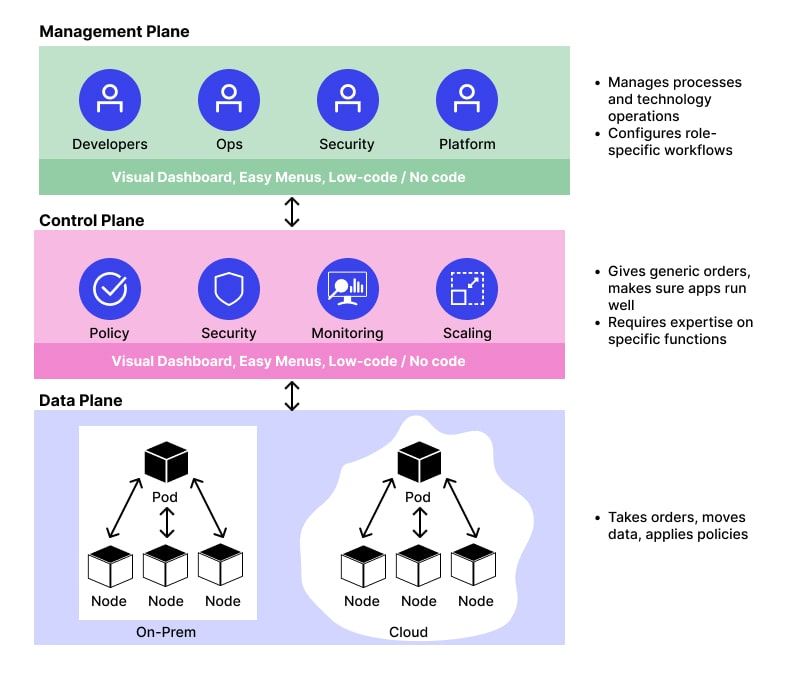
A control plane handles tenant onboarding, provisioning, metadata, admin workflows, billing orchestration, routing, and environment lifecycle. A data plane handles the tenant-facing runtime: application instances, databases, queues, storage, and processing workloads. Azure’s control-plane guidance literally separates these concerns in its reference architectures, showing the control plane orchestrating new tenant deployment into the data plane. Google’s GKE guidance likewise notes that a SaaS provider’s tenants include both per-customer instances and the SaaS control plane.
Why does this matter?
Because you can keep a shared control plane for operational efficiency while selectively isolating parts of the data plane for enterprise customers. That is often the sweet spot for mature B2B SaaS. It preserves centralized governance and automation while giving strategic accounts stronger isolation options.
Security, Compliance, and Performance Realities
Security and tenant isolation are the part you cannot fake
The biggest mistake in discussions about tenant isolation in SaaS is reducing the topic to database separation.
AWS defines tenant isolation as the use of tenant context to limit access to resources and stresses that, in multi-tenant environments, each tenant must be prevented from accessing another tenant’s resources. AWS also says a SaaS identity must connect the user to the tenant and that this context must be applied across all services.
That means real SaaS tenant isolation has to exist across:
- authentication and tenant identity mapping;
- server-side authorization logic;
- RBAC and, when needed, ABAC;
- APIs and object-level access checks;
- database reads and writes;
- caches and background jobs;
- logs, observability data, and analytics pipelines;
- admin tooling and support consoles;
- queues, storage paths, and AI prompts or model access.
NIST defines RBAC as access control based on roles rather than individual identities, and NIST’s ABAC guidance defines authorization as evaluating attributes of subjects, objects, operations, and environment against policy. In multi-tenant SaaS, that usually translates into combining role information with tenant attributes and object ownership context, especially for enterprise permission models.
OWASP’s API Security Top 10 explains why this matters so much in multi-tenant products. Broken Object Level Authorization happens when an API accepts object identifiers but fails to verify that the caller is authorized for that specific object. Broken Function Level Authorization arises when regular users can access privileged endpoints or functions they should not access. Broken Object Property Level Authorization covers cases where users can read or modify sensitive fields they should not see or change. In a shared SaaS platform, these are classic cross-tenant failure modes.
Here is the concise answer many teams need:
The biggest risk in multi-tenant SaaS is not sharing infrastructure itself. The real risk is incomplete tenant isolation across APIs, databases, caches, queues, logs, analytics, and administrative tools. AWS’s tenant-context guidance and OWASP’s API guidance point to the same truth: the failure usually occurs in authorization, scoping, or context propagation, not in the mere fact that infrastructure is shared.
Common mistakes include relying on frontend filtering, missing tenant_id checks in backend queries, using shared admin roles without scoped permissions, exposing tenant data in logs, failing to scope cache keys, processing background jobs without tenant context, mixing tenant events in analytics pipelines, and under-testing cross-tenant access flows. Those are practical implementation errors consistent with AWS’s requirement to propagate tenant context across services and OWASP’s emphasis on object-, function-, and property-level authorization.
Compliance, data residency, and regulated industries
Compliance does not automatically require single tenancy.
GDPR Article 25 requires data protection by design and by default. GDPR Article 32 requires technical and organizational measures appropriate to risk, including encryption, confidentiality, integrity, availability, resilience, restoration capability, and regular testing. HIPAA’s Security Rule similarly requires administrative, physical, and technical safeguards for the confidentiality, integrity, and availability of ePHI. ISO/IEC 27001 specifies requirements for establishing, implementing, maintaining, and continually improving an information security management system. SOC 2 examinations evaluate controls over security, availability, processing integrity, confidentiality, and privacy. None of those frameworks says, categorically, “You must always use single tenancy.”
What they do demand is evidence.
That evidence usually includes:
- access control design;
- encryption and key management;
- audit logging;
- data retention and deletion controls;
- backup and restore procedures;
- incident response readiness;
- regional deployment choices;
- testing and continuous control operation.
This is why regulated SaaS often benefits from hybrid tenancy. Pooled defaults may be entirely acceptable for some workloads, but certain tenants or data classes may need database-level separation, dedicated regions, tenant-specific backup controls, or customer-managed encryption keys. Google Cloud’s Spanner guidance is quite explicit that database-level patterns support tenant-specific backups and CMEK, while more shared table-level patterns do not. Azure’s multitenant storage/data guidance also allows separate databases, servers, subscriptions, or accounts depending on the required isolation level.
That matters for healthcare, fintech, insurance, legaltech, govtech, cybersecurity, HR tech, and enterprise AI SaaS.
For example:
- Healthcare SaaS may need stronger safeguards, regional controls, and clean auditability for ePHI.
- Fintech and insurance SaaS often need clearer segregation stories, strict key management, and predictable recovery processes.
- Legaltech and HR SaaS can face buyer sensitivity around confidential documents, privilege, and employee data, which often pushes the architecture toward stronger isolation packaging.
- Enterprise AI SaaS may need dedicated model deployments or even tenant-provided AI resources when sensitive data, custom fine-tuning, or strict model access controls are involved.
Data residency is a similar story. Azure says many services let you choose where customer data is stored and processed, and Azure OpenAI guidance explicitly recommends regional deployment when you need residency support. Google Spanner’s geo-partitioning guidance also connects data placement to regulatory and latency requirements.
Performance, noisy neighbors, and scalability
The noisy neighbor problem is real. Azure defines it simply: one tenant’s performance is degraded because of another tenant’s activity. Google Cloud’s GKE guidance gives concrete examples, such as CPU spikes and networking events caused by one tenant affecting others in shared clusters. Azure also recommends quotas, throttling, governance controls, scaling out, and even reserved capacity where appropriate.
That does not mean multi-tenancy is flawed. It means multitenancy without resource governance is flawed.
Key mitigation methods include:
- tenant-level quotas;
- rate limiting and throttling;
- workload prioritization by tier or SLA;
- queue or worker isolation for long-running jobs;
- data partitioning or sharding;
- per-tenant observability;
- autoscaling and stamp-based expansion;
- reserved or dedicated resources for premium accounts.
Azure’s throttling pattern notes that in multitenant systems with different SLAs, high-value tenants may need immediate processing while lower-priority work is deferred through queue-based load leveling or separate endpoints. GKE guidance recommends resource quotas per namespace, and Azure’s noisy neighbor guidance recommends treating the issue as a governance problem with quotas and throttling. Azure’s deployment stamp pattern then provides the scale-out mechanism when a pool is reaching capacity.
| Problem | Risk | Mitigation |
|---|---|---|
| One tenant overloads API | Latency spikes or failed requests for everyone else | Per-tenant rate limits, quotas, priority routing, autoscaling |
| Long-running reports | Shared worker starvation | Separate worker pools, job priority queues, async execution by tier |
| Heavy AI or LLM workloads | Expensive bursts, quota exhaustion, high latency | Dedicated model deployments for selected tenants, token metering, regional or stamp-based isolation |
| Large data imports | Queue congestion and database pressure | Tenant-specific queues, batch windows, backpressure controls, sharding |
| Database locks or hot partitions | Cross-tenant contention | Better partition keys, shard tenants, move large tenants to dedicated databases |
| Queue congestion | Delayed background operations for all tenants | Queue isolation, priority queues, concurrency caps by tenant or plan |
| Cache pressure | Evictions and inconsistent performance | Tenant-aware cache partitioning, scoped keys, reserved space for premium tenants |
| Storage spikes | Cost surprises and degraded shared services | Per-tenant usage monitoring, quotas, storage account or bucket isolation for large tenants |
The last two rows are architecture recommendations inferred from the same cloud-vendor governance principles: if one tenant can overwhelm a shared resource, that resource needs either isolation or enforcement boundaries.
Economics, Product Design, and Data Models
Cost and unit economics are the hidden architecture question
A tenancy model affects more than cloud spend. It affects total operating cost per customer.
AWS’s cost-per-tenant guidance is especially important here. AWS says measuring tenant resource consumption is crucial for determining cost per tenant and for making business and technical decisions about how to design, scale, and operate a SaaS environment. AWS also notes that there is no single universal model for measuring tenant resource consumption across architectures. Complexity depends on how resources are shared and what can be attributed directly.
That leads to a principle many SaaS teams miss:
SaaS architecture should be evaluated not only by infrastructure cost, but by total operating cost per customer.
That includes:
- infrastructure spend;
- cloud waste and idle headroom;
- DevOps labor;
- support labor;
- release overhead;
- compliance evidence overhead;
- onboarding effort;
- customization cost;
- data recovery complexity;
- cost attribution difficulty.
Azure’s dedicated-stamp guidance is blunt about infrastructure cost: each single-tenant stamp needs dedicated infrastructure sized for peak demand, and your pricing model must offset that cost. Azure also notes that reporting across isolated tenants becomes cumbersome and that manual tenant-specific operations become overwhelming without automation.
| Cost driver | Single-tenant impact | Multi-tenant impact | Strategic note |
|---|---|---|---|
| Base infrastructure | Higher per tenant because capacity is reserved or duplicated | Lower average cost through pooled utilization | Best for customers who will pay for isolation |
| DevOps labor | Higher if each tenant needs provisioning, patching, and incident workflows | Lower when most tenants share the same operational pipeline | Automation quality changes the math dramatically |
| Release cost | Higher when environments diverge | Lower when one release train serves many tenants | Strongly affects product velocity |
| Support cost | Higher if customers run different versions or configurations | Lower when support can reproduce on common infrastructure | Version sprawl is expensive |
| Compliance cost | Easier to evidence tenant-specific controls, but more artifacts to manage | Central controls can be efficient, but some buyers want tenant-specific evidence | Hybrid often wins here |
| Customization cost | Lower initial friction for one customer, higher long-term fragmentation risk | Requires stronger configuration architecture up front | Product design discipline matters |
| Cost attribution | Easier when resources are tenant-dedicated | Harder in deeply pooled systems without strong telemetry | AWS explicitly recommends tenant-level consumption mapping |
| Analytics and benchmarking | Fragmented | Stronger fleet-wide analysis | Important for usage-based pricing and account health |
| Gross margin leverage | More linear with tenant growth | Better potential leverage as tenant count grows | Usually the decisive long-term factor |
This is where many B2B SaaS companies realize that tenancy is tightly connected to segmentation. Not every customer should get the same architecture. Some customers should pay for more expensive isolation features. Others should live in an efficient shared tier.
Customization without creating fifty products
Single-tenant environments often make customization easier in the short term. A team can add a custom integration, schema adjustment, workflow, or deployment exception for one customer without immediately affecting others. Azure SQL even notes that the database-per-tenant model makes certain tenant-specific schema customizations more straightforward.
But customization is where teams accidentally create product fragmentation.
The healthier long-term path is configuration-first product design:
- feature flags by tenant or plan;
- tenant-level settings and policy controls;
- branding and domain configuration;
- modular integration architecture;
- workflow builders or rule engines;
- role-based and attribute-based permissions;
- optional plugins or extension points.
Azure’s storage/data guidance explicitly warns against column-level tenant customization and manual schema changes in shared systems because they quickly become unmanageable. That is one of the clearest official reminders that the real problem may be product architecture, not tenancy alone.
So here is the practical rule:
If every customer needs code changes, the problem may not be tenancy. The problem may be product architecture.
A well-designed multi-tenant platform can still support meaningful enterprise variation. It just does so through configuration, policy, modules, and controlled isolation boundaries rather than one-off forks.
Database architecture options for SaaS tenancy
Database choices are where the single-tenant vs multi-tenant SaaS debate becomes concrete.
AWS, Azure, and Google all document multiple patterns rather than a single blessed design. That alone should tell founders something important: there is no one universal winning database model.
| Pattern | Best for | Benefits | Risks | When to avoid |
|---|---|---|---|---|
| Shared database, shared schema | MVPs, SMB SaaS, high tenant counts, low-cost onboarding | Cheapest starting point, simple onboarding, high density | weakest isolation, hard tenant-specific ops, more risk from bad query scoping | Avoid when regulated tenants need dedicated backup, keys, or recovery paths |
| Shared database, separate schema | Teams that want moderate isolation without full database sprawl | Better separation than shared tables, some operational efficiency | schema management complexity, weaker flexibility than dedicated DBs | Avoid if tenant count is very high or schema customization is frequent |
| Separate database per tenant | Enterprise tiers, moderate customization, cleaner backup/restore | stronger isolation, tenant-specific backup, easier offboarding, clearer blast radius | more provisioning overhead, more management complexity, still shared app risks | Avoid without strong automation or if customers will not pay for extra ops |
| Fully isolated environment | High-value enterprise, strict compliance, private deployment cases | strongest isolation narrative, dedicated compute/network/data controls | highest cost and highest operational burden | Avoid as a default for large tenant counts unless pricing fully supports it |
| Hybrid database model | Mixed customer base, freemium plus enterprise, regulated add-ons | lets you move large or regulated tenants to stronger isolation while keeping pooled defaults | routing, migration, and control-plane complexity | Avoid if platform automation and tenant metadata are weak |
A few vendor-specific details sharpen the choice:
Shared database, shared schema. Azure says a multitenant database requires tenant identifier columns and sacrifices tenant isolation. During development, queries must never expose data from more than one tenant. Azure also notes increased noisy-neighbor risk and harder tenant-specific management operations like point-in-time restore. Google’s Spanner row pattern similarly offers huge scale and low overhead, but it has the lowest level of data isolation and no tenant-level security at the database side.
Separate database per tenant. Azure says a database-per-tenant model provides strong tenant isolation and allows schema customization, while elastic pools can lower cost by sharing capacity across many single-tenant databases. Google’s database pattern allows independent backups, backup schedules, and CMEK per tenant, but still shares underlying infrastructure and can experience noisy neighbors at the instance level.
Hybrid. Azure’s hybrid sharded multitenant model explicitly supports moving a tenant into its own database when needs change, then moving it back if necessary. That is exactly the kind of architecture mature SaaS teams need when serving both their long tail and their largest accounts.
Choosing, Migrating, and Packaging the Right Model
Which model wins at each stage
| Stage | Business situation | Recommended model | Why | Watch out for |
|---|---|---|---|---|
| MVP | Fast learning, unclear PMF, few customers | Multi-tenant-aware architecture with simple pooled infrastructure | Fastest iteration and lowest operating overhead | Do not skip tenant identity, auth scoping, logs, and usage tagging |
| First enterprise pilot | One or two serious buyers ask for stronger isolation | Targeted single-tenant deployment or dedicated database | Can unlock strategic proof points | Avoid one-off code forks and manual ops |
| Early repeatable sales | More tenants, still some enterprise asks | Shared app with selective tenant isolation options | Preserves efficiency while keeping flexibility | Poor automation will slow everything down |
| Growth | Standardized product, repeatable onboarding | Multi-tenant by default | Best fit for onboarding, releases, analytics, and margin | Noisy-neighbor risk if governance is weak |
| Enterprise expansion | Big accounts need dedicated controls | Hybrid or bridge model | Lets you monetize isolation without rebuilding the whole platform | Complexity migrates into control plane and provisioning |
| Regulated market | Residency, keys, audits, backup separation matter | Hybrid with dedicated data-plane elements | Better compliance packaging and cleaner evidence | Avoid promising full isolation if only the database is isolated |
| Global scale | Regional performance and jurisdiction matter | Deployment stamps with pooled and isolated variants | Supports regional scale and tenant placement control | Stamp sprawl without strong automation |
| AI or data-heavy SaaS | Sensitive prompts, fine-tuned models, large workloads | Shared core plus dedicated AI/data paths for selected tenants | Controls latency, quotas, and sensitive model access | Shared AI endpoints can create both security and latency problems |
This table is a decision framework, not a law. Still, it matches the direction of official guidance from AWS, Azure, and Google Cloud: pooled models are powerful for growth, but isolation can and should increase selectively by tenant, workload, region, or compliance tier.
Moving from single-tenant to multi-tenant without breaking the product
A lot of SaaS companies begin with customer-specific deployments and only later need to consolidate. That is a normal maturity path.
A practical migration path looks like this:
First, audit the current architecture. Identify where tenancy exists implicitly in environment variables, hard-coded routes, custom scripts, schema variants, or support workflows.
Second, find tenant-specific code. Separate behavior that is truly product configuration from behavior that is just customer-specific branching.
Third, introduce explicit tenant identity everywhere. AWS’s identity guidance is clear: tenant context must connect the user to the tenant and flow across services.
Fourth, standardize config and data models. Turn hard-coded customer differences into config objects, flags, tenant policy records, or modular integrations.
Fifth, build migration tooling. This includes schema migration pipelines, data transfer utilities, tenant mapping metadata, rollout controls, and rollback paths.
Sixth, unify CI/CD. Azure’s guidance repeatedly stresses automation for deploying databases, stamps, and tenant resources. Manual provisioning does not scale.
Seventh, add tenant-aware observability and access testing. You need confidence that logs, alerts, and test suites can detect cross-tenant leakage and tenant-specific regressions before you consolidate more customers. AWS explicitly recommends tenant context in logs and tenant-aware health analysis. OWASP guidance makes clear why access testing must cover object-, property-, and function-level authorization.
Eighth, move low-risk tenants first. Start with smaller accounts, more standardized usage, and workloads that are easiest to validate.
Ninth, watch performance and data integrity closely. Consolidation often reveals weak partition keys, hot tenants, or hidden operational assumptions.
Warning signs that a company has outgrown a single-tenant default model include deployments taking too long, customers running many different versions, support being unable to reproduce issues, cloud cost growing almost linearly with every account, onboarding requiring engineering, enterprise customizations blocking the roadmap, and aggregated analytics becoming painfully difficult. Azure’s guidance on reporting across isolated tenants and the operational burden of dedicated resources speaks directly to several of those symptoms.
When single-tenant is still the right choice
Single-tenancy is not less mature. It is a different operating model.
It is often the right choice when:
- the customer requires a dedicated environment and will pay for it;
- strict data residency or jurisdictional control is non-negotiable;
- the contract value justifies reserved capacity and dedicated ops;
- the product needs heavy customer-specific integration or workflow control;
- workloads are large enough to justify dedicated performance isolation;
- regulated workflows need cleaner backup, recovery, key, or audit boundaries;
- private cloud or customer-managed infrastructure is part of the deal;
- the product is helping enterprises migrate from legacy or on-prem stacks and needs transitional deployment patterns.
Azure’s deployment stamp guidance explicitly says single-tenant stamps provide the highest isolation, avoid many noisy-neighbor issues, and can support specific customer requirements such as region or availability needs. The trade-off is cost and fleet complexity.

When multi-tenant is the better choice
Multi-tenancy is usually the better choice when:
- the product is standardized and not heavily customized per customer;
- the business serves many customers or plans to;
- self-service onboarding matters;
- PLG, SMB, or mid-market motion matters;
- release cycles need to stay fast and centralized;
- usage-based pricing or product analytics matter;
- improving gross margin matters;
- support and operations must stay repeatable.
AWS’s pooled model is specifically associated with economies of scale, manageability, and agility. That is why multi-tenancy wins when repeatability matters more than customer-specific control.
The best model may be tier-based
Architecture is also packaging.
AWS’s tenant tier guidance says SaaS applications often support different market segments by introducing architectural constructs that shape cost, operations, and reliability for each tier. That is exactly how many mature B2B SaaS companies productize tenancy.
A practical version might look like this:
- Standard plan: shared multi-tenant environment;
- Business plan: stronger tenant-level controls, throttling tiers, or dedicated database;
- Enterprise plan: dedicated database, reserved capacity, or dedicated environment;
- Regulated plan: regional deployment, customer-managed keys, custom retention, enhanced audit support.
This is often the healthiest way to avoid a false binary. Instead of choosing one permanent global model, choose a default model and package escalating isolation where the business case supports it.
Practical checklist before choosing a SaaS tenancy model
Use this checklist before committing to a direction:
- How many tenants do we realistically expect in the next 12 months?
- Are we selling to SMB, mid-market, enterprise, or a mix?
- Do customers require data residency or regional deployment control?
- Will customers actually pay for dedicated infrastructure?
- Do we need self-service onboarding?
- How often do we plan to release updates?
- How much customization is truly required versus just requested?
- Which compliance frameworks matter in actual deals?
- Can we automate provisioning, patching, and recovery?
- Can we monitor cost, performance, and usage per tenant?
- Do we have tenant-aware security tests for APIs and admin tools?
- What would migration cost later if today’s choice becomes bottlenecked?
If you cannot answer those questions clearly, you do not yet have an architecture problem. You have a decision-clarity problem.
How Intersog Helps and the Final Take
For SaaS companies scaling in Israel and selling into US or EU enterprise markets, this decision often becomes urgent earlier than expected. A startup may begin with a pragmatic pooled model, then land a security-sensitive pilot, then discover it needs tenant-aware observability, automation, regional deployment, and a stronger enterprise architecture story almost all at once.
That is the kind of transition where a practical engineering partner matters.
Intersog Israel works with startups, scaleups, and enterprises on custom SaaS product development, architecture audits, cloud and DevOps, dedicated development teams, and AI-enabled product engineering. In practical terms, that means helping teams make the tenancy decision in a way that fits roadmap, budget, compliance needs, and go-to-market reality, then building the platform so it remains operable a year later. If you are evaluating a SaaS platform redesign, custom software development services and cloud and DevOps services are the two service areas most directly tied to this kind of architecture decision. Teams building AI features into SaaS products may also care about AI development services when model isolation, regional deployment, and tenant-aware usage controls enter the picture.
Conclusion
So, in single-tenant vs multi-tenant SaaS, which model wins at your stage?
For most SaaS products, multi-tenant wins the long-term economics game. It supports repeatable onboarding, centralized releases, stronger product learning loops, and better cost leverage as tenant count grows. AWS, Azure, and Google Cloud all point in that direction when the product is standardized and growth is the objective.
But single-tenant can absolutely win important stages of the journey, especially when a strategic enterprise customer requires stronger isolation, dedicated infrastructure, regional controls, or custom deployment terms and is willing to pay for them. Azure’s guidance is explicit that dedicated stamps and dedicated data resources make sense when isolation requirements are stronger.
And at maturity, hybrid usually wins reality. Shared control plane. Selectively isolated data plane. Pooled defaults. Premium isolation tiers. Regional stamps. Dedicated databases for large or regulated accounts. Dedicated AI deployments where sensitive workloads demand them. That is the architecture pattern many mature B2B SaaS companies eventually converge on because it matches how customers, margins, and compliance requirements actually behave.
The right decision is not the one that sounds most “enterprise” or most “cloud-native.” It is the one that best supports your next stage in product maturity, customer profile, compliance posture, pricing model, and operational capacity.
FAQ
What is the difference between single-tenant and multi-tenant SaaS?
Single-tenant SaaS gives each customer some form of dedicated environment, data store, or deployment footprint. Multi-tenant SaaS serves multiple customers from shared infrastructure while enforcing logical separation through tenant-aware identity, authorization, and data controls. AWS refers to these patterns broadly as silo and pool models.
Is multi-tenant SaaS less secure than single-tenant SaaS?
Not inherently. The main security risk is weak tenant isolation, especially broken authorization across APIs, data access, admin functions, logs, or analytics. OWASP’s API Security Top 10 shows that object-, function-, and property-level authorization failures are the real danger areas.
Is single-tenant SaaS better for enterprise customers?
Sometimes, especially when enterprise buyers need dedicated environments, private networking, stronger audit narratives, reserved capacity, or region-specific deployments. But many enterprise products also succeed with hybrid models that isolate only the components that truly need stronger separation.
Which SaaS architecture is cheaper?
Multi-tenant architecture is usually cheaper on a per-tenant basis because shared resources improve utilization. However, the best choice depends on total operating cost, including support, DevOps, release overhead, compliance work, and customer willingness to pay for isolation. AWS recommends measuring cost per tenant, not just looking at raw infrastructure bills.
Can a SaaS product be both single-tenant and multi-tenant?
Yes. AWS explicitly describes the bridge model, where some services or tenants use pooled resources while others use dedicated resources. That hybrid approach is common in mature B2B SaaS.
When should a startup choose multi-tenant architecture?
Usually early, at least in a tenant-aware form, when speed of onboarding, centralized releases, and scalable economics matter more than customer-specific deployment control. Even an MVP should carry tenant context through auth, logs, and core data models.
When should a SaaS company migrate from single-tenant to multi-tenant?
Usually when dedicated environments start slowing releases, increasing support fragmentation, weakening margins, and making cross-customer analytics difficult. Azure’s guidance on isolated deployments and reporting complexity captures several of those maturity signals.
What is tenant isolation in SaaS?
Tenant isolation is the set of controls that ensures one customer cannot access another customer’s resources or data. AWS defines it as using tenant context to limit access to resources, and that principle must apply across identity, auth, APIs, databases, queues, logs, analytics, and admin tooling.
Leave a Comment