
Healthcare startups are racing to ship AI copilots, ambient scribes, patient triage tools, clinical summarizers, care navigation assistants, and predictive workflows. The opportunity is real. So is the risk. In healthcare, AI does not live in a sandbox for long. It ends up touching patient messages, appointment flows, clinical notes, claims data, care team communications, and increasingly, decisions that affect real people. That means the question is not only whether your model is accurate or your product is useful. The question is whether your architecture, data flows, vendors, and operating model can withstand HIPAA obligations, enterprise buyer due diligence, and the realities of clinical safety.
That is why healthcare startup compliance for AI cannot be reduced to a one-time review by counsel or a sales phrase like “HIPAA-certified.” HHS and OCR do not certify products or vendors as HIPAA compliant, and OCR explicitly says it does not endorse, certify, or recommend specific cloud technologies or products. In practice, “HIPAA compliant AI software” usually means a startup has built a defensible combination of administrative, technical, contractual, and operational safeguards around protected health information and ePHI.
This article is written for founders, CTOs, product managers, AI leads, and healthcare innovation teams building for the U.S. market or for buyers that expect HIPAA-grade privacy and security. It explains how to approach healthcare AI product development as a product strategy and systems design problem, not as a last-mile legal checkbox. It also distinguishes HIPAA from adjacent frameworks that matter to AI in healthcare startups, including FTC health app obligations, FDA oversight for certain AI medical software, ONC transparency expectations inside certified health IT ecosystems, and nondiscrimination duties tied to patient care decision support tools.
Why AI healthcare products raise the bar
HIPAA compliance is an operating model, not a slogan
The HIPAA Privacy Rule protects individually identifiable health information held or transmitted by covered entities and their business associates in any form or medium, while the Security Rule establishes administrative, physical, and technical safeguards for ePHI. The Security Rule is grounded in confidentiality, integrity, and availability, and it requires risk analysis and risk management rather than a static feature checklist. That is the core reason startup teams should think about HIPAA-compliant AI products as an ongoing discipline. If your AI product touches identifiable health data, then access controls, audit logs, vendor contracts, data retention, incident response, and governance matter every day the product runs.
For founders, the practical takeaway is simple: compliance debt in healthcare compounds faster than feature debt. If your MVP ships with ad hoc logging, broad internal access, unclear vendor data use, or no reliable audit trail, that is not just a future clean-up problem. It can become a sales blocker, a breach multiplier, or a product redesign later. OCR’s cloud guidance and tracking technology guidance both point to the same operating principle: if a third party creates, receives, maintains, or transmits PHI on your behalf, then that relationship, the related permissions, and the related safeguards must already be designed in.
Why AI changes the risk profile of healthcare software
A standard healthcare app may store records, move data between systems, or support communication workflows. An AI-enabled product adds another risk layer because it can generate, summarize, classify, predict, recommend, or personalize outputs in ways that are probabilistic rather than deterministic. NIST’s AI Risk Management Framework says AI risks can differ from or intensify traditional software risks, and the Generative AI Profile specifically highlights risks unique to or exacerbated by generative systems.
For healthcare products, that shift shows up in a few predictable ways. First, generative systems can produce false but plausible output. NIST uses the broader concept of “confabulation” for unreliable generated content, and it recommends empirically validated evaluation rather than anecdotal testing. Second, AI systems are exposed to security risks that ordinary CRUD apps do not face at the same intensity, including prompt injection, indirect prompt injection against retrieval flows, privacy compromise, and third-party model and data risks. Third, model behavior can degrade over time because of drift, demographic shifts, changing clinical workflows, or upstream data changes. FDA’s guidance for AI-enabled device software functions explicitly warns that changes in input data and deployment settings can affect performance and safety.
That matters because healthcare users can over-trust automation, especially when a model output is presented inside a clinical workflow. FDA’s CDS guidance ties non-device decision support to the idea that a health professional should be able to independently review the basis for recommendations and not rely primarily on the software’s output. In other words, the more your system influences diagnosis, triage, treatment, prioritization, or patient communication, the more your product must account for hallucinations, source grounding, override paths, and human review.
The founder’s first question is not “How do we get HIPAA certified”
The first question is whether HIPAA applies to your startup at all. HIPAA applies to covered entities, their business associates, and downstream subcontractors handling PHI on their behalf. Covered entities include health plans, healthcare clearinghouses, and healthcare providers that conduct certain standard electronic transactions. Business associates are separate persons or entities that perform certain functions or services involving PHI for a covered entity, and subcontractors of business associates can also become business associates.
Not every health-related app is under HIPAA. HHS makes clear that the HIPAA Rules apply when PHI is created, received, maintained, or transmitted by covered entities and business associates, and that health information stored in consumer apps or personal devices outside that regulated chain is generally not protected by HIPAA. But that does not create a free pass. The FTC enforces the Health Breach Notification Rule for certain vendors of personal health records, related entities, and their service providers, and its July 2024 amendments clarified that many health apps, connected devices, and similar products fall within scope.
A good founder checklist looks like this:
- Are you selling to a provider, payer, clearinghouse, or another HIPAA-regulated organization?
- Will you create, receive, maintain, or transmit PHI on that customer’s behalf?
- Will any of your vendors do that on your behalf?
- Are you offering a direct-to-consumer app that collects identifiable health information from multiple sources or integrates with wearables, portals, or APIs?
- Are you mixing B2B and D2C models in the same platform?
If the answer to the first three questions is yes, HIPAA likely applies somewhere in your chain. If the answer to the last two is yes, FTC health app rules may matter even if HIPAA does not. Many startups end up in both worlds at once: HIPAA on the enterprise side, FTC and broader consumer privacy obligations on the consumer side.
What counts as PHI and ePHI in AI workflows
PHI is not limited to a neatly labeled medical record. HHS defines protected health information broadly as individually identifiable health information relating to a person’s past, present, or future physical or mental health, care provision, or payment for care. ePHI is PHI that is maintained or transmitted electronically. That means patient messages, symptom descriptions, diagnoses, medication lists, care plans, transcripts, screenshots, insurance details, scheduling details, and billing data are all obvious candidates. But in modern AI healthcare app development, the less obvious locations often create more risk than the primary database.
In practice, startups should treat all of the following as possible PHI or ePHI when they can identify a person or be tied back to a patient context: prompts, model completions, conversation histories, uploaded attachments, speech-to-text transcripts, OCR outputs, embeddings derived from patient text, vector database chunks, inference payloads, evaluation datasets, feedback labels, support tickets, error logs, chatbot logs, analytics events, appointment metadata, device identifiers, IP addresses in context, portal registration data, and mobile telemetry. OCR’s tracking technology guidance is especially important here because it shows how identifiers that teams sometimes treat as “just metadata” can become PHI when connected to healthcare context, including appointment data, email addresses, login or registration data, device IDs, and app interactions.
This is why “we do not store the raw chart” is not a serious compliance position. If your retrieval layer stores vectorized chunks of clinical notes, if your observability pipeline captures raw prompts, or if your support desk exports screenshots of patient interactions, you still have a PHI problem. HIPAA does not use the words “embedding” or “vector database,” but the definition is broad enough that founders should make a conservative architectural inference: if the artifact is derived from identifiable health information and can reasonably be linked back to a patient or patient workflow, handle it like PHI unless a qualified de-identification process says otherwise.
Build the right architecture before the AI layer
Your MVP already needs compliance architecture
Healthcare founders often ask whether full HIPAA architecture can wait until after product-market fit. The honest answer is that some things can wait, but the core security and privacy architecture cannot. The Security Rule requires covered entities and business associates to conduct an accurate and thorough risk analysis and implement security measures sufficient to reduce risks to a reasonable and appropriate level. It also requires access controls, audit controls, person or entity authentication, and transmission security for systems containing ePHI. That means the foundations of a HIPAA compliant healthcare app have to exist in the MVP, especially if you are collecting or processing ePHI from day one.
At a minimum, the MVP for HIPAA-compliant AI products should include strong authentication, RBAC, encrypted transport, practical encryption at rest, audit logging, environment separation, secrets management, secure backups, constrained admin access, and documented vendor agreements. HIPAA treats some implementation details as scalable or addressable rather than universally identical for every organization, but enterprise buyers will still expect modern baseline controls. OCR’s cloud guidance also makes clear that encryption alone is not enough: encryption does not replace integrity, availability, contingency planning, access management, and risk analysis.
Architecture principles that reduce healthcare data risk
A workable healthcare AI architecture starts with data minimization. HIPAA’s minimum necessary standard requires regulated entities to make reasonable efforts to limit uses, disclosures, and requests for PHI to what is needed for the intended purpose. For startup teams, that means deciding early which AI features truly require identifiable data and which do not. Many products over-collect because the team wants future optionality. In healthcare, that posture creates unnecessary risk surface.
The second principle is segmentation. Separate tenant data, separate production from non-production, separate privileged operations from general application traffic, and separate retrieval permissions from model invocation permissions. A secure architecture should also separate prompt orchestration, retrieval, application logic, and logging so that one misconfigured component does not turn into a full data spill. NIST’s AI RMF and Generative AI Profile both emphasize governance over third-party software and data, supply chain issues, and risk mapping across all system components.
The third principle is explicit traceability. You want to know what data entered the system, which model or rule touched it, which retrieval sources were used, who saw the output, and what downstream action was taken. HIPAA audit controls require mechanisms to record and examine activity in information systems containing or using ePHI. In AI contexts, that should extend to model version, prompt template version, retrieval source identifiers, and any clinician override or correction events for high-risk workflows.
Decide how your AI will use health data before choosing the model
Not every healthcare AI product has the same risk profile. A patient-facing FAQ assistant that only answers from approved policy content is materially different from an ambient documentation tool summarizing clinician conversations. A workflow assistant that drafts prior authorization text is different from a sepsis risk predictor. A wellness coach is different from AI medical software that influences diagnosis or treatment. FDA, ONC, and NIST all reinforce the same point from different angles: intended use, intended users, and deployment context determine how much evidence, control, transparency, and review you need.
As a practical framework, most healthcare AI product development falls into five buckets:
Frontend assistant. Low-to-moderate risk tools that answer questions, navigate records, or explain operations content.
Clinical workflow assistant. AI that drafts notes, summarizes charts, suggests coding, routes messages, or generates patient communications.
Predictive model. Tools that estimate no-shows, deterioration, utilization, readmission, adherence, or task priority.
Patient care decision support. Tools that influence diagnosis, treatment, urgency, risk stratification, or care planning.
AI-enabled medical device. Software whose intended use may bring it within FDA device oversight.
Risk rises as AI moves closer to patient-specific diagnosis, treatment, or care prioritization, and as humans become less able or less likely to independently review the basis of the output.
A startup AI use policy should say at least four things. First, which use cases are allowed with PHI. Second, which outputs require human approval before action. Third, which data can be sent to which model providers and under what contracts. Fourth, which claims marketing and sales are not allowed to make without regulatory review. ONC’s intervention risk management approach for predictive DSIs is a useful north star here because it explicitly frames governance around validity, reliability, robustness, fairness, intelligibility, safety, security, and privacy.
Govern models, training data, and vendors
Do not train on PHI without a clear basis
One of the most common mistakes in AI healthcare software development is treating inference and training as the same thing. They are not. Using PHI as model input for a permitted service under a BAA is a different legal and technical posture from retaining that PHI for model improvement, fine-tuning a shared model, labeling it with third-party reviewers, or reusing it across customers. The further you move from immediate service delivery into model development and reuse, the more important your data rights, data lineage, and contractual permissions become.
That distinction matters because vendor terms can silently expand your risk. NIST recommends contract clauses that let organizations evaluate third-party generative AI processes and standards, inventory all approved providers, define fallback plans, and avoid vendor terms that allow unexpected secondary data use or weaken liability allocation. In healthcare, that translates into very practical questions: Will the provider store prompts? For how long? Are prompts excluded from model training by default or only on a paid enterprise tier? Are annotation or abuse-review teams human? In which region? Can you delete data on request? Can you get logs, retention controls, and subprocessor transparency?
RAG, fine-tuning, de-identification, and synthetic data are not interchangeable
For many healthcare startups, retrieval-augmented generation is the safer starting point than fine-tuning on PHI. RAG still requires careful design, but it lets you keep domain-specific knowledge in a controlled retrieval layer instead of embedding it directly into model weights. NIST’s Generative AI Profile specifically calls out the need to verify provenance for training data and TEVV data, document fine-tuning and retrieval approaches, and re-evaluate risk after fine-tuning or retrieval augmentation.
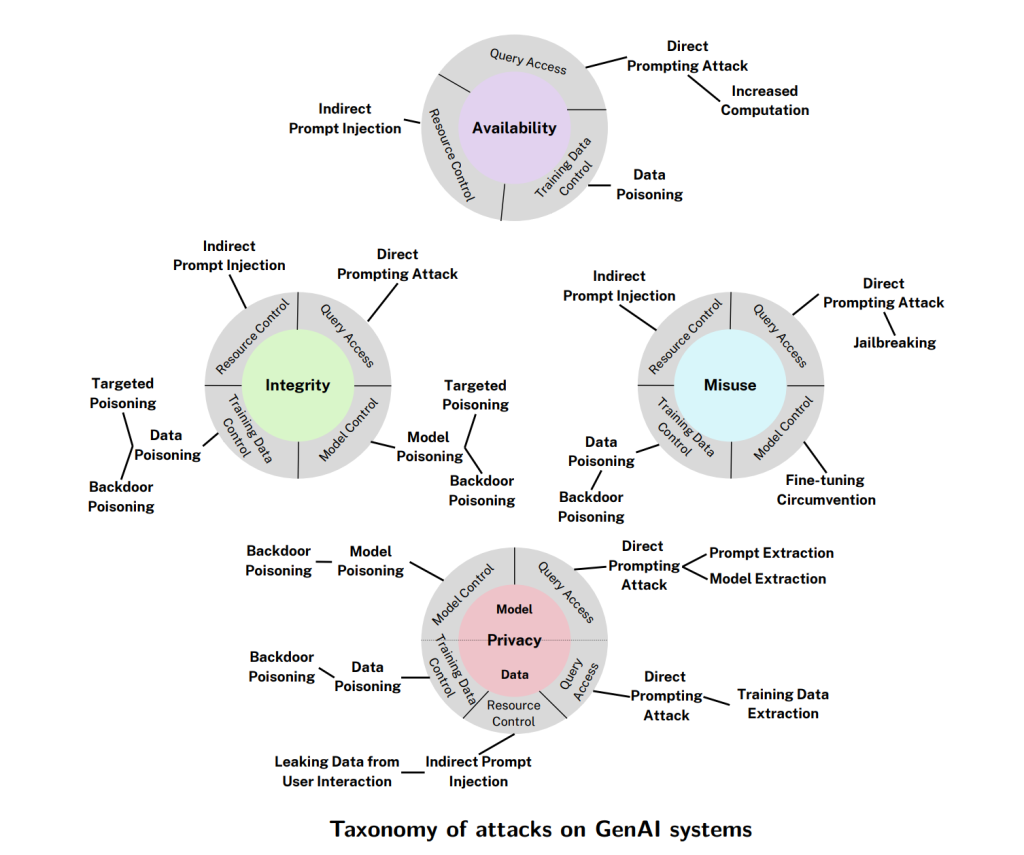
That does not mean RAG is inherently safe. Indirect prompt injection can target data likely to be retrieved, and NIST’s adversarial ML guidance warns that RAG systems may be manipulated into leaking private information or exfiltrating uploaded data. So if you use RAG for clinical or patient-facing workflows, your retrieval layer needs document-level permissions, source trust boundaries, content scanning, and output filtering.
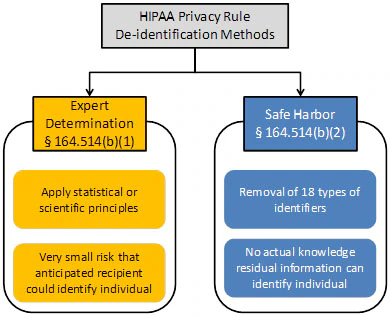
When you can avoid PHI entirely, do it. HHS de-identification guidance gives two methods: Safe Harbor and Expert Determination. But founders should not confuse de-identification with simple redaction. OCR explicitly says both HIPAA de-identification methods still retain some re-identification risk; the risk is very small, but it is not zero. Free text, rare clinical narratives, temporal patterns, and linkable metadata all complicate de-identification in AI settings. That is why clinical AI product development benefits from rigorous data lineage: you need to know which datasets are identified, de-identified, limited, synthetic, or derived, and what rules govern each one.
Synthetic data can help in some scenarios, especially for prototyping or privacy-preserving testing, but it is not a magic substitute for real-world validation. NIST encourages responsible use of synthetic data and privacy-enhancing techniques where appropriate, while also warning about model collapse and homogenization problems if systems over-rely on synthetic data. The right posture is to use synthetic data tactically, de-identified data carefully, and PHI only when the use case truly requires it and the legal, technical, and contractual basis is explicit.
How to evaluate AI vendors for healthcare AI compliance
The vendor stack behind AI in healthcare startups is often larger than founders realize. It is not just the model API. It may include cloud hosting, vector databases, OCR, speech-to-text, human labeling, analytics, observability, customer support, notification tools, authentication, and EHR integration middleware. Under OCR’s cloud guidance, a cloud service provider storing or processing ePHI is a business associate even if the data is encrypted and the provider lacks the decryption key. OCR’s tracking technology guidance similarly shows that analytics and tracking vendors can become PHI recipients in regulated contexts. FTC guidance adds another layer for direct-to-consumer health apps and connected products.
That means vendor review has to be systematic, not ad hoc. Your procurement process should ask about BAAs, retention, deletion, training exclusion, logging, auditability, subprocessor chains, encryption, access control, security certifications, and incident response. NIST explicitly recommends due diligence processes that address data privacy, security, legal compliance, third-party risk monitoring, and incident response for third-party AI technologies.
| Vendor category | PHI risk | BAA needed | Key questions | Startup mistake to avoid |
|---|---|---|---|---|
| Foundation model provider | High if prompts/completions include PHI | Usually yes in HIPAA workflows | Are prompts stored, for how long, and excluded from training? Can retention be disabled? What logs are retained? Which subprocessors are involved? | Assuming “enterprise plan” automatically means healthcare-grade handling |
| Cloud platform | High | Yes | Is there a signed BAA? What shared-responsibility controls apply? How are backups, key management, logging, and data return handled? | Treating the cloud vendor as a simple conduit |
| Vector database / retrieval store | High | Usually yes | Can you enforce row- or document-level permissions? How is data deleted? Are embeddings encrypted and auditable? | Treating embeddings as non-sensitive metadata |
| Speech-to-text / OCR | High | Usually yes | Are transcripts or images retained? Is data used for model improvement? Are human reviewers involved? | Forgetting these services may see raw clinical content |
| Analytics / tracking / APM | Medium to high | Often yes if PHI context exists | What identifiers are captured? Can PHI be blocked or redacted? Are cookies, pixels, or mobile SDKs sending data off-platform? | Logging PHI into observability or marketing tools |
| Support desk / CRM / ticketing | Medium to high | Often yes | Can support views be role-limited? Are screenshots or exports stored? What is retention? | Letting support staff access full patient context by default |
| Labeling / annotation provider | High | Yes | Who sees the data? In what region? Under what confidentiality and security controls? Can PHI be minimized first? | Sending raw PHI to annotators without scoped tasks and controls |
| Messaging / email / notifications | Medium to high | Often yes | What message metadata and contents are retained? Are links secure? Can templates avoid unnecessary PHI? | Using consumer messaging defaults for clinical notifications |
This framework synthesizes OCR cloud guidance, OCR tracking guidance, the HIPAA Security Rule, FTC health app obligations, and NIST third-party AI risk governance. Startups should treat it as a practical procurement baseline, then refine it with counsel and customer-specific requirements.
Design for clinical safety, fairness, and regulation
Human-in-the-loop is a workflow design choice, not a marketing phrase
Human review only works when the interface, timing, and accountability are real. FDA’s CDS guidance links lower-risk decision support to a clinician’s ability to independently review the basis for the recommendation, and FDA’s AI-device guidance describes a continuum from supportive tools to more autonomous systems. NIST, meanwhile, recommends that organizations define roles and responsibilities for human-AI configurations and document override events during monitoring.
For healthcare startups, that means different patterns for different outputs. AI-generated notes should be clearly marked as drafts, attributed to a model version, and require clinician sign-off before finalization. Triage recommendations should expose the factors or source content behind the suggestion, show uncertainty where possible, and route patients to human escalation when risk thresholds are crossed. Patient-facing messaging should avoid unsupervised medical advice unless the scope is tightly constrained and clinically approved. Risk alerts should support acknowledgement, override, and retrospective review so teams can learn when clinicians ignore or correct the model.
A practical human review design for clinical AI should include: approval gates for high-risk outputs, visible source references, confidence or uncertainty indicators when appropriate, explicit “use with caution” boundaries, documented override reasons, and escalation paths for ambiguous or unsafe cases. If your product cannot explain who is supposed to review the output, when they review it, what evidence they see, and how overrides are recorded, then human-in-the-loop is probably just a slide, not an operating control.
Bias, nondiscrimination, and fairness belong in the product from day one
Healthcare AI compliance is not only about privacy and security. It is also about whether the system performs acceptably across the populations it is meant to serve. NIST defines fairness as a trustworthy AI characteristic tied to harmful bias and discrimination. FDA’s AI-device guidance recommends representative development and validation data, notes that poor subgroup performance can make a device unsafe for certain groups, and stresses that performance should be evaluated in the intended use population as well as subgroups of interest.
That matters for startups far beyond regulated devices. If your model is used in intake, message routing, risk scoring, or patient communication, you should test performance across language groups, sex, age, disability status, geography, care settings, and relevant clinical populations. NIST’s Generative AI Profile also recommends reviewing and measuring sources of bias in training and evaluation data, seeking structured feedback from affected communities, and monitoring whether outputs are equitable across sub-populations.
Section 1557 adds legal weight when covered entities use patient care decision support tools. The 2024 HHS rule prohibits discrimination on the basis of race, color, national origin, sex, age, or disability through the use of patient care decision support tools and imposes an ongoing duty to make reasonable efforts to identify uses of such tools that employ variables or factors measuring those attributes. HHS also stated that later vacatur notices in 2026 did not generally void provisions outside the vacated gender-identity-related areas, so the broader patient care decision support obligations remain materially relevant.
A founder-level fairness program should do five things: define intended users and intended patient populations; document training and evaluation data sources; test subgroup performance before launch; monitor disparities after launch; and maintain an incident review process for complaints, overrides, and adverse findings. If you sell into hospitals, do not assume the customer owns this problem alone. Enterprise buyers increasingly expect vendors to show their homework.
Check out a related article:
How to Build a Telehealth App in 2026: A Complete Guide
Know when FDA may care even if you are focused on HIPAA
HIPAA and FDA solve different problems. HIPAA governs privacy, security, and certain breach and disclosure obligations for health data in the regulated chain. FDA governs certain software functions that meet the legal definition of a device. A product can implicate one, both, or neither. That is a critical distinction for AI healthcare software development.
FDA’s current CDS guidance explains that some decision support software for healthcare professionals can fall outside the device definition if it meets all criteria in the Cures Act pathway, including that the professional can independently review the basis of the recommendation and not rely primarily on it. But software functions that analyze medical images or signals, or software with intended uses more closely tied to diagnosis and treatment without meaningful independent review, can remain device software functions. Intended use is the fulcrum. Sales copy, demos, website language, and product labels therefore matter just as much as the model architecture.
If you are building diagnostic support, imaging analysis, treatment recommendation, dosing support, or anything marketed as detecting, predicting, diagnosing, curing, mitigating, treating, or preventing disease in a way that crosses into device functionality, you need regulatory strategy early. FDA’s AI-enabled device guidance and its PCCP guidance both emphasize lifecycle risk management, validation, subgroup evaluation, monitoring, versioning, and planned modification governance. Even startups whose first release is positioned as administrative should be careful not to overclaim clinical capability in marketing or roadmap conversations.
HTI-1 matters if hospitals will use your model inside certified health IT
ASTP/ONC’s HTI-1 final rule established algorithm transparency requirements for predictive decision support interventions in certified health IT. ONC describes these as first-of-their-kind transparency requirements for AI and other predictive algorithms that are part of certified health IT. For startups, the implication is straightforward: even if you are not the certified EHR vendor yourself, hospitals and health IT partners may ask you for the information they need to satisfy those requirements or procurement expectations derived from them.
The DSI fact sheet and resource guide are especially useful because they turn policy into practical documentation expectations. Predictive DSIs include technologies that support decision-making through outputs such as prediction, classification, recommendation, evaluation, or analysis. ONC’s materials also explain that the definition is broad enough to include many AI/ML techniques, from LLMs and generative AI to simpler risk calculators. Developers supplying predictive DSIs in certified health IT contexts must support source attributes, ongoing maintenance, and risk management practices. For predictive DSIs, ONC points to 31 source attributes and a risk management approach spanning validity, reliability, robustness, fairness, intelligibility, safety, security, and privacy.
In practical startup terms, that means you should be ready to provide a model-card-style package with intended use, intended users, cautionary out-of-scope use, input features, fairness process, external validation approach, quantitative performance, local validation expectations, update schedule, and change history. ONC explicitly says these source attributes help create a baseline on which structured model cards can be built. FDA’s AI guidance also recommends model cards as a useful way to summarize intended use, users, evidence, performance, limitations, confidence, and update practices.
Secure, document, and validate the product
AI security has to extend beyond the cloud perimeter
A strong VPC and encrypted database are necessary but not sufficient for HIPAA-compliant AI products. NIST’s generative AI work and adversarial ML taxonomy make clear that AI systems introduce attack paths that ordinary applications often do not face in the same way: prompt injection, privacy compromise, model extraction, membership inference, model inversion, data poisoning, and retrieval-layer abuse. Prompt injection in particular is not theoretical. NIST describes both direct and indirect prompt injection, including attacks against internet-connected chatbots and RAG systems that can cause a model to leak private information or exfiltrate user-uploaded content.
For a healthcare startup, that means AI security should include at least these controls:
- A server-side model gateway rather than direct frontend-to-model calls, so you can enforce auth, data policies, logging rules, and provider routing.
- Retrieval permissions tied to user and role context, not just a free-form vector search.
- Prompt and response filtering for PHI leakage, unsafe instructions, and policy violations.
- Red-teaming and adversarial prompt testing before launch and after major prompt or model changes.
- Segmented tool permissions for agentic workflows, with explicit allow-lists.
- Rate limits, anomaly detection, and abuse monitoring for model and retrieval endpoints.
- Logging policies that capture enough for audit and incident response without dumping raw PHI everywhere.
These controls align with NIST’s guidance to assume prompt injection is possible when a model is exposed to untrusted inputs, to use rigorous TEVV and red-teaming, and to continuously monitor third-party AI risks.
The documentation package that opens enterprise doors
Enterprise healthcare buyers do not only buy code. They buy evidence that your team understands risk. HIPAA audits and OCR guidance emphasize policies, procedures, and documentation. FDA and ONC guidance for AI systems similarly push teams toward documented intended use, performance, validation, limitations, updates, and transparency. Good documentation is not bureaucracy for its own sake. It shortens security reviews, clarifies roles internally, and reduces the chaos of customer due diligence.
A practical startup package should include:
- HIPAA risk analysis and risk treatment plan
- Security policies and workforce access policies
- Incident response and breach response plan
- BAA templates and vendor risk assessments
- Data flow diagrams and architecture diagrams
- Access control matrix and privilege review process
- Retention and deletion policy
- Encryption and key management documentation
- Audit logging policy and log review procedures
- Backup, disaster recovery, and business continuity plan
- AI use policy and acceptable-use boundaries
- Model card or equivalent transparency artifact
- Data lineage and provenance record
- Validation report with subgroup testing summary
- Human oversight policy and escalation paths
- Change management SOP with model/version history
- Clinical safety review process for higher-risk workflows
- Penetration testing or security assessment results
- Roadmap for SOC 2, HITRUST, or equivalent buyer expectations where relevant
This is not copied from a single statute. It is a synthesis of what HIPAA, OCR, NIST, FDA, and ONC collectively reward: evidence that risks are identified, documented, measured, mitigated, and monitored over time.
A practical reference architecture for a HIPAA-compliant AI healthcare product
For most healthcare AI product development, a good architecture is layered and boring in the best possible sense.
Frontend layer. Web or mobile client with strong auth, session controls, device-aware security, and no direct calls to foundation models.
API and application layer. Business logic, tenancy enforcement, orchestration, RBAC, rate limiting, policy checks, and integration services.
Data layer. Transactional database, object storage, document storage, encrypted backups, and separate stores for audit and analytics.
AI orchestration layer. Prompt templates, model gateway, provider routing, safety checks, PHI handling rules, and response normalization.
Retrieval and vector layer. Document chunking, embeddings, index storage, source metadata, document-level permissions, and retrieval logs.
Audit and monitoring layer. Security logs, application logs, AI event logs, override logs, model health metrics, drift monitors, and alerting.
Integration layer. FHIR and HL7 interfaces, EHR connectors, payer or pharmacy integrations, identity federation, and webhook controls.
DevSecOps layer. CI/CD, infrastructure as code, secrets management, vulnerability scanning, environment isolation, rollback, and release approval.
A simple pattern looks like this:
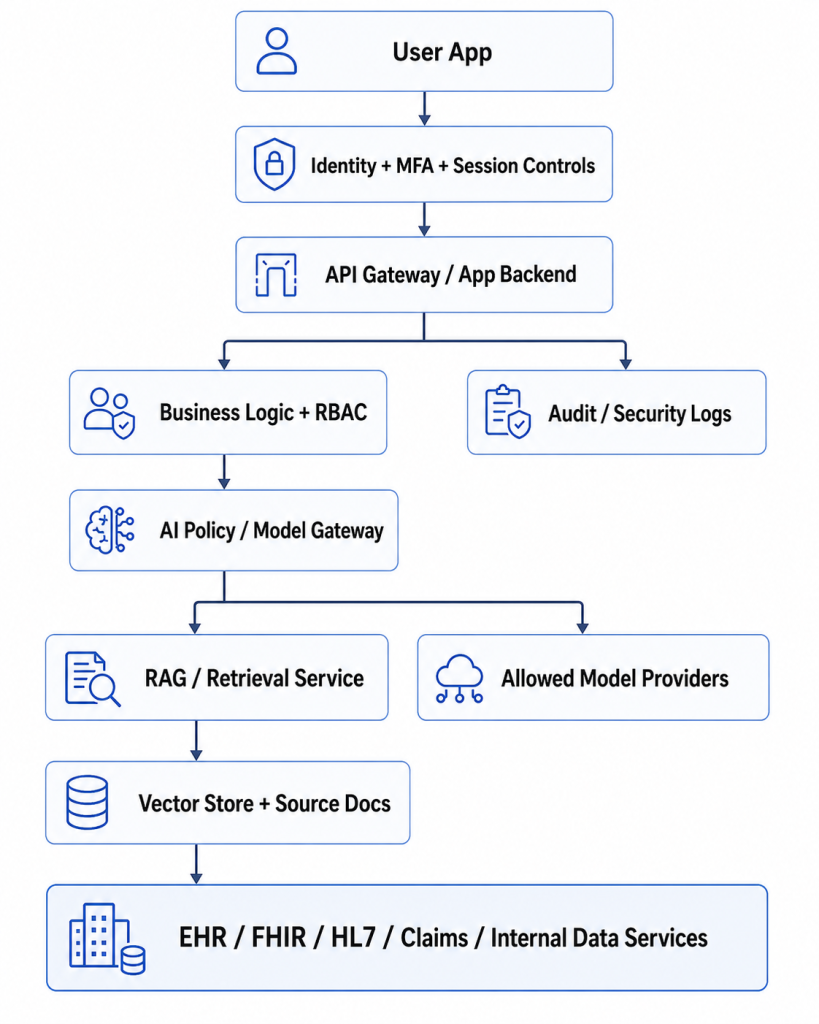
The reason to prefer a model gateway pattern is governance. It centralizes PHI policies, provider controls, logging hygiene, failover, and prompt management instead of leaking those decisions across client code and one-off services. It also supports the supplier oversight model NIST recommends for third-party AI systems. Where EHR integrations are in scope, standards-based APIs matter: ONC certification materials continue to anchor interoperability around HL7 FHIR for certified API technology, which is why many hospitals now expect FHIR-first integration strategies from serious healthcare vendors.
Validation has to cover software quality and AI assurance
Traditional QA still matters. Functional testing, regression testing, integration testing, performance testing, accessibility testing, and disaster recovery testing are all part of a production-grade healthcare product. But AI adds another test layer. NIST’s Generative AI Profile stresses robust TEVV and warns that anecdotal testing, prompting games, or exam benchmarks do not prove validity or reliability in real deployment contexts. FDA similarly recommends validation on independent datasets, subgroup analyses, robustness checks, and post-deployment monitoring for performance changes.
For AI healthcare app development, a strong test plan should cover at least:
- Prompt and retrieval tests for unsafe instructions, confabulation, and source grounding
- Hallucination testing against approved reference content
- Adversarial testing for prompt injection and malicious uploads
- Permission tests for retrieval and role-based output boundaries
- Bias and subgroup performance testing
- Human factors testing for review, override, and escalation flows
- Performance drift monitoring and threshold alerts
- Clinical validation relevant to intended use
- Disaster recovery drills for systems containing ePHI
On the software side, teams should still invest in mature QA & Testing and release processes. On the AI side, they should add red-teaming, provenance checks, grounding verification, and structured feedback loops. That combination is far more defensible than treating model evaluation as a set of ad hoc demos.
Launch without losing control
Move fast, but do not build compliance debt into the MVP
Healthcare startups absolutely can move fast. What they cannot do safely is move sloppy. The right question is not “How little compliance can we get away with?” It is “Which controls are mandatory for safe launch, and which can mature later?” A smart MVP for HIPAA compliant AI software does not need a perfect enterprise control plane on day one, but it does need the controls that prevent obvious harm, obvious violations, and obvious buyer rejection.
A simple prioritization model helps:
| Must be in MVP | Can mature after MVP |
|---|---|
| Authentication, RBAC, encryption, audit logs, secure cloud setup, BAA-backed vendors, PHI-safe prompt handling, privacy notice and consent flows, admin controls, human review for risky outputs, basic incident response, backup and restore | Expanded dashboards, broader integrations, advanced automation, model fine-tuning on customer data, multi-model routing, deeper analytics, formal certification programs, highly customized optimization workflows |
That split is consistent with HIPAA’s risk-based structure and with buyer expectations. If the product ships without access control, logging, BAAs, or constrained PHI handling, you are not moving fast. You are creating rework with breach potential.
Post-launch governance is where serious healthcare products separate from demos
Launch is the beginning of compliance, not the end. NIST recommends continuous monitoring, structured feedback, and documentation of human overrides and third-party risks. FDA’s AI-device guidance similarly emphasizes performance monitoring plans that look for changes in patient demographics, disease prevalence, input shifts, pipeline corruption, and user behavior in deployment. Even when your product is not regulated as a device, that is still a strong template for operating AI responsibly in healthcare.
Post-launch governance for HIPAA-compliant AI products should include recurring vendor reviews, prompt and guardrail reviews after model changes, log and access reviews, drift and quality monitoring, incident response rehearsals, customer audit support, and a change management process that ties release decisions to documented risk assessment. If a model changes, the output behavior changes, or a retrieval corpus changes, those changes should be versioned and traceable. FDA’s PCCP guidance and AI-device guidance both underscore the importance of version control, change communication, and updated documentation.
Common mistakes healthcare startups make with HIPAA and AI
The mistakes below show up again and again in clinical AI product development:
- Using public AI tools with PHI. If there is no appropriate BAA and no approved use path, you likely should not send patient data there.
- Assuming HIPAA does not apply because you are “just a startup.” The rules attach to roles and data flows, not company size.
- Forgetting BAAs for cloud, analytics, support, or transcription vendors. OCR is explicit that cloud providers maintaining ePHI are business associates, and tracking vendors may also require that treatment.
- Leaking PHI into logs, pixels, or support workflows. OCR’s tracking guidance is a direct warning here.
- Training on customer data without explicit permission and controls. Secondary use and third-party AI contract terms are a major blind spot.
- Overclaiming clinical capabilities. Marketing language can change your FDA posture.
- Treating de-identification as simple name removal. OCR is explicit that proper de-identification is more rigorous and residual re-identification risk remains.
- Skipping model versioning and change logs. That creates audit, safety, and procurement problems fast.
- No documentation package for enterprise buyers. Hospitals increasingly want security, validation, and transparency evidence before they buy.
A practical roadmap from idea to HIPAA-compliant AI products
A sensible roadmap for healthcare AI compliance looks like this:
Discovery and risk classification. Define intended users, intended use, whether the product is B2B or D2C, whether HIPAA applies, what data will be touched, and whether FDA or ONC considerations may arise.
Compliance and architecture planning. Map PHI flows, classify vendors, define the minimum necessary dataset, choose hosting and identity patterns, and draft your AI use policy.
MVP design. Build the narrowest product that can deliver value without over-collecting PHI.
Secure development. Implement auth, RBAC, audit logging, encryption, secrets management, BAA-backed vendors, and AI gateway controls.
Validation and QA. Add software testing, AI red-teaming, fairness checks, source-grounding tests, and human-review workflow validation. This is where QA & Testing and disciplined model evaluation become part of the same release gate.
Pilot launch. Start with constrained workflows, explicit oversight, limited integrations, and real instrumentation for quality, access, and incidents. Do not market beyond validated scope.
Scale and enterprise readiness. Expand interoperability, documentation, third-party governance, audit support, and model transparency. This is when HTI-1-style information, model cards, broader procurement packages, and post-launch governance become especially important.
Teams that want deeper context around adjacent product decisions can also connect this workflow to Intersog’s related content, including:
- Building a Healthcare Software Product: A Startup Founder’s Guide,
- AI in Medicine: Opportunities, Challenges, and What’s Next,
- How to Build a Telehealth App in 2025,
- AI Security Solutions,
- Part 1 of the AI stack guide on RAG vs. fine-tuning vs. hybrid, and Part 3 on the data retrieval layer.
HIPAA-compliant AI is a product strategy, not a legal checkbox
Healthcare startups can absolutely build ambitious AI products. But the strongest ones do not start by asking how to bolt compliance onto a model after the fact. They start by asking which data they truly need, which workflows actually benefit from AI, how humans will stay in control, how vendors will be governed, and how the system will be monitored after launch. That is what turns “HIPAA-compliant AI products” from a marketing phrase into a real operating capability.
If you want your healthcare AI product development roadmap to hold up under HIPAA, buyer security reviews, and real clinical usage, build privacy, security, oversight, validation, and documentation into the product from day one. That is how healthcare data security becomes a product advantage instead of a drag on growth. And that is how AI in healthcare startups becomes commercially credible, not just technically impressive.
If your team is planning a HIPAA compliant AI software initiative, clinical workflow assistant, or broader custom healthcare software development project, Intersog can help you translate strategy into secure execution through the right combination of discovery, architecture, engineering, AI software development services, and delivery support.
Leave a Comment