
The financial technology sector in 2026 is defined by a profound transition from open banking to deep open finance. The structural consolidation of regulatory mandates, real-time infrastructure, and cryptographic validation has transformed consumer expectations. Consumers no longer tolerate reactive, batch-processed, or siloed digital interactions. The standard has shifted to predictive, instant, and hyper-personalized experiences that run continuously. To satisfy these demands, fintech architectures must handle high transaction volumes with minimal latency, ensure strict data privacy, and maintain compliance across multiple jurisdictions.
This change is driven by the rise of real-time settlement rails, such as FedNow and RTP in the United States and the fully implemented Payment Services Regulation (PSR) and Payment Services Directive 3 (PSD3) frameworks in the European Union. These rails have made traditional, end-of-day batch processing obsolete. Financial ledger systems must now operate with continuous, deterministic real-time reconciliation. Simultaneously, consumer aggregation has expanded beyond standard depository accounts. Modern platforms must coordinate data across insurance, wealth management, and tokenized real-world assets (RWAs). This multi-asset aggregation requires architectures that can process structured open finance payloads while maintaining transactional consistency.
Furthermore, consumer interactions have evolved through Agentic AI. The industry has moved past basic, reactive chatbots to autonomous financial assistants running locally on mobile devices or inside secure cloud enclaves. These agents dynamically optimize user wealth, negotiate recurring bills, and manage liquidity by executing trades and transfers based on real-time market data. Underpinning this shift are strict security frameworks: Zero-Knowledge Proofs (ZKPs) protect consumer identity during Know Your Customer (KYC) processes , and Explainable AI (XAI) models ensure that fraud mitigation engines are auditable and transparent to regulators.
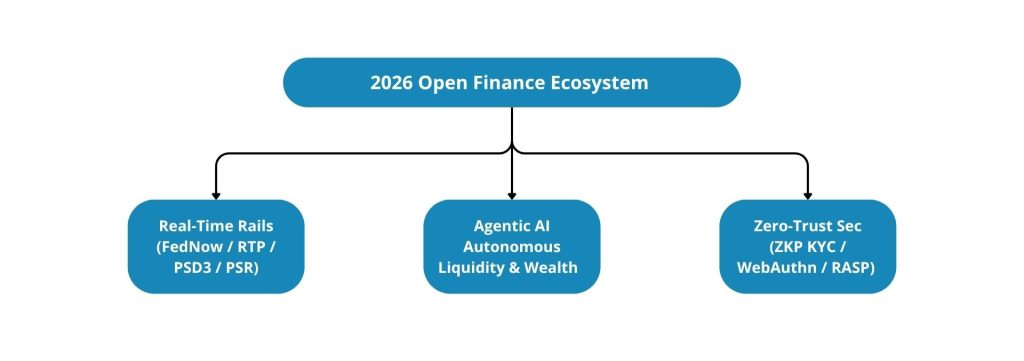
Legacy banking infrastructures, built on relational databases and nightly batch reconciliation, cannot support this environment. Operating in 2026 requires a modern, event-driven, and highly resilient architecture.
| Tech Dimension | Legacy Core Banking Architecture | 2026 Open Finance Application Architecture |
| Settlement Velocity | T+1 to T+3 batch clearing via legacy ACH rails. | Instant, transaction-by-transaction settlement via FedNow, RTP, and PSR channels. |
| Data Aggregation Scope | Basic checking and savings account balances via screen scraping. | Real-time APIs spanning deposits, credit, insurance, investments, and tokenized RWAs. |
| Concurrency & Ledger Locking | Row-level table locking; prone to transaction timeouts under heavy concurrent loads. | Deterministic single-writer ring buffers executing in-memory state changes without database locks. |
| User Authentication | Password-based systems backed by SMS-based multi-factor authentication (MFA). | Cryptographically secure, passwordless WebAuthn (Passkeys) bound to native Secure Enclaves. |
| KYC & Identity Management | Centralized collection and storage of raw, high-risk PII documents (data honeypots). | Privacy-preserving decentralized identifiers (DIDs) verified offchain via zk-SNARK circuits. |
| Fraud Mitigation | Rule-based post-facto anomaly detection; "black box" machine learning models. | Real-time Explainable AI (XAI) models using SHAP/LIME for auditable decision-making. |
2. Regulatory Compliance-by-Design
Operating a global fintech platform in 2026 requires embedding compliance directly into the software architecture. Point-in-time compliance checks are no longer sufficient; engineering teams must build systems that support automated, continuous compliance monitoring.
2.1 CFPB Section 1033 Compliance (United States)
The Consumer Financial Protection Bureau (CFPB) Section 1033 final rule mandates that depository and non-depository institutions make consumer financial data available to authorized third parties through secure developer portals. This regulation reshapes data sovereignty by giving consumers explicit control over their financial records.
- Access Timelines and Scale: Compliance requirements began on April 1, 2026, for depository institutions with at least $250 billion in assets and non-depositories generating at least $10 billion in receipts. The mandates roll out incrementally to smaller institutions through April 1, 2030, while commercial banking entities holding $850 million or less in assets remain exempt.
- Interface Standards & Data Formats: Under Section 1033, data providers must expose developer interfaces that conform to standardized formats established by CFPB-recognized standard-setting bodies. While screen scraping is not explicitly banned, institutions must offer high-availability developer APIs. The initial proposed response time threshold of 3,500 milliseconds has been updated to align with the consensus standards of recognized standard-setting bodies.
- Consent and Retrievability Limits: Authorized third parties must present clear disclosures to consumers. They can collect, use, and retain covered data only as reasonably necessary to provide or improve the requested product or service. Data collection authorizations are capped at one year. Architectures must enforce token expiration policies that automatically stop data fetching and trigger secure data deletion or anonymization when authorization expires.
- Security Exemptions: Data providers may deny interface access to third parties or data aggregators on grounds of safety and soundness, or to protect information under Gramm-Leach-Bliley Act (GLBA) security standards. Any such denial must be based on a documented risk and applied consistently.
2.2 EU PSR and PSD3 Compliance
In Europe, the provisional political agreements from late 2025 have transitioned into the active execution of the Payment Services Directive 3 (PSD3) and Payment Services Regulation (PSR). This framework introduces a dual legislative approach: PSD3 governs licensing and prudential supervision, while the PSR directly regulates conduct, including Secure Customer Authentication (SCA) and open banking execution.
- Consolidated Licensing Regime: The previous separation between E-Money Institutions (EMIs) and Payment Institutions (PIs) is eliminated. EMIs are now categorized as a sub-group of PIs under PSD3, requiring re-authorization under this unified framework.
- SCA & API Performance Mandates: PSR tightens open banking requirements by enforcing prescriptive API uptime and functional performance standards. National regulators are empowered to act against platforms that fail to maintain reliable APIs or rely on slow fallback systems.
- Expanded Fraud Liability: PSR expands liability for Authorized Push Payment (APP) fraud, requiring institutions to reimburse payers who are victims of spoofing or credential manipulation. Importantly, this liability extends to third-party technology enablers whose system or validation failures contribute to fraud in the payments chain. The transaction gateway must enforce real-time, synchronous payee name and IBAN validation checks prior to transaction execution.
2.3 Markets in Crypto-Assets (MiCA) Compliance
For fintech platforms handling stablecoins, tokenized assets, or crypto-assets, the transition period under the EU Markets in Crypto-Assets (MiCA) regulation ends on July 1, 2026, making compliance mandatory for all Crypto-Asset Service Providers (CASPs).
- Licensing & Capitalization Tiers: CASPs must operate as authorized EU entities with localized directors. They must meet minimum capital reserves aligned with their risk profiles: €50,000 for advisory and execution, €125,000 for custody and transfer services, and €150,000 for operating a trading platform. They must also hold funds equal to at least one-quarter of their fixed overhead expenses.
- Stablecoin Reserve Segmentation: Issuers of Asset-Referenced Tokens (ARTs) and E-Money Tokens (EMTs) must establish segregated reserve accounts held with credit institutions. These reserves must be invested in low-risk, highly liquid assets to guarantee redemption at par value at any time.
- Crypto-Asset Reporting Framework (CARF): Effective January 1, 2026, under DAC8, CASPs must systematically gather and report detailed transaction and originator metadata to tax authorities, requiring robust database indexing and reporting tools.
- The Travel Rule: CASPs must comply with the Transfer of Funds Regulation (TFR) by embedding originator and beneficiary information into every crypto-asset transaction.
2.4 Automated Continuous Compliance Architecture
Traditional, manual, point-in-time compliance checks are insufficient for the speed of modern financial networks. Modern architectures must utilize automated compliance platforms (such as Scrut or Drata) integrated directly into development and infrastructure operations.
- PCI DSS 4.0 Continuous Auditing: PCI DSS 4.0 requires multi-factor authentication (MFA) for all access to the Cardholder Data Environment (CDE). This requirement applies to all users accessing CDE systems, not just administrators.
- Automated Log Auditing (Requirement 10): Systems must run automated mechanisms to analyze audit logs daily to detect security anomalies, unauthorized access attempts, or critical system failures. GRC integrations must continuously pull log signatures and system configurations, generating a real-time record of compliance.
2.5 Technical Risk Register
The following register details key high-level vulnerabilities in a 2026 open finance environment, mapping them to regulatory frameworks and technical mitigations.
| Risk ID | Vulnerability / Threat | Applicable Standard | Impact Level | Architectural Mitigation |
| TR-01 | Unauthorized data scraping or API access by unverified third parties. | CFPB Section 1033 | Critical | Deploy mutual TLS (mTLS), strict OAuth 2.1 authorization flows, and dynamic client registration (DCR) via open finance standards. |
| TR-02 | Transaction routing failure or APP fraud via payee spoofing. | EU PSR / PSD3 | High | Implement real-time, synchronous proxy-name verification against destination IBAN/Routing directories prior to payload processing. |
| TR-03 | Compromise of raw PII during KYC document uploads or database storage. | GDPR / CFPB Sec 1033 | Critical | Shift to an offchain decentralized identity architecture backed by zk-SNARK proof generation and onchain verification. |
| TR-04 | API service degradation or downtime under high market volatility. | EU PSR / DORA | High | Deploy single-writer, lock-free transaction queues (Disruptor pattern) coupled with aggressive auto-scaling edge proxies. |
| TR-05 | Loss of cryptographic asset reserve status or reporting failure. | EU MiCA / TFR / CARF | Critical | Automate smart-contract-enforced reserve checks; run real-time transaction monitoring to execute Travel Rule metadata matching. |
| TR-06 | Unauthorized privilege escalation or credential access within the CDE. | PCI DSS 4.0 | Critical | Enforce hardware-bound MFA for all CDE endpoints ; execute continuous zero-trust authorization audits via automated GRC tools. |
3. The 2026 Fintech Tech Stack & Distributed Architecture
To achieve the low latency, high throughput, and strict transactional consistency required in 2026, fintech applications must move away from classical, thread-per-request monolithic structures. The modern stack is optimized for hardware efficiency, memory safety, and deterministic execution.
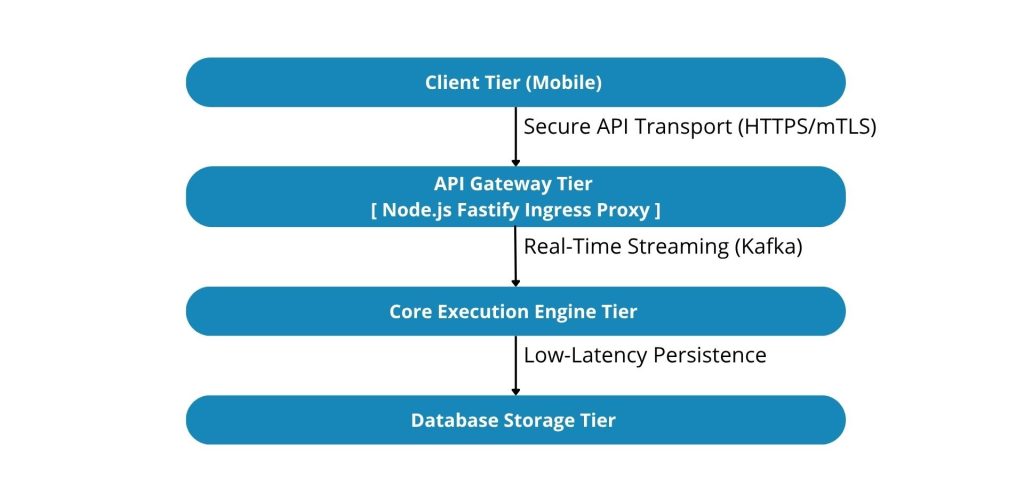
3.1 Tech Stack Selection
The technical architecture consists of a multi-language microservices framework where each component is chosen for its runtime characteristics:
- Core Execution Ledger (Rust or Go): Rust is selected for the core transaction engine. Its type system and borrow checker guarantee memory safety without garbage collection pauses, allowing for highly predictable tail latencies (p99 < 1ms). Go is used for orchestrating secondary services where developer velocity is balanced with concurrent performance.
- API Gateway Layer (Node.js with Fastify): Fastify provides a low-overhead web framework that speeds up JSON parsing and schema validation, maximizing network throughput at the edge.
- AI & Machine Learning Engine (Python): Python is utilized strictly within isolated services to run deep learning model training, vector embeddings, and SHAP/LIME explainability calculations.
- Frontend Mobile Client (Flutter or React Native): This layer handles user interaction and integrates directly with device-level WebAuthn APIs and Secure Enclaves.
3.2 Event-Driven Architecture (EDA) & Ledger Consistency
To achieve high throughput and maintain system-wide consistency, the platform relies on an Event-Driven Architecture (EDA) powered by Apache Kafka or AWS Kinesis. This setup ensures that transactional operations are handled asynchronously and reliably.
- Partitioning & Ordering Guarantees: Kafka partition keys are generated as a hash of the primary
account_id. This configuration guarantees that all events related to a specific account are routed to the same Kafka broker partition, ensuring strict chronological ordering within that account's event stream. - Transactional Outbox Pattern: To prevent inconsistencies where a ledger write succeeds but the corresponding event notification fails to publish, the core engine implements the transactional outbox pattern. The ledger state change and the outbound event message are written to the local database in a single, atomic transaction. A separate, high-velocity publisher service then reads from this table and pushes messages to Kafka.
- Consumer Idempotency: Every transaction request must carry a unique, client-generated UUID acting as an idempotency key. The consumer ledger engine verifies this key against a high-performance, in-memory cache before processing any write operations, preventing duplicate execution from network retries.
3.3 Design of an Immutable, Lock-Free Double-Entry Ledger
The system's core ledger acts as an append-only transaction store. It prohibits deletes and updates, maintaining an immutable trail of financial events. To process heavy concurrent transaction loads without database row locks, the engine adopts a deterministic "single-writer" architecture, similar to the LMAX Disruptor pattern.
- The Single-Writer Architecture: Rather than having multiple threads concurrently read and write to a relational database, the transaction core runs a single, highly optimized thread pinned to a dedicated CPU core. This single thread is the only writer authorized to mutate the active ledger state. The core uses lock-free ring buffers to pass transaction events between the network threads and the state execution thread. By eliminating mutexes, database row locks, and context switching, the CPU core maintains hot ledger data in its L1/L2 cache, executing transfers at memory speed.
- Distributed Consensus and Persistence: To prevent single-point-of-failure vulnerabilities, the in-memory state is continuously replicated across a cluster of nodes using Viewstamped Replication (VSR) or the Raft consensus protocol. Transactions are written to disk as a Write-Ahead Log (WAL) and replicated across a quorum of nodes before the system confirms execution to the client.
The ledger enforces strict double-entry logic, requiring that every transaction contains at least one debit and one credit entry that sum to zero. Let E be the set of entries associated with a transaction. The balance equation is defined as:
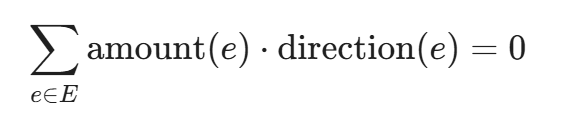
Where direction(e) = 1 if the entry is a debit, and direction(e) = -1 if the entry is a credit.
Furthermore, the true balance of any account a at any point in time must be calculable by aggregating the entire history of its committed ledger entries, preventing silent database updates:

Where Ea represents all committed entries linked to account a.
-- Core Double-Entry Ledger Schema
CREATE TYPE account_type AS ENUM ('asset', 'liability', 'equity', 'revenue', 'expense');
CREATE TYPE entry_direction AS ENUM ('debit', 'credit');

CREATE TABLE accounts (
    id UUID PRIMARY KEY,
    name VARCHAR(255) NOT NULL,
    type account_type NOT NULL,
    created_at TIMESTAMP WITH TIME ZONE DEFAULT CURRENT_TIMESTAMP
);

CREATE TABLE transactions (
    id UUID PRIMARY KEY,
    idempotency_key UUID UNIQUE NOT NULL,
    description TEXT NOT NULL,
    posted_at TIMESTAMP WITH TIME ZONE NOT NULL DEFAULT CURRENT_TIMESTAMP
);

CREATE TABLE entries (
    id UUID PRIMARY KEY,
    transaction_id UUID NOT NULL REFERENCES transactions(id),
    account_id UUID NOT NULL REFERENCES accounts(id),
    direction entry_direction NOT NULL,
    amount NUMERIC(19, 4) NOT NULL CHECK (amount > 0),
    created_at TIMESTAMP WITH TIME ZONE DEFAULT CURRENT_TIMESTAMP,
    CONSTRAINT check_single_side CHECK (
        (direction = 'debit' AND amount > 0) OR
        (direction = 'credit' AND amount > 0)
    )
);

CREATE INDEX idx_entries_account_id ON entries(account_id);
CREATE INDEX idx_entries_transaction_id ON entries(transaction_id);
To support real-time clearing networks like FedNow or RTP, the ledger operates a Two-Phase Transfer paradigm :
Critical Architectural Guardrail: Two-Phase Ledger Operations
Phase 1 (Reserve): Upon receiving a transaction request, the system executes a pending transfer. The specified funds are mathematically reserved in the payer's account and cannot be spent elsewhere, but they are not yet credited to the payee's ledger.
Phase 2 (Commit or Void): The funds remain locked until the external clearing network confirms successful settlement. Upon receiving this confirmation, the system commits the transfer, finalizing the credit to the payee. If settlement fails, the system executes a void instruction, releasing the reserved funds back to the payer's available balance.
4. Next-Generation Feature Sets
A competitive open finance application development in 2026 requires integrating autonomous execution and zero-trust identity architectures.
4.1 Agentic AI: Autonomous Wealth and Liquidity Orchestration
Fintech applications are shifting away from basic personal financial management tools toward autonomous Agentic AI. These systems proactively execute multi-step financial plans on behalf of users within pre-approved parameters.
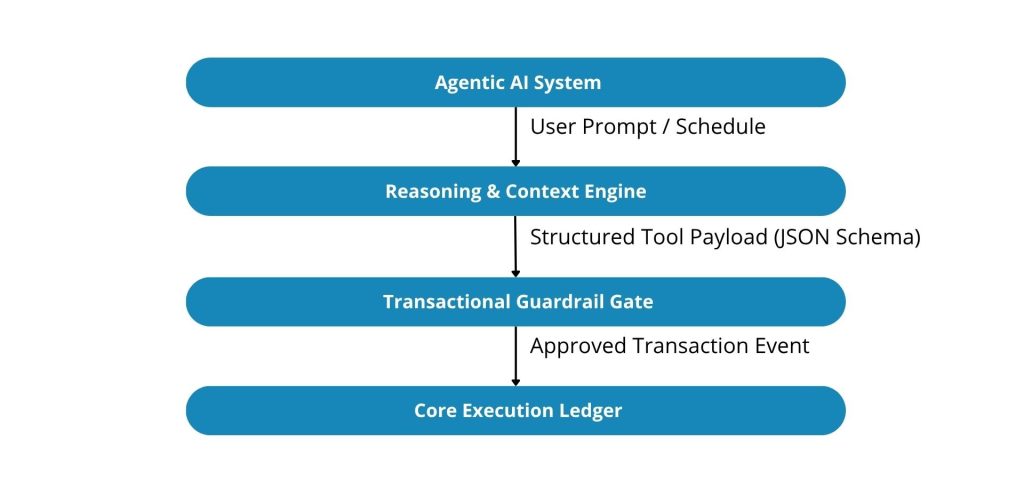
The Agentic AI framework consists of several key components:
- The Reasoning & Action (ReAct) Loop: The AI agent uses a small, domain-specific large language model (LLM) running in a secure, confidential cloud enclave. It processes user instructions (e.g., "Keep my checking account balance at $1,000, and route any excess funds to yield-generating USD stablecoins unless my electric bill is due within five days").
- Memory & Context Storage (pgvector): Real-time financial activity, external transaction logs, and user-defined constraints are vectorized and stored in PostgreSQL using the
pgvectorextension, providing long-term contextual memory. - Structured Tool-Calling Gateways: The agent cannot write directly to the database. Instead, it generates a structured JSON schema payload specifying the proposed actions. This payload is routed to a validation gate.
- Transactional Guardrail Gate: The validation gate parses the agent's proposed action and verifies it against hardcoded, deterministic rules:
Critical Security Guardrail: Autonomous Tool Execution Boundaries
- Hard Limits: The engine must enforce strict transaction ceilings (e.g., capping autonomous actions at $250 per transaction or $1,000 per day) that require step-up biometric authentication if exceeded.
- Dynamic Circuit Breakers: The system must run real-time checks on external APIs and counterparties, immediately blocking any agent actions that route funds to unverified wallets, sanctioned entities, or high-risk accounts.
4.2 WebAuthn Passkeys: Passwordless, Cryptographic Authentication
Passkeys have replaced passwords and SMS-based multi-factor authentication, helping to neutralize phishing, credential stuffing, and SIM-swapping attacks. Passkeys are built on the FIDO2 standard, combining browser-level WebAuthn APIs with Client-to-Authenticator Protocols (CTAP).
Under the hood, passkeys use public-key cryptography where the public key is stored on the application server and the private key never leaves the secure enclave of the user's device.
The registration process runs through the following sequence:
- Challenge Generation: The server generates a random, cryptographically secure challenge and sends it to the mobile client along with the Relying Party (RP) configuration.
- Client Execution: The client application calls the browser or native OS WebAuthn API.
- Hardware Authentication: The user's device requests biometric confirmation (Face ID, Touch ID, or PIN). The Secure Enclave generates a unique, domain-bound cryptographic key pair.
- Server Storage: The device signs the challenge with the new private key and returns the signature, public key, and Credential ID to the authentication server. The server verifies the signature and stores the public key and Credential ID linked to the user's profile.
To authenticate, the server sends a new challenge, the user confirms biometrically to sign the challenge with their device's private key, and the server validates the signature using the stored public key.
4.3 Privacy-Preserving Zero-Knowledge KYC Verification
Traditional KYC practices rely on a "reveal-and-store" model, forcing users to upload sensitive personal documents to centralized databases. This approach creates highly vulnerable targets for data breaches. To address this risk, modern systems use Zero-Knowledge Proofs (ZKPs) to verify consumer identities without exposing raw personal data.
In a zero-knowledge framework, a user can prove they meet specific regulatory criteria (e.g., "The user is over 18 years of age and not on a global sanctions list") without disclosing their actual birthdate or full legal identity.
The verification system relies on a mathematical relationship between three parties:
- The Issuer: A trusted authority (such as a government identity portal or credit agency) that generates a cryptographically signed attestation of the user's attributes.
- The Prover (User Client): The user's application, which uses the signed attestation as a private witness
and runs a zero-knowledge circuit (such as a zk-SNARK) to generate a succinct proof
.
- The Verifier (Fintech Server / Smart Contract): The application backend, which executes a verification algorithm to confirm the proof's validity using only public parameters
.
This workflow is mathematically defined by three algorithms:
- Setup: Generates a proving key PK and a verification key VK for a specific circuit:
- Prove: The prover takes the public inputs
and the private witness
to generate a zero-knowledge proof
:
- Verify: The verifier checks the proof's mathematical validity against the public inputs:
The cryptographic proof must satisfy three core properties:
- Completeness: If the prover's statement is true and the prover is honest, the verification algorithm will return True.
- Soundness: If the prover's statement is false, a dishonest prover cannot convince the verifier, except with negligible mathematical probability.
- Zero-Knowledge: The verifier learns nothing about the private witness
beyond the validity of the statement itself.
Critical Guardrail: Cryptographic Identity Separation
- To satisfy data minimization principles, the verification pipeline must process raw data and generate proofs strictly on the user's local device.
- The server must only ingest, evaluate, and store the resulting cryptographic proof (
) and public parameters (
). The platform is prohibited from storing raw PII, neutralizing the risk of data leakage.
By using technologies like Chainlink DECO, platforms can verify data from external HTTPS sessions (such as an existing bank portal) and prove account balances or identity attributes to a smart contract without exposing passwords or session tokens.
5. Cyber Defense & AI-Driven Fraud Prevention
The expansion of real-time open finance platforms has increased the need for runtime protection and explainable fraud detection engines.
5.1 Runtime Application Self-Protection (RASP)
Because client-side applications run on untrusted consumer hardware, platforms must use Runtime Application Self-Protection (RASP) embedded directly within their mobile binaries. RASP actively monitors the application's runtime state to detect and block threats in real time.
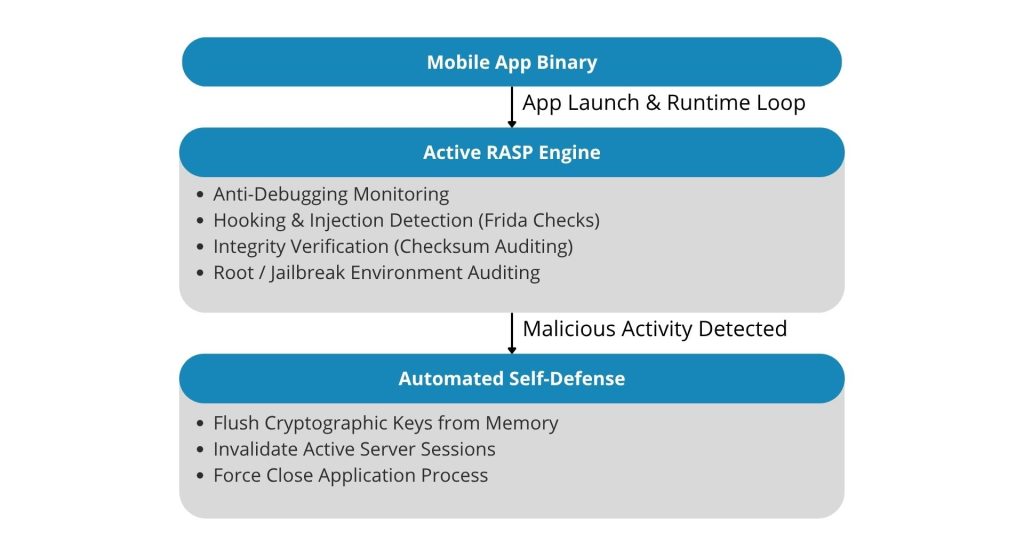
The RASP framework actively monitors several areas:
- Anti-Debugging and Anti-Hooking: It continuously monitors system register states and memory maps to detect debuggers or dynamic injection tools like Frida. It intercepts calls between the application and the host operating system to identify unauthorized modifications to critical execution paths.
- Integrity Auditing: The engine runs background integrity checks of the application's binary code, comparing its in-memory checksum to its original signature to detect tampering or repackaged code.
- Environment Verification: At launch and during execution, RASP checks for indicators of jailbreaking or rooting, such as the presence of unauthorized binaries or unusual file permissions.
- Defensive Actions: If malicious activity is detected, RASP triggers defensive protocols :
Critical Security Guardrail: RASP Defensive Actions
- Immediate Memory Sanitization: Upon detecting an active debugger or hook, the application must immediately erase sensitive session tokens, public keys, and cached financial data from its memory space.
- Server-Side Session Revocation: The app must notify the authentication backend to invalidate the active device binding and session tokens.
- Process Termination: The application must immediately close the active process to prevent further reverse engineering or exploit attempts.
5.2 Explainable AI (XAI) for Fraud & Risk Engines
When checking transactions for fraud in real time, using complex deep learning models can lead to a "black box" challenge. Regulators, compliance auditors, and consumers must be able to verify why a transaction was declined or why an account was frozen. Incorporating Explainable AI (XAI) models directly into the risk engine addresses this challenge.
- LIME (Local Interpretable Model-agnostic Explanations): Generates a simplified, interpretable model around a specific transaction data point to identify which immediate inputs contributed to that decision.
- SHAP (SHapley Additive exPlanations): Based on cooperative game theory, SHAP calculates the exact contribution of each transaction feature. By evaluating every combination of inputs, SHAP provides a mathematically consistent explanation for each prediction.
The Shapley value () for any feature
is calculated as:

Where:
- N is the set of all available transaction features.
- S is a subset of features excluding feature i.
- f(S) is the model prediction when restricted to the features in subset S.
- f(S U {i}) is the prediction including feature i.
By computing SHAP values in parallel with the fraud score, the risk engine can instantly generate clear, human-readable explanations:
Critical Compliance Guardrail: Real-Time Fraud Explanations
- If a transaction is blocked, the engine must write a structured log detailing the contributing features (e.g., "Transaction blocked: geographic anomaly contributed +0.45, device fingerprint mismatch contributed +0.32, while transaction history offset the score by -0.11").
- This structured explanation must be saved to the transaction database to support compliance audits and prevent unexplained account freezes under PSD3 and CFPB guidelines.
Check out a related article:
Fintech Cybersecurity Protocols in 2025: A Practical Playbook for Startups & Scale-ups
6. The Engineering Roadmap: From Concept to Production
Building and deploying a compliant, secure open finance application in 2026 requires a structured, multi-phase timeline that aligns development milestones with rigorous security and regulatory testing.
26-Week Production Pipeline
The following timeline details the necessary steps for engineering teams to transition a high-performance, compliant fintech app from initial design to production-ready deployment.
| Phase | Weeks | Focus Area | Key Architectural Objectives | Deliverables | Regulatory / Security Verification |
| Phase 1 | Weeks 1–4 | Discovery & Regulatory Scoping | Map data architecture to compliance boundaries (CFPB 1033, PSD3/PSR, and MiCA). Map data lineage pathways. | High-level system architecture, data lineage maps, and open finance compliance strategy. | Submit license applications to national competent authorities (NCAs) ; sign off on data governance policies. |
| Phase 2 | Weeks 5–10 | Core Ledger & Event Pipeline | Implement the Rust single-writer transaction core and establish double-entry validation schemas. Deploy the Apache Kafka event log infrastructure. | Localized transaction engine, WAL persistent database schema , and Kafka event partition infrastructure. | Perform performance testing under synthetic load to verify tail latencies (p99 < 1ms) and evaluate consensus recovery protocols. |
| Phase 3 | Weeks 11–16 | Integrations & Feature Sets | Deploy WebAuthn registration and verification flows. Establish local zk-SNARK proof generation for KYC. Set up the Agentic AI vector memory layers. | Active Passkey authentication APIs , a decentralized identity system, and an AI wealth-management agent. | Audit token expiration policies to ensure consumer data authorizations automatically expire and delete after one year. |
| Phase 4 | Weeks 17–21 | Hardening & Threat Simulation | Integrate mobile RASP defenses. Deploy SHAP and LIME algorithms into the risk engine. Deploy automated GRC pipelines. | Obfuscated application binaries, real-time XAI transaction logs , and continuous GRC security telemetry. | Conduct independent third-party penetration testing, including debugger injection attacks and API vulnerability scanning. |
| Phase 5 | Weeks 22–26 | Audits & Production Rollout | Address security and compliance findings from earlier phases. Deploy staging canary systems. Initiate gradual customer onboarding. | Production-certified mobile clients, active GRC monitoring, and verified transaction pathways. | Secure formal SOC 2 Type II attestation , PCI DSS 4.0 Attestation of Compliance (AoC) , and final regulatory approvals. |
7. Strategic Conclusions
The evolution of financial technology in 2026 requires a fundamental shift in how applications are architected, developed, and secured. Legacy patterns built on batch processing and reactive security models are no longer sufficient to meet modern open finance demands.
To build a resilient platform that can scale through these shifts, engineering teams must adopt several structural principles:
- Implement Event-Driven, Lock-Free Foundations: Real-time settlement networks require moving away from classical database locking models. Platforms must use event-driven messaging structures and deterministic single-writer engines to process concurrent ledger writes at memory speed.
- Adopt Privacy-Preserving Security Paradigms: The centralized collection of raw PII documents represents an unnecessary operational liability. Modern security architectures should protect consumer data by utilizing passwordless WebAuthn and decentralized, zero-knowledge identity validation systems.
- Enforce Runtime Protection and Explainability: As execution moves to client devices, applications must defend their runtime space using integrated RASP shielding. Similarly, automated risk engines must remain auditable and transparent by pairing deep learning models with explainable mathematical frameworks like SHAP and LIME.
By executing against this technical blueprint, financial institutions can deliver high-performance, compliant, and secure applications that are prepared to lead the global open finance ecosystem.
Leave a Comment