
Most startup products do not begin with too few ideas. They begin with one useful idea and then accumulate requirements.
A founder starts with a core workflow. Then the product needs a dashboard. Someone asks for Salesforce integration. A prospective customer wants another user role. The team decides mobile apps will eventually matter. Analytics become more sophisticated. AI appears on the roadmap. Then localization, configurable permissions, automated onboarding, enterprise reporting, and infrastructure for a level of traffic the company does not yet have.
Individually, each addition sounds reasonable. Collectively, they turn Version 1 into the entire product roadmap compressed into a single release.
That is the central problem in how to scope an MVP or any first production version: deciding where the boundary goes.
Version 1 should not be a miniature version of everything the company might become. It should be the smallest credible product that solves a meaningful problem for a specific first user, lets that user complete a valuable workflow from beginning to end, tests the assumptions that matter now, produces measurable evidence, and can be operated safely enough for real use.
That philosophy is consistent with the original logic behind the minimum viable product. Eric Ries describes an MVP as a vehicle for obtaining validated learning with limited effort, while Y Combinator's guidance repeatedly emphasizes getting a product in front of real users so founders can learn what actually matters rather than endlessly expanding the pre-launch specification.
But there is an important qualification that is sometimes lost when teams interpret "minimum" too literally:
Reduce scope, not product integrity.
A first version can deliberately have fewer features, integrations, platforms, user roles, automation paths, and scaling mechanisms than the eventual product. That does not automatically make it acceptable to omit authorization, security controls, data protection, backups, payment correctness, error handling, instrumentation, or compliance obligations that apply to the intended use.
Think of the distinction as product completeness versus product integrity.
Product completeness asks: How much of the eventual roadmap exists?
Product integrity asks: Can the part we are releasing be used as intended without being deceptive, unsafe, operationally blind, or fundamentally unreliable?
Version 1 can be intentionally incomplete and still have integrity.
That distinction also separates a first production release from a prototype. A prototype can simulate a workflow specifically because the objective is to learn about an interaction or proposition rather than operate a real service. Intersog's own MVP prototyping process addresses that earlier validation stage. Once customers entrust a live product with real money, business data, health information, or consequential decisions, a different boundary applies.
The scoping question is therefore not, "How few screens can we build?"
It is:
What is the minimum product boundary that lets us deliver real value, operate responsibly, and obtain evidence for the next important decision?
Everything else has to earn its place.
Start With What Version 1 Must Prove, Then Choose the User and Workflow
A weak V1 planning process starts with a backlog:
"We have 83 possible features. Which 17 make the MVP?"
A stronger process starts one level higher:
What uncertainty are we spending this release to reduce?
Steve Blank's Customer Development work frames startups as organizations working through untested hypotheses rather than merely executing a known business model. Strategyzer makes a similar distinction between assumptions and evidence: stronger validation comes from what customers actually do, not simply what they say they might do.
That changes how product scope is discussed.
One startup may need Version 1 to determine whether accountants will abandon a spreadsheet workflow. Another already knows demand exists but must prove that a machine-learning technique can reach usable accuracy. A B2B startup may need to learn whether security teams will permit deployment. A marketplace may need to establish that buyers and sellers can successfully complete a transaction. A vertical SaaS company may need to discover whether customers will pay for the outcome at all.
Those products should not have the same scope, because they are buying different information.
A practical scoping model is:
User → Problem → Action → Outcome → Evidence
| Element | Scoping question |
|---|---|
| User | Who specifically needs to succeed with Version 1? |
| Problem | What sufficiently painful situation are we addressing? |
| Action | What must that person be able to do in the product? |
| Outcome | What result constitutes actual value? |
| Evidence | What observable behavior will tell us whether our hypothesis deserves more investment? |
Consider a hypothetical accounts-receivable startup.
Its initial vision might be "an AI finance operations platform for SMBs." That description creates an enormous feature surface: invoicing, payment reconciliation, cash-flow forecasting, collections, accounting integrations, team permissions, analytics, and perhaps a conversational finance assistant.
A useful V1 hypothesis might instead be:
Finance managers at B2B service companies with overdue invoices will repeatedly use a tool that prioritizes which invoices to follow up on and helps them create the next action.
Now the scope becomes more concrete.
User: finance manager at a 20–100-person B2B services company.
Problem: overdue invoices are manually tracked across accounting software, email, and spreadsheets.
Action: import open invoices, review prioritized accounts, generate or approve a follow-up, and mark the result.
Outcome: the finance manager leaves each session knowing which accounts require action and can execute that action.
Evidence: activation into the workflow, repeated weekly use, follow-ups sent or approved, continued account usage, interviews about replaced behavior, and eventually willingness to pay.
Notice how much is not required to answer the first question: mobile apps, forecasting, multi-entity accounting, custom dashboards, ten integrations, configurable AI agents, or advanced role hierarchies.
Narrow the first user before you narrow the features
"Healthcare providers" is not a first user.
Neither is "SMBs," "e-commerce companies," "marketers," or "enterprises."
A customer segment becomes useful for product scoping when the team can describe the actual person, job, trigger, working environment, existing alternative, and desired result.
For example:
"Software for healthcare providers"
creates possible requirements for physicians, nurses, patients, administrators, billing staff, insurers, laboratories, scheduling departments, and compliance teams.
Compare that with:
"A web application for outpatient behavioral-health clinic managers who currently reconcile appointment no-shows from their scheduling system and spreadsheets each morning."
That is narrow enough to start deleting requirements.
The first version may no longer need a patient experience, physician workflow, mobile app, insurance-claims module, broad clinical-documentation system, or sophisticated cross-department role matrix.
Paul Graham has long argued that the initial population that urgently needs a startup's product is often narrow, and YC advises founders to get someone using the product rather than designing abstractly for everyone who may use it someday.
A useful discovery brief should therefore capture:
Customer segment. Which type of organization or market?
Actual user role. Who touches the product?
Job to be done. What progress are they trying to make?
Trigger. What causes the workflow to begin?
Environment. Where and under what constraints does it happen?
Existing alternative. Spreadsheet, email, incumbent software, manual service, internal tool, or simply doing nothing?
Desired outcome. What changes when the job is completed successfully?
The narrower those answers become, the more honestly the team can reason about scope.
Build one thin, complete vertical slice
Once the first user is clear, map the shortest meaningful path from problem to value:
Entry → Setup → Core action → Result → Next action
Jeff Patton's User Story Mapping work is useful here because it organizes product requirements around the user's activity rather than leaving them in a flat feature backlog. Basecamp's Shape Up similarly advocates building vertical slices that cross the necessary layers of the product instead of completing isolated technical components that users cannot yet experience end to end.
For a hypothetical recruitment product, that slice might be:
- Recruiter creates a role.
- Recruiter imports a candidate profile.
- Product evaluates the candidate against a defined rubric.
- Recruiter reviews the evidence and assessment.
- Recruiter saves a decision or requests human follow-up.
That is much more useful than shipping three disconnected areas at 60% completion: a beautiful candidate database, half of an analytics dashboard, and the beginnings of an automated sourcing engine.
A completed workflow gives users something to react to. More importantly, it gives the startup behavior to measure.
That is why product analytics belongs in scope planning rather than being added after launch. YC's analytics guidance explicitly connects metrics with the process of learning from an early product; operational guidance from AWS likewise recommends instrumenting applications so teams can connect technical telemetry and business outcomes.
Your V1 does not need every metric the company will ever track. It does need enough instrumentation to answer the questions the release exists to answer.
Separate Core Value From Product Integrity, Then Fake, Operate, Buy, or Defer the Rest
One of the most useful V1 exercises is to split requirements into two categories.
The first category contains capabilities necessary to create the user outcome.
The second contains capabilities necessary to operate that product responsibly.
The categories overlap, but they are not identical.
For an ordinary B2B SaaS application, the value-producing scope might contain customer onboarding, one core workflow, one necessary integration, and a result screen.
Its operational scope might also require authentication, authorization, data isolation, backups, basic administrative recovery, logging, analytics events, error handling, security measures, and a tested deployment path.
Customers may never praise these capabilities in a demo. They still determine whether the product behaves like software they can trust.
OWASP's Application Security Verification Standard, whose current stable release is ASVS 5.0, treats areas such as authentication, access control, logging, data protection, cryptography, API security, and architecture as explicit security requirements rather than optional polish. NIST's Secure Software Development Framework similarly recommends integrating secure development practices into the software lifecycle instead of treating security as a final-stage add-on.
Observability is another example. A startup does not need an enterprise-scale observability estate on day one. It does need enough visibility to know whether the product is failing. Current OpenTelemetry guidance describes instrumentation through signals such as metrics, logs, and traces, while AWS recommends application telemetry that can expose both technical health and business outcomes.
The exact minimum depends on consequences.
A content-planning application and a healthcare platform holding electronic protected health information do not share the same minimum safe product. In the United States, where a company is acting as a HIPAA covered entity or business associate, the HIPAA Security Rule requires appropriate administrative, physical, and technical safeguards for ePHI, including requirements concerning access, integrity, authentication, and transmission security. Those controls do not become optional because the product is early.
Similarly, PCI DSS establishes technical and operational security requirements for environments that store, process, or transmit payment account data. A fintech or commerce startup should therefore think carefully about whether it needs to handle card data itself or can design the payment flow so a specialist provider handles more of that sensitive surface.
For products processing personal data in the EU, privacy architecture may also affect Version 1. GDPR Article 25 explicitly establishes data protection by design and by default, which is a reason to make decisions about data collection and access early rather than retrofitting them after the product model has hardened.
Accessibility can belong in the same discussion. WCAG 2.2 is the W3C's current recommended accessibility standard for web content, although the exact contractual or legal requirements for a particular product depend on market and jurisdiction.
The lesson is not that every startup needs every control.
It is that mandatory product foundations are determined by the actual risk, users, data, transactions, and regulatory environment - not by how exciting a requirement looks in a pitch deck.
Before building anything else, run four tests
Every proposed capability should face four questions.
Can we fake it?
A simulated experience is appropriate when the purpose is to learn about an interaction before investing in production technology.
Suppose a startup is testing whether sales managers find an AI account-planning assistant useful. A prototype can let participants interact with a realistic interface while the response behind the scenes is generated manually or from a constrained script.
That can answer questions about workflow, terminology, usefulness, and trust without requiring production-grade automation. Lean Startup guidance explicitly treats pre-build experiments and MVPs as tools for reducing uncertainty before committing unnecessary engineering effort.
The line is simple: do not represent a simulation as a production guarantee. A fake interface is a research technique, not an excuse to fake financial transactions, security, medical logic, or irreversible actions.
Can we operate it manually?
Many uncertain workflows can begin with humans behind the software.
A marketplace may manually approve providers. A B2B SaaS startup may onboard every first customer by hand. An operations product may have staff review exceptions manually. An AI system may route uncertain outputs to a reviewer instead of attempting full autonomous handling.
Paul Graham's "Do Things That Don't Scale" describes manual user acquisition and highly manual early operations as legitimate tools for startups learning what users need. The principle is not to stay manual forever. It is to avoid automating a process before the company understands what the process should be.
Manual operations stop being sensible when they undermine guarantees the product must make. A founder manually checking unusual imports is one thing; manually bypassing authorization boundaries or improvising how money is reconciled is another.
Can we buy it?
The default V1 question for undifferentiated infrastructure should not be "Can our engineers build this?" It should be "Is building this where our differentiation comes from?"
Authentication, cloud storage, transactional email, commodity search, observability infrastructure, video processing, and payments are common areas where mature services can remove work from the first release.
AWS uses the phrase "undifferentiated heavy lifting" for infrastructure work that managed services can absorb, allowing teams to spend more effort on customer-facing differentiation. Its architecture guidance also reframes build-versus-buy as a question of how much a company needs to build.
Buying does not make responsibility disappear. Vendors create cost, dependency, integration, privacy, and portability tradeoffs. But rebuilding commodity infrastructure simply to avoid having a dependency is rarely a good V1 default.
Payments illustrate the point. Hosted or tokenized payment integrations can keep sensitive card information away from a startup's own systems and thereby reduce its PCI scope, although the company's actual compliance responsibilities still depend on the integration and environment.
Can we defer it?
This is the most powerful question because it requires no implementation at all.
Could CSV export work before a custom reporting studio?
Could responsive web serve the first use case before native iOS and Android?
Could the startup support one accounting integration rather than six?
Could English-only work in the first market?
Could founders onboard the first ten B2B accounts manually before building an onboarding automation engine?
Could a simple organization-admin/member model work before introducing configurable permission policies?
Deferral is not declaring that a capability is unimportant forever.
It is saying:
We do not yet have evidence that building this now is a better use of constrained startup resources than learning from the product we already need.
Prioritize Ruthlessly, Write Down Exclusions, and Let Evidence Reopen Them
Feature-prioritization frameworks are useful, but they cannot tell you what the product is trying to prove.
MoSCoW separates Must, Should, Could, and Won't Have requirements, with its formal guidance explicitly recognizing that "Must" can include requirements without which a solution would be unsafe, illegal, or non-viable. User Story Mapping helps teams preserve the end-to-end user journey while slicing releases. Impact/Effort matrices make tradeoffs visible. RICE asks teams to consider reach, impact, confidence, and effort. Kano helps distinguish different ways product attributes affect customer satisfaction.
Use those tools for the jobs they are good at.
MoSCoW is useful when a release boundary and deadline are already being negotiated. Story mapping is particularly good when the danger is shipping disconnected features rather than a coherent workflow. Impact/Effort helps expose expensive low-value requests. Kano can clarify whether a feature is a baseline expectation or potential differentiator.
RICE is more useful when its inputs have some grounding. Before launch, "reach," "impact," and even "confidence" can be speculative. A spreadsheet that multiplies assumptions to two decimal places does not automatically create certainty.
For detailed framework coverage, this article should hand readers off to Intersog's existing feature-prioritization guide rather than repeat it.
For Version 1 itself, one question is often more decisive:
If we remove this capability, can our first target user still complete the core workflow and generate the evidence this release is intended to produce?
If yes, it is a strong candidate for deferral—unless it satisfies a mandatory security, legal, operational, accessibility, reliability, or data requirement.
Put an "Out of Scope" section in the scope document
Product teams often record what they are building and leave everything else implicit.
That is how scope creep returns.
An explicit exclusion has a different status from an unmentioned idea. Everyone can see that it was considered, and everyone knows that bringing it back changes the agreed boundary.
For example:
| Version 1 | Later |
|---|---|
| One primary user type | Advanced role hierarchy |
| Responsive web application | Native mobile applications |
| One required integration | Integration marketplace |
| Basic operational reporting | Custom dashboard builder |
| English interface | Multiple languages |
| Manual customer onboarding | Fully automated onboarding |
| One market configuration | International market configuration |
These are examples, not universal recommendations. A mobile-first consumer product obviously may need a native application. An enterprise security product may need SSO in its first sellable release. A multilingual public service may have language obligations from the beginning.
What makes the table powerful is not which column a feature occupies. It is that the team has made the choice intentionally.
Give deferred features re-entry triggers
"Later" should not mean "whenever someone mentions it loudly enough."
Attach a trigger.
| Deferred capability | Possible re-entry trigger |
|---|---|
| Enterprise SSO | Qualified enterprise opportunities repeatedly require it to proceed |
| Second major integration | A meaningful share of target users cannot complete the workflow without it |
| Automated onboarding | Manual onboarding consumes enough capacity to limit growth or materially delays activation |
| Native mobile app | Measured usage patterns or customer demand show the web experience cannot serve the dominant context |
| Advanced permissions | Real customers require role distinctions that the current model cannot represent safely |
| Custom reporting | Users repeatedly export data and reconstruct the same analysis elsewhere |
| Additional AI automation | Evaluation shows the bounded workflow is sufficiently reliable and users want broader delegation |
The threshold does not have to be a universal percentage. Define one that makes sense for your sales volume and market.
A startup with six design partners may act on three consistent requests. A product with thousands of active customers should usually demand broader evidence.
This is how a product roadmap becomes evidence-driven: deferred scope re-enters because observed behavior, operating cost, sales friction, risk, or technical constraints have changed—not because the idea has been sitting in Jira for six months.
Scope the Architecture and the Runway Together
There are two equally expensive mistakes in early architecture.
The first is:
"It's just an MVP. Architecture doesn't matter."
The second is:
"We could have millions of users, so we need the architecture for millions of users now."
A startup should avoid both.
Some Version 1 decisions have unusually high switching costs because many later capabilities depend on them. Depending on the product, these can include the core data model, tenant and data-ownership boundaries, identity and permissions, security model, regulatory constraints, externally exposed API contracts, critical integrations, analytics event design, and the ability to export important customer data.
Multi-tenant SaaS provides a good example. AWS's SaaS architecture guidance describes tenant identity as foundational because the user's tenant context affects downstream isolation and access decisions. Tenant isolation is not merely a future scalability optimization; it is part of determining which customer's resources a user is allowed to access.
That does not mean the startup needs an elaborate distributed architecture.
Microsoft's current Azure Architecture Center explicitly notes that a microservices system has more moving parts than an equivalent monolith and adds challenges around data consistency, communication, service discovery, transactions, testing, and operations. Microsoft also notes that monolithic applications can be simpler to design and test, while acknowledging their own tradeoffs as systems grow.
For many early products, a well-structured monolith or modest service-based architecture on managed infrastructure can therefore be entirely rational. For others, especially where independent scaling, isolation, specialized workloads, or organizational boundaries already exist—services may make sense earlier.
The point is not "monolith good, microservices bad."
It is:
Architecture should match today's credible problem while preserving affordable paths for normal evolution.
A useful architecture discussion asks:
- Can we evolve the data model without a rewrite?
- Are tenant and data-ownership boundaries explicit?
- Can permissions become more sophisticated without rebuilding the whole application?
- Are important integrations behind understandable boundaries?
- Can the product's key events be measured?
- Is sensitive data handled deliberately?
- Can we back up and recover the data that matters?
- Can engineers diagnose failures?
- Are we avoiding a platform whose operating complexity exceeds the current team's needs?
AWS's Well-Architected guidance treats security, reliability, operational excellence, performance, and cost as architectural concerns, and specifically recommends backing up necessary data according to recovery requirements and testing recovery rather than merely assuming backups work.
This is where reducing scope rather than reducing quality matters most.
When the schedule is threatened, deleting the advanced dashboard is a scope decision.
Shipping without authorization testing because "users cannot see it" is a quality and risk decision.
Dropping an optional integration is scope.
Having no way to diagnose a failing payment or data-import flow is product integrity.
Treat time and budget as inputs to product design
Basecamp's Shape Up offers an especially useful concept for founders: the appetite.
Instead of first designing an ideal solution and asking, "How long will all of this take?", the team asks how much time the problem deserves and shapes a solution that fits inside that constraint. Basecamp describes this as fixed time, variable scope and explicitly contrasts reducing scope with compromising quality.
A startup does not need to adopt Basecamp's cycle lengths or process wholesale. Basecamp itself says small teams can adapt the method and need not use its formal six-week structure. The more transferable principle is that a budget or deadline should create pressure to make scope choices, not pressure engineering to pretend the work is smaller than it is.
The anti-pattern looks like this:
- Define the ideal product.
- Estimate it.
- Discover that the estimate exceeds the funding or deadline.
- Keep all requirements anyway.
- Ask engineering to "be more agile."
- Quietly remove testing, security work, instrumentation, contingency, or architectural thinking.
That does not produce a smaller product. It produces the same product with hidden risk.
A better process is:
Start with strategic constraints. What runway, team, deadline, contractual commitment, regulatory environment, and technical dependencies actually exist?
Reserve capacity for the whole release. Integrations, deployment, QA, security, data migration, instrumentation, and unknown technical work consume engineering time even though they are not exciting demo features.
Shape a valuable workflow that fits. If it does not fit, cut breadth: user types, platforms, optional automation, integrations, configuration, advanced reporting, and edge-case coverage that can safely be deferred.
Protect the non-negotiables. Do not fund visible functionality by deleting the controls that make the functionality trustworthy.
There is no universal "correct" number of MVP features, no defensible rule that all MVPs take a particular number of weeks, and no fixed V1 budget that transfers across products.
A simple collaboration tool and a medical device platform do not have equivalent release boundaries. Hardware dependencies, specialized integrations, security reviews, payment infrastructure, healthcare obligations, safety-sensitive AI, and enterprise deployment requirements can all make a legitimate Version 1 larger.
The principle is minimum scope relative to the hypothesis, risks, and constraints, not minimum scope in the abstract.
Avoid the Common Scope Traps and Look at What Good Scope Actually Looks Like
Most scope creep arrives disguised as reasonable planning.
The patterns below are particularly dangerous because each sounds responsible in isolation.
| Scope trap | What it sounds like | Better question |
|---|---|---|
| Competitor parity | "Competitor X has this, so we need it." | Does our first user need it to complete our V1 workflow? |
| Every future customer | "Enterprise buyers will eventually ask for this." | Is an actual target deal blocked today, or are we designing for an imagined buyer? |
| Stakeholder accumulation | "It's only one small feature." | What leaves the release when this enters? |
| Investor-demo scope | "This will look great in the pitch." | Does it prove customer value or merely make the demo broader? |
| Premature automation | "We cannot do that manually at scale." | Do we yet understand the process well enough to automate it? |
| Premature scale | "What happens when we have ten million users?" | What architecture is required for the next credible order of magnitude? |
| Invisible-essential cutting | "Can QA/logging/backups wait until after launch?" | Are we cutting scope, or removing our ability to operate the product safely? |
| AI feature creep | "We should add an agent/chatbot/copilot." | Does AI improve the core workflow and can we evaluate its output? |
AI deserves special attention in 2026 because generative features can make scope expand in two directions simultaneously: more functionality and more uncertainty.
Adding an agent is not simply another UI feature. It may introduce model selection, prompt and context management, evaluation datasets, unpredictable output, permissions for tool use, observability, human review, privacy questions, cost control, and new failure modes.
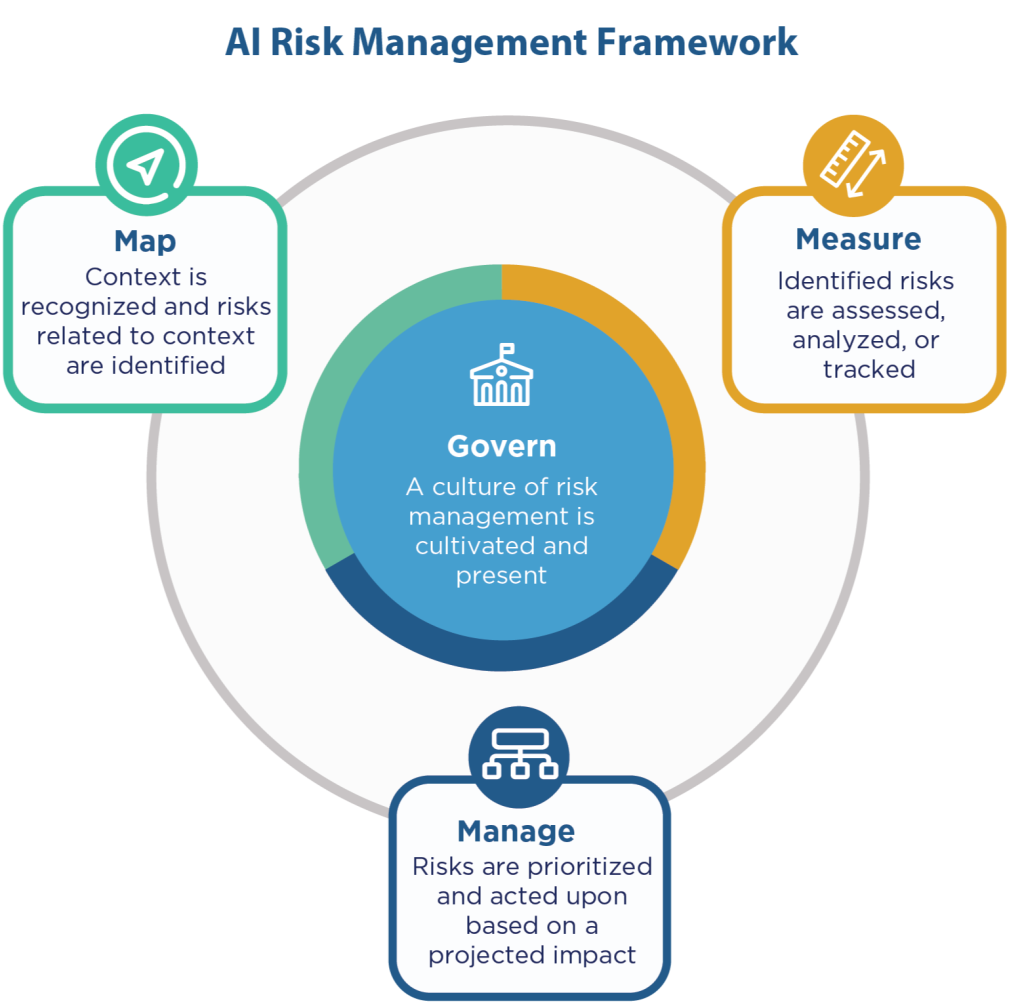
NIST's AI Risk Management Framework organizes AI risk work around governing, mapping, measuring, and managing risk, and its Generative AI Profile extends that thinking to generative systems. The practical V1 lesson is straightforward: an AI release is easier to evaluate when inputs, permitted actions, outputs, and success criteria are bounded.
Consider three hypothetical examples.
B2B SaaS: procurement approvals
The oversized concept is an end-to-end procurement operating system: vendor discovery, purchase requests, approvals, contract storage, budget controls, renewals, spend analytics, accounting synchronization, mobile approvals, SSO, and a supplier portal.
The core hypothesis is narrower: Operations managers at 50–200-person technology companies have enough pain around ad hoc software purchase approvals that they will move requests into a structured workflow.
The first user is the operations manager.
The V1 workflow is: employee submits request → manager reviews context → required approver accepts or rejects → requester receives status → operations can see the decision history.
V1 includes organization accounts, a simple requester/approver role model, approval rules for the first target customer profile, notifications, audit history, and basic reporting.
Deferred: supplier marketplace, native mobile apps, contract intelligence, sophisticated budget planning, dozens of integrations, and configurable workflow builders.
Evidence: percentage of invited teams completing real requests, number of active requesters, repeated usage, cycle completion, replacement of the previous email/Slack process, and willingness to continue or pay.
Marketplace: local specialist booking
The initial idea contains discovery, personalized recommendations, real-time availability, instant payments, subscriptions, loyalty, reviews, dynamic pricing, provider CRM, referral programs, chat, and nationwide geographic coverage.
The hypothesis is: Customers seeking a specific specialist in one city will request and complete bookings through a curated marketplace, and providers will accept enough of those bookings to sustain the loop.
V1 supports one service category in one geography. Customers search or choose a provider, request a slot, receive confirmation, and complete the booking. Provider onboarding and quality checks can initially remain highly manual.
Deferred: recommendation engines, many service categories, automated provider acquisition, nationwide configuration, loyalty, subscriptions, and sophisticated pricing.
Evidence comes from both sides: customer booking completion, provider acceptance, successful service delivery, repeats, cancellations, and whether supply remains willing to participate.
The manual operating layer is defensible precisely because the team is learning how the marketplace works. YC's longstanding guidance on doing things that do not scale applies particularly well to this kind of uncertainty.
AI product: contract review assistant
The oversized version is an autonomous legal agent connected to document repositories, email, CRM, e-signature systems, negotiation history, and multiple external research tools.
The first hypothesis is much narrower: An in-house legal operations user will trust a system that extracts a fixed set of clauses from one contract type, highlights deviations from an approved playbook, and provides evidence for review.
The V1 accepts defined document formats and one contract family. It produces structured clause extraction, a bounded risk assessment, citations back to the source document, and an explicit human approval step.
Evaluation is designed before expansion: a representative test set, expected outputs, error categories, and thresholds appropriate to the intended use. Low-confidence or unsupported results are surfaced for review rather than silently automated.
Deferred: general legal chat, autonomous negotiation, dozens of contract types, broad agentic tool access, and automatic downstream actions.
That product may look less ambitious in a demo than an "AI legal agent." It is much easier to determine whether it actually works.
For higher-stakes healthcare, financial, or regulated AI applications, the minimum safe product can be larger because risk controls are themselves part of the release. NIST explicitly treats AI risk management as context-dependent, and sector-specific regulatory obligations can add controls that would not exist in a lower-consequence productivity application.
Build a One-Page Version 1 Scope and Make Version 2 Earn Its Way Back In
A good Version 1 scope should be understandable without opening a 100-ticket backlog.
The following template can fit on one page before it expands into design and engineering documentation.
| Scope field | What to write |
|---|---|
| Primary user | The specific person who must succeed with Version 1. Include role, organization type, and relevant context. |
| Problem | The painful situation that currently drives the user to an existing workaround or alternative. |
| Core hypothesis | The important assumption this release is intended to test. Phrase it so evidence could prove the team wrong. |
| Core workflow | The shortest complete path from entry to value: setup → core action → result → next action. |
| Success moment | The observable point at which the user has actually received value—not merely signed up or viewed a screen. |
| In scope | Only the capabilities required to complete the workflow or satisfy mandatory product requirements. |
| Out of scope | Features, platforms, integrations, roles, automation, markets, and edge cases intentionally deferred. |
| Non-functional requirements | Security, privacy, reliability, recovery, performance, accessibility, compliance, data integrity, observability, or operational requirements that apply. |
| Integrations | External systems that are genuinely required for the first workflow. State why each is required. |
| Success metrics | The user behaviors and system outcomes that will inform the next decision. |
| Constraints | Budget, deadline, team composition, runway, regulation, dependencies, technical limitations, contracts. |
| Release criteria | What must be true before real users can rely on the product: workflow acceptance tests, security checks, data integrity, error paths, monitoring, recovery, support readiness, etc. |
| Version 2 triggers | The evidence that would justify adding major deferred capabilities. |
A team should be able to read that page and understand not only what it is building, but why the boundary exists.
That matters especially when working with an external development partner. Without an explicit hypothesis, workflow, exclusions, and release criteria, a vendor can deliver exactly what a feature list requested while the startup still fails to learn anything useful.
The document also changes how change requests work.
When someone says, "Could we also add customer-defined approval rules?", the answer does not have to be an argument about whether the idea is good.
Ask:
Does the first user require it to complete the workflow?
Does it satisfy a mandatory product requirement?
Does it change the hypothesis we are testing?
What evidence suggests it must happen now?
What current scope would it replace?
If the answers are weak, put it beside an explicit Version 2 trigger.
Diagnostic checklist: is Version 1 actually scoped?
Before development is committed - or whenever scope is drifting - ask:
- Can we describe Version 1 in two sentences without listing ten unrelated product areas?
- Can we identify one primary user rather than a collection of future segments?
- Is there one dominant end-to-end workflow that produces recognizable value?
- Does every V1 capability either enable that workflow or satisfy a mandatory product requirement?
- Do we know which startup assumption the release is testing?
- Will our instrumentation capture the behavior needed to evaluate that assumption?
- Can uncertain automation remain manual while we learn the workflow?
- Have we considered buying commodity infrastructure instead of building it?
- Are imagined future customers introducing roles, integrations, configurability, or enterprise requirements that nobody currently needs?
- Have we documented what is explicitly out of scope?
- Are security, authorization, data integrity, backups, error handling, and operational visibility appropriate to the product's risk?
- Have we defined release criteria, including unhappy paths rather than only the demo path?
- Does the architecture support normal Version 2 evolution without trying to anticipate Version 20?
- Do the scope and quality expectations actually fit the available team, budget, and time?
- Do deferred features have evidence-based re-entry triggers?
- Can the product launch safely, reliably, and honestly for the users it claims to serve?
The correct result is not always a tiny release.
A startup building software around hardware, bank infrastructure, clinical workflows, identity systems, regulated data, safety-sensitive AI, or difficult third-party integrations may have a substantial irreducible minimum.
That is fine.
"Minimum" is relative to the problem and the guarantees the product must make.
The mistake is not having a large Version 1 when the domain genuinely demands it.
The mistake is being unable to distinguish the irreducible product from the roadmap.
Early startups have limited money, engineering capacity, time, and founder attention. Every additional capability spends some of each.
The first release should spend those resources to buy information.
Did the right user use it?
Did the workflow replace something?
Did the product produce the promised result?
Where did users fail?
What did they trust?
What would they pay for?
Which assumptions survived contact with reality?
Which deferred capability has finally earned its place?
That is the most useful definition of a well-scoped Version 1:
Build enough to deliver value.
Build enough to be trustworthy.
Build enough to learn.
Make everything else earn its place in the next release.
How Intersog Can Help Scope and Build Your First Release
The best time to control Version 1 complexity is before a large backlog becomes a large implementation.
Intersog can support startup teams through product discovery, requirements analysis, technical feasibility work, UX/UI prototyping, architecture planning, custom software development, QA, launch, and iteration.
For teams still testing the shape of an idea, Intersog's MVP Development and Prototyping Services can help turn assumptions into a testable product boundary. Product strategy, competitive analysis, requirements work, and technical planning can be addressed through IT Consulting and Product Ideation. Once the scope is defensible, Custom Software Development Services can take that boundary into engineering, QA, deployment, and subsequent releases.
The goal is not to make Version 1 artificially small.
It is to make it deliberate: enough product to solve the first real problem, enough engineering to operate it responsibly, and no more complexity than the startup has evidence to justify.
Leave a Comment