
For fintech companies in 2026, fintech compliance is no longer a workstream that can be delegated to legal, security, or an external assessor shortly before launch. It shapes the checkout, identity model, cloud topology, data flows, vendor strategy, fraud engine, customer-support tooling, observability stack, and even the product metrics that engineering leaders optimize.
PCI DSS illustrates the change particularly well. PCI DSS v4.0.1 is the active version of the standard in 2026. PCI SSC published it in June 2024 as a limited revision of v4.0, without adding or deleting requirements; v4.0 was retired on December 31, 2024. Most importantly for product teams, the requirements that had previously been designated “future-dated” became effective on March 31, 2025. PCI SSC described 51 such requirements in PCI DSS v4.x. They are no longer optional preparation items for assessments performed in 2026.
At the same time, the payment-security problem has moved well beyond protecting card numbers. The European Central Bank and European Banking Authority reported €4.2 billion of payment fraud in the European Economic Area in 2024, up from €3.5 billion in 2023. Strong Customer Authentication continued to reduce fraud in areas it was designed to address, but manipulation of legitimate customers became increasingly important: users themselves bore roughly 85% of credit-transfer fraud losses, largely because scams persuaded them to initiate the payment.
That creates the central architectural principle for this article:
PCI DSS compliance is not the same as fraud prevention.
PCI DSS is principally concerned with protecting payment-account data and the environments that store, process, transmit, or can affect the security of that data. Fraud systems make a different decision: Should this identity, device, session, beneficiary, account, or transaction be trusted? A fintech can protect card data appropriately and still approve transactions involving stolen cards, account takeover, synthetic identities, authorized push-payment scams, mule accounts, refund abuse, card testing, or first-party misuse.
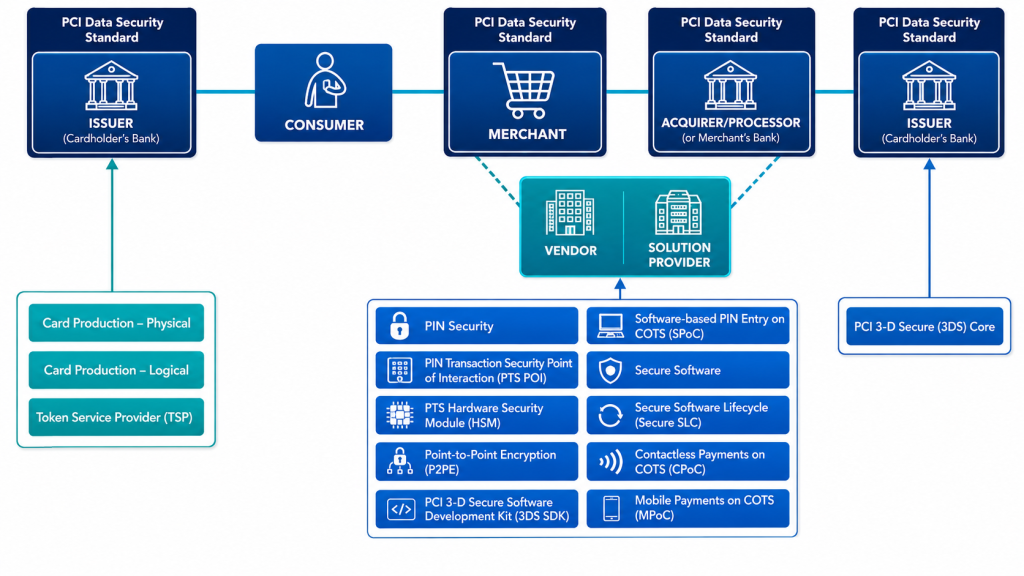
The practical objective, therefore, is not merely to “pass PCI.” It is to build a payment architecture in which compliance, fraud controls, monitoring, authentication and evidence can evolve without forcing the company to redesign its product every time risk, regulation or scale changes.
Fintech compliance is now a product and architecture problem
A traditional compliance project starts with requirements and asks, “What evidence must we produce?” A product-oriented compliance program starts earlier and asks, “What architecture would make the required behavior normal?”
That distinction matters because controls increasingly sit directly on paths owned by engineering and product teams. Payment-page script controls influence frontend deployment. Multi-factor authentication influences IAM architecture. Fraud checks influence checkout latency. Logging affects event schemas and retention. Third-party responsibilities affect procurement. Vulnerability remediation affects release engineering. Incident response affects observability and operational runbooks. Data-retention decisions determine whether cardholder data or sensitive identity records end up scattered through warehouses, analytics systems and support tools.
PCI DSS v4.0.1 reinforces this architecture-first direction. PCI SSC says the standard provides baseline technical and operational requirements for protecting payment-account data. The v4.x generation also increased emphasis on continuous security, clearer assignment of responsibility, targeted risk analysis and controls that address modern e-commerce threats.
The March 31, 2025 date is especially important. Before then, the future-dated v4.x requirements were best practices; afterward they became effective requirements and must be considered in applicable assessments. PCI SSC did not move that deadline when it published v4.0.1.
For a CTO, this changes roadmap economics. A payment-page control that requires a deployable script inventory is cheap when introduced with the checkout architecture; it is expensive when retrofitted across years of tag-manager history. A service-account governance model is straightforward when infrastructure identities are standardized; it becomes a cleanup program after hundreds of long-lived credentials have accumulated. A fraud feature store is a manageable platform decision while event contracts are being designed; reconstructing historical device, identity and beneficiary context after losses begin is substantially harder.
Three control domains should be separated conceptually even when they share technology.
| Domain | Primary question | Typical scope | Examples |
|---|---|---|---|
| PCI DSS compliance | Is payment-account data and the environment affecting its security adequately protected? | Cardholder-data environment and other applicable systems, people and processes | Data protection, access control, secure development, payment-page security, logging, vulnerability management, incident response |
| Fraud prevention | Should this user, session or transaction be trusted? | Customer and transaction lifecycle | Device risk, behavioral analytics, velocity, 3-D Secure strategy, transaction scoring, beneficiary risk, ATO detection, fraud investigation |
| AML/KYC/KYB and financial regulation | May we legally onboard and serve this customer/business, and are we meeting financial-crime and regulatory obligations? | Customers, beneficial owners, counterparties, transactions, regulated activities | Identity verification, customer due diligence, beneficial ownership, sanctions/PEP controls where applicable, ongoing monitoring, suspicious-activity processes |
FATF’s standards, for example, address customer due diligence, beneficial ownership and risk-based anti-money-laundering and counter-terrorist-financing controls. These objectives are different from PCI’s objective of protecting payment-account data.
The systems can nevertheless overlap. A KYC result may become a fraud feature. A device associated with several suspicious accounts may matter to both fraud investigators and AML analysts. Transaction monitoring, case management and evidence retention may support several control programs. But teams should resist combining the underlying decisions into one vague “risk score.” A transaction can be fraudulent without being money laundering; an AML alert may involve no immediate payment fraud; a perfectly legitimate customer can still use a compromised card.
PCI DSS should also not be described as legislation. It is a payment-industry security standard. The way organizations validate and report PCI DSS compliance is governed through payment-brand, acquirer and other compliance programs. Depending on the entity and program, validation may involve an SAQ, Report on Compliance, Attestation of Compliance or other applicable process. PCI SSC itself advises organizations to confirm validation obligations with the organization managing their compliance program.
That is why “PCI-certified fintech” is often imprecise language. The more useful engineering question is: what is the organization’s PCI DSS scope, what requirements apply to it, who performs each control, and what evidence demonstrates that those controls operate?
PCI DSS 4.0.1 engineering implications and scope minimization
Not every PCI DSS requirement needs to become a product feature. But several requirements have direct architectural consequences.
Payment-page scripts are now a first-class security asset. PCI DSS Requirement 6.4.3 addresses scripts loaded and executed in consumer payment pages. PCI SSC’s e-skimming guidance explains that organizations need controls around authorization, integrity and management of those scripts because malicious JavaScript can compromise payment information inside the customer’s browser even when backend infrastructure remains intact. Requirement 11.6.1 complements this by addressing change and tamper detection for payment pages and security-impacting HTTP headers.
A practical implementation should therefore treat checkout JavaScript more like a software supply chain than marketing content. Maintain an authoritative script inventory. Record why each script is required. Restrict who can add one. Detect unexpected changes. Review tag-manager permissions. Understand what third-party analytics, chat, experimentation and affiliate tools execute near payment flows. Build alerts that distinguish expected deployment changes from unauthorized mutations.
This does not mean that one particular technology - Content Security Policy, Subresource Integrity, a commercial client-side monitoring product or anything else - automatically satisfies PCI DSS. Controls must meet the applicable requirement and be validated in the context of the implementation.
The 2025 SAQ A revision needs careful interpretation. In January 2025, PCI SSC removed Requirements 6.4.3 and 11.6.1 from SAQ A itself and introduced a new eligibility criterion requiring applicable e-commerce merchants to confirm that their site is not susceptible to attacks from scripts that could affect the payment system. PCI SSC later clarified that this can be supported by techniques similar to those in Requirements 6.4.3 and 11.6.1, whether implemented by the merchant or a third party, or—under applicable circumstances - through confirmation from the compliant payment provider supplying the embedded payment solution. The eligibility criterion relating to scripts applies differently to embedded payment forms than to pure redirection models. Importantly, the underlying PCI DSS requirements were not removed from the standard generally.
And the scope story did not end there. PCI SSC’s June 2026 FAQ 1604 explicitly confirms that PCI DSS v4.x SAQ A includes external vulnerability scanning by a PCI SSC Approved Scanning Vendor for merchant e-commerce webpages even when payment processing is fully outsourced. The clarification covers both merchant pages that redirect to a third-party payment service provider and pages containing the provider’s embedded iframe.
So the statement “we use an iframe, therefore PCI is handled by our PSP” is not a defensible architecture strategy.
PCI SSC’s current FAQ is explicit: merchants outsourcing all payment processing can still have PCI DSS responsibilities. They must understand the shared-responsibility model, manage the relevant provider relationship, and validate their own compliance as required by the applicable program.
MFA and identity architecture also matter. PCI DSS v4.x broadened authentication expectations. PCI SSC guidance explains that Requirement 8.4.2 requires MFA for applicable access into the cardholder-data environment, while v4.0.1 also clarifies the treatment of phishing-resistant authentication in particular circumstances.
For engineering leaders, the larger lesson is to design distinct identity classes from the beginning:
human workforce identities, privileged administrator identities, workload identities, application/service accounts, CI/CD identities and emergency “break-glass” access should not all be governed as variants of a username and password.
Service credentials should not quietly become permanent shared secrets embedded in source code or environment files. Their privileges, ownership and intended interactive/non-interactive use should be explicit. Secrets should be retrievable through controlled mechanisms and rotated according to risk and applicable requirements. Privileged activity should be attributable to individual operators whenever possible.
Vulnerability and patch management should be driven from an asset and risk model. PCI SSC’s 2025 FAQ clarifies that entities must identify and risk-rank vulnerabilities. Requirement 6.3.3 requires applicable security patches for critical vulnerabilities to be installed within one month of release, while other patches follow timeframes determined according to the entity’s risk assessment. Internal scanning, risk ranking and targeted risk analysis interact with that process.
This argues against a compliance spreadsheet with generic “30-day patching” applied indiscriminately. Engineering needs asset ownership, vulnerability-to-service mapping, severity contextualization, remediation workflows and exceptions that are visible and reviewable.
Targeted risk analysis is another product-management issue. PCI DSS v4.x uses targeted risk analysis in situations where an entity determines the frequency of certain activities, and separately as part of the customized approach. PCI SSC emphasizes that the analysis should identify the threats, vulnerabilities and factors supporting the chosen control frequency rather than simply documenting a preference.
That means a TRA should be connected to real operational data. How frequently does the environment change? What is the attack surface? How quickly can compromise be detected? What systems are internet-exposed? A meaningful answer comes from platform telemetry, not only a policy document.
Logging, monitoring and incident response need to be engineered together. A compliant logging control has little value if events cannot answer operational questions during an incident. Payment and access events should have consistent timestamps, identities, correlation IDs and environment context. Security alerts should point to a response path. Runbooks should identify which systems can be isolated and what evidence must be preserved.
The same principle applies to security awareness. Phishing and social engineering are not solved by annual training alone. Phishing-resistant authentication, privileged-action verification, support-agent procedures and payment warnings can turn a human-risk program into an actual control system. NIST’s current Digital Identity Guidelines place substantial emphasis on phishing resistance, risk-based identity assurance and modern authenticators.
Third-party service providers require architecture-level ownership. PCI SSC says customers using TPSPs must manage those relationships, perform appropriate due diligence, understand the allocation of responsibilities, maintain appropriate agreements and monitor relevant compliance status at least annually. When a provider performs a PCI DSS requirement on behalf of a customer, that requirement remains relevant to the customer assessment: absence of adequate provider evidence can affect the customer’s compliance.
Scope minimization is a design strategy, not a checkbox
The most powerful PCI engineering decision is often not “how do we protect PAN in this service?” but “does this service need PAN at all?”
A useful architecture pattern is:
Customer → isolated payment surface → PCI-capable PSP/vault → token → core product services
The core application, CRM, analytics platform, support tooling and data warehouse should receive a non-sensitive reference wherever the payment architecture allows it rather than a primary account number.
Hosted payment pages and redirects can reduce the merchant-controlled payment surface because card information is collected on infrastructure operated by the provider. Hosted fields and embedded iframes can similarly isolate individual collection elements. But the exact PCI scope depends on the integration and on which merchant systems can affect payment security. PCI SSC explicitly notes that even an SAQ A-eligible merchant website remains relevant to assessment, and its 2026 guidance confirms ongoing requirements for redirect and iframe models.
Tokenization can reduce exposure, but “tokenized” does not automatically mean “out of PCI scope.” PCI SSC’s guidance on EMVCo Payment Tokens provides a useful example: compliant payment tokens outside the token-service-provider environment can be treated differently from account data, but any system that also stores, processes or transmits account data - or is connected in a way that makes it relevant - can remain in scope.
Similar caution applies to encrypted or hashed PAN. The transformation service and surrounding environment may remain in scope even when downstream representations no longer constitute cardholder data under specific conditions. PCI SSC’s March 2026 hashing guidance, for example, states that the system performing the hashing remains in scope.
Segmentation helps because it limits which systems can communicate with the cardholder-data environment and can therefore reduce the number of components requiring the same level of control and evidence. But segmentation must be real and testable. PCI SSC’s modern scoping guidance explicitly considers architectures such as cloud environments, software-defined networking, microsegmentation and ephemeral infrastructure; architectural complexity does not remove the need to understand boundaries and connectivity.
A strong fintech scope-minimization program therefore has several recurring practices: maintain a current data-flow map; isolate payment functions; prevent PAN from entering logs and analytics; scan telemetry and support tooling for unexpected sensitive values; inventory third-party dependencies; and review scope whenever payment flows change.
The governing rule is simple: reduce the number of components that can handle or materially affect payment-account data, then prove that the boundary is accurate.
Fraud threat models, layered controls, and customer experience
Once card data is properly protected, the next question is whether the payment itself is legitimate.
Consider five transactions:
A criminal buys stolen card credentials from a previous breach and makes a card-not-present purchase through a correctly implemented hosted checkout.
A criminal credential-stuffs a customer account, logs in successfully and uses the legitimate stored payment token.
A synthetic identity opens an account, builds apparent credibility and later abuses credit or payment functionality.
A scammer socially engineers a legitimate user into authorizing an instant transfer to a mule account.
A genuine customer receives goods and later disputes the legitimate transaction.
None of these scenarios inherently requires the fintech’s cardholder-data environment to have been compromised. The payment infrastructure could be operating according to PCI DSS while the business still experiences fraud. That conclusion follows from the different objectives of payment-data security and transaction-trust controls.
The 2026 fraud threat model should therefore cover the entire lifecycle.
At onboarding, stolen identities, synthetic identities, forged documents, automated account creation and coordinated account farms create risk before a payment exists. NIST’s current SP 800-63-4 digital identity guidance strengthened attention to fraud in identity proofing, including protections against automated attacks and forged or manipulated media.
At login and session level, credential stuffing, phishing, password reuse, account takeover, session theft and malicious recovery attempts can transform an otherwise valid account into a fraud channel.
At payment initiation, card testing, card-not-present fraud, abnormal amount or merchant patterns, compromised credentials and automated bot activity matter. Mastercard describes card testing as the automated use of payment attempts, often low-value, to identify stolen card details that remain usable, with spikes in attempts and declines among the indicators merchants can monitor.
At bank-transfer and instant-payment level, social engineering and beneficiary manipulation become critical. In the ECB/EBA 2024 data, credit-transfer fraud reached €2.2 billion and users bore most of those losses because scams frequently manipulated them into initiating payments themselves.
European regulation is consequently pushing additional controls into the payment UX. The EU Instant Payments Regulation introduced verification-of-payee requirements under which the payer’s provider compares the beneficiary information supplied by the payer with the account identifier and communicates the result before authorization. This is a textbook example of compliance becoming a product interaction rather than a back-office process.
At the post-transaction stage, refund abuse, return fraud, chargebacks and first-party misuse require different signals again. Visa describes first-party misuse - often called friendly fraud - as cases in which a legitimate cardholder disputes a transaction that they or someone authorized by them actually made.
Mule activity illustrates the boundary between fraud and AML. Fraud teams may identify an account because it receives money from many recently compromised victims or sends funds rapidly onward. AML teams may investigate the same account because its flows are consistent with laundering criminal proceeds. They can share signals and cases, but the investigations do not have identical objectives, obligations or reporting requirements. FATF’s risk-based AML/CFT framework remains concerned with money laundering, terrorist financing, beneficial ownership and customer due diligence rather than simply transaction loss.
A layered fraud-control stack
No single fraud vendor or machine-learning score can cover this threat model. Mature systems combine layers whose failures are partially independent.
| Control layer | Representative signals and controls | Primary risks addressed |
|---|---|---|
| Identity / KYC / KYB | Identity verification, business verification, beneficial-owner checks, consistency signals, risk classification | Synthetic/stolen identities, fraudulent merchants, account farms |
| Device and session intelligence | Device reputation, emulator/bot indicators, IP/network context, session continuity, device-account relationships | Automated signup, credential stuffing, ATO, bot abuse |
| Authentication and step-up | Passkeys/MFA, 3-D Secure where applicable, re-authentication for risky actions | ATO, stolen credentials, suspicious payments |
| Transaction risk | Amount, merchant/beneficiary, funding source, geography, card or bank-payment context | Stolen-card use, CNP fraud, APP fraud, abnormal transfers |
| Velocity and behavior | Transactions per device/account/card/IP, beneficiary creation velocity, deviation from historical patterns | Card testing, account farming, bot attacks, rapid cash-out |
| Network and graph signals | Shared devices, funding instruments, phone numbers, addresses, beneficiaries and linked accounts | Mule networks, coordinated fraud rings, synthetic-account clusters |
| Investigation and case management | Review queues, evidence, dispositions, analyst actions, customer contact | Ambiguous cases, high-value payments, model/rule feedback |
The stack should not apply maximum friction at every layer. A known device making a normal €30 purchase should not experience the same workflow as a new device attempting a €20,000 transfer to a newly created beneficiary.
That is where adaptive authentication becomes more useful than blanket authentication. Step-up controls should be triggered by actual risk and by regulatory/payment-network requirements. A challenge may make sense after a password reset, new device, beneficiary change or material transaction anomaly while being unnecessary for routine low-risk activity.
Rules, ML and human investigation solve different problems
Fraud engines work best when they combine deterministic rules, statistical or machine-learning models and human judgment.
Rules are excellent for precise policy: “deny this blocked BIN,” “limit attempts per card,” “hold a large payment immediately after credential recovery,” or “challenge when a newly added beneficiary is combined with a new device.”
Models are useful when risk depends on many weak signals whose combined relationship is difficult to encode manually. But models require reliable labels, controlled versions, monitoring and feedback. NIST’s AI Risk Management Framework emphasizes that AI risk must be managed throughout design, deployment, use and evaluation rather than treating a model as an autonomous source of truth.
Human analysts cover the ambiguous middle: high-value cases, emerging fraud patterns, customer context and cases where the cost of a wrong automated decision is unusually high.
This hybrid architecture also protects against a common mistake: optimizing exclusively for historical model accuracy. Fraud labels can arrive weeks after a transaction through disputes. Chargeback labels may mix genuine third-party fraud with first-party misuse. Investigators can label only cases that were surfaced to them, introducing selection effects. Attackers also change tactics when controls become predictable.
The model lifecycle should therefore include threshold tuning, production performance monitoring, segmented false-positive analysis, feature-quality checks, delayed-label handling and retraining or challenger evaluation when distributions change. NIST’s broader risk-management guidance similarly emphasizes continuous monitoring rather than one-time control assessment.
Security controls must be optimized with conversion
The objective of fintech fraud prevention is not to block the largest possible number of transactions. It is to minimize expected loss while preserving legitimate activity and meeting regulatory and scheme obligations.
An aggressive fraud threshold can reduce fraud rate while simultaneously increasing false declines, lowering authorization rates and harming payment conversion. Additional KYC steps can improve confidence but increase onboarding abandonment. Mandatory step-up authentication can stop some attacks while creating authentication failure for legitimate users.
Mastercard’s card-testing guidance makes this tension explicit: merchants need security while avoiding unnecessary customer friction, which is why risk-based controls are preferable to indiscriminate friction.
The decision vocabulary should therefore be richer than approve/decline. Fintech teams need soft interventions: ask for another authentication factor, delay a beneficiary, display a scam warning, hold the payment temporarily, request additional evidence or route the case to a reviewer.
A hard decline should be reserved for situations in which the risk and policy justify it.
Real-time fraud decisioning and the metrics that govern it
A useful reference architecture for payment fraud detection is:
Event → signal collection → feature computation → rules/models → risk score → policy engine → decision
The event may be account creation, login, password reset, card authorization, beneficiary creation, bank transfer, withdrawal or refund.
The signal layer enriches the event with identity, device, session, network, historical and payment information. A feature layer converts these inputs into reusable facts, for example, “number of attempts by this card in ten minutes,” “age of beneficiary relationship,” “number of accounts observed on this device,” or “distance from the user’s normal behavior.”
Rules and models then produce findings or scores. The policy engine should remain a separate component because business action is not identical to model probability. A fraud probability of 0.71 could produce different actions for a €15 card purchase, a €15,000 transfer and a withdrawal from a newly opened account.
Typical decisions include approve, approve and monitor, step up authentication, hold, manual review, decline, and block the account/device/instrument.
For payment paths, latency matters. Remote lookups that frequently exceed the authorization budget can cause more business harm than the fraud control prevents. Hot features should therefore be accessible through low-latency stores, while event streaming can update historical state asynchronously.
The engine also needs idempotency. If a PSP retries a webhook or a transfer request is retried after a network timeout, the system must not increment risk state incorrectly or generate contradictory decisions. Similarly, replayability matters for investigations and model testing: teams should be able to reconstruct what the engine would have seen at decision time.
Every decision should produce a durable record containing the event identifier, important signals, rule and model versions, policy version, score, final decision and explainable reason codes. That log supports disputes, investigation, tuning and auditability. It also makes rollback possible when a newly deployed rule unexpectedly blocks legitimate customers.
Metrics should expose trade-offs, not just fraud loss
No single KPI describes a good fraud system.
| Metric group | Metrics to monitor | Why the combination matters |
|---|---|---|
| Fraud | Fraud losses, fraud rate, chargebacks, ATO rate, card-testing attempts, fraudulent value blocked | Indicates loss and attack pressure |
| Customer / product | Authorization or approval rate, false-positive rate, authentication completion, payment conversion, onboarding abandonment | Reveals the legitimate-customer cost of controls |
| Operations | Decision latency, manual-review rate, investigation time, cases per analyst | Shows whether the operating model can scale |
| Compliance / security | PCI-scope coverage, unauthorized scripts, remediation SLA performance, access-review completion, control failures, evidence completeness | Measures control health rather than transaction outcomes |
Definitions and denominators should be explicit. “Fraud rate” might mean fraud value divided by payment value, fraudulent transactions divided by total transactions, or confirmed fraud divided by settled payments. Authorization rate may differ from internal approval rate because an issuer can still decline a transaction that the fintech sends for authorization.
The trade-offs matter more than any isolated target. Falling fraud loss accompanied by collapsing approval rates may indicate overblocking rather than better detection. A falling manual-review rate may reflect improved automation, or a threshold change that simply ignores ambiguous risk. Better conversion can be achieved by reducing authentication, but that may shift loss elsewhere.
For Europe, the ECB/EBA data provides useful context rather than a benchmark: in 2024 the EEA payment-fraud rate was approximately 0.002% of total transaction value, yet the absolute fraud value still reached €4.2 billion. Card fraud was materially higher on transactions where the recipient was outside the EEA and strong customer authentication was not legally required or often not used.
The correct targets for an individual fintech should instead be segmented by payment rail, geography, customer type, product, transaction value and fraud modality.
Continuous compliance, build-vs-buy decisions, and the twelve-month roadmap
Traditional audits create a familiar pattern: for months the company runs engineering normally; then a compliance deadline approaches and teams manually collect screenshots, access lists, tickets, vulnerability reports and vendor documents.
That operating model does not scale.
Continuous compliance reverses it. The production systems that operate controls should also create evidence that those controls operate.
Infrastructure-as-code can demonstrate the intended configuration of networks and cloud services. CI/CD records show which code reached production and through which approvals. IAM systems show privileged access and review status. Vulnerability platforms provide findings and remediation history. Payment-page monitoring produces script inventories and tamper alerts. Vendor management stores current attestations and responsibility matrices. Incident exercises create dated evidence that plans have actually been tested.
Policy-as-code can enforce selected controls before deployment rather than discovering violations months later, for example, disallowing prohibited public storage configurations, enforcing required tags, preventing unapproved network paths or requiring security checks for high-risk repositories.
This does not mean every compliance requirement can be automated. Risk acceptance, incident judgment, vendor assessment and human-security controls still require accountable people. Automation is most useful for controls that already produce structured digital evidence.
The PCI SSC’s July 2026 PCI DSS v4.0.1-to-NIST Cybersecurity Framework 2.0 mapping is relevant here. Developed with PCI SSC’s Board of Advisors, it provides a crosswalk between PCI DSS requirements and NIST CSF 2.0 outcomes. It can help organizations map common security capabilities and evidence across programs rather than building entirely separate control inventories. It does not mean that implementing NIST CSF makes an organization PCI DSS compliant, or vice versa.
For fintechs already running an enterprise security program, this is strategically useful. IAM, vulnerability management, asset inventory, incident response and supplier management can become reusable platform capabilities, with each framework mapping its own requirements onto the same underlying controls.
Build versus buy
The architecture question is not “Should fintechs build everything?” In many cases, doing so would increase both security risk and time to market.
| Capability | Typical startup bias | Architecture rationale |
|---|---|---|
| PSP / card processing | Buy | Processing networks and acquiring are rarely a useful differentiation for a normal fintech product |
| Card vault | Buy unless payments infrastructure is core IP | Avoid unnecessary direct PAN storage and handling |
| Tokenization | Buy / use PSP or network capability | Mature token infrastructure is difficult to reproduce safely |
| 3-D Secure | Buy / integrate | Scheme ecosystem and protocol complexity favor specialist providers |
| Device intelligence | Buy first, reassess at scale | External networks provide useful cross-customer reputation signals |
| Identity verification | Buy + orchestrate | Document/data coverage changes by country; own the policy, not necessarily every verification primitive |
| Fraud rules | Hybrid | Vendor primitives are useful, but product-specific policy normally belongs to the fintech |
| Risk-policy engine | Build or hybrid | Decision semantics, orchestration and product actions are often core business logic |
| ML fraud models | Buy early; selectively build at sufficient scale | Proprietary models become valuable only with enough data, labels and specialist capability |
| Case management | Buy or hybrid | Workflow is commodity until investigation scale or domain complexity becomes differentiating |
| Compliance evidence tooling | Buy / integrate | Evidence collection benefits from connectors, but control ownership remains internal |
Outsourcing a capability is not the same as outsourcing accountability. PCI SSC’s third-party guidance is explicit that customers remain responsible for managing provider relationships and understanding which requirements each party fulfills.
The right contractual question is therefore not merely “Is the vendor PCI compliant?” Ask what services its assessment covers, what evidence it supplies, which controls remain with the customer, how incidents are communicated, how architectural changes are notified and what happens when an attestation approaches expiration.
A practical twelve-month fintech compliance roadmap
The phases overlap deliberately. Fraud engineering should not wait until all PCI work is finished, and continuous-evidence design should begin while controls are being implemented.
| Roadmap phase | Product work | Engineering work | Security / compliance work | Fraud / risk work | Expected outcome |
|---|---|---|---|---|---|
| Phase 1 — Map scope and risk, weeks 0–4 | Document payment/onboarding journeys and markets | Trace PAN, tokens, identity data, sessions, transaction and vendor flows | Determine preliminary PCI scope, validation path, regulatory inventory and owners | Create fraud taxonomy and top abuse scenarios | Shared map of systems, data, obligations and risks |
| Phase 2 — Reduce exposure, months 1–3 | Decide hosted checkout/field/redirect UX and retention requirements | Isolate payment services; implement vault/token strategy; remove PAN from logs/analytics | Validate segmentation assumptions and TPSP responsibility matrix | Add basic bot/card-testing/ATO controls | Smaller sensitive-data footprint and lower attack surface |
| Phase 3 — Build fraud foundations, months 2–5 | Define step-up, hold, review and decline experiences | Create event schema, feature services, velocity state and decision API | Review identity/authentication controls | Deploy rules, device/session signals and case workflow | Real-time transaction-risk capability |
| Phase 4 — Operationalize PCI DSS 4.0.1, months 3–6 | Account for security behavior in checkout/admin UX | Script management, tamper detection, IAM improvements, vulnerability workflows, logging | Run TRA where applicable; test incident response; collect provider evidence | Connect security events to fraud investigations | Controls operate continuously rather than only for assessment |
| Phase 5 — Optimize fraud decisions, months 6–9 | Tune challenge/hold experiences using conversion data | Add graph features, model infrastructure and reason logging | Review control changes for PCI/regulatory impact | Tune thresholds, analyze false positives, introduce models where justified | Better fraud-loss/conversion frontier |
| Phase 6 — Continuous compliance, months 9–12+ | Make compliance impact part of feature planning | Automate evidence, CI/CD gates and compliance telemetry | Continuous dashboards, periodic access/vendor/control review | Ongoing model/rule monitoring and emerging-threat reviews | Compliance and fraud become operating capabilities |
The crucial deliverable after the first month is not a giant requirements spreadsheet. It is a joint architecture and risk map that engineering, product, security, compliance and fraud teams recognize as the same system.
By month three, the company should have materially reduced avoidable sensitive-data exposure. By month six, the major applicable PCI DSS v4.0.1 controls should be operational and evidence-producing. By month nine, fraud tuning should be based on quantified customer and loss trade-offs rather than rule intuition. By month twelve, the audit should mostly summarize evidence already produced through normal operations.
Startup-stage priorities, Israeli fintech considerations, and the compliance backlog
Not every startup should build a sophisticated graph model or custom compliance platform before product-market fit. But several decisions become disproportionately expensive to postpone.
| Stage | Build early | Reasonable to defer |
|---|---|---|
| Pre-MVP | Hosted/outsourced payment collection where feasible, clean data-flow boundaries, least-privilege IAM, basic KYC/vendor integration, auditable transaction model, basic velocity/rate controls | Custom fraud ML, proprietary device intelligence, advanced graph analysis |
| Early traction | Centralized event logging, fraud decision API, review workflow, script/change controls, provider responsibility inventory, incident runbooks | Complex in-house model platform unless loss/data justify it |
| Scale-up | Segmented payment architecture, historical features, mature rules, model experimentation, access automation, continuous vulnerability/evidence workflows | Highly specialized internal tooling where vendors still meet requirements |
| Enterprise / global expansion | Multi-jurisdiction control mapping, vendor governance, policy versioning, regional payment/fraud strategies, graph/network analytics, resilience testing, compliance telemetry | Very little foundational work should remain manual |
One architectural feature deserves special treatment from the beginning: financial correctness. Fraud and PCI controls should sit around a transaction system that preserves authoritative financial state, idempotency and reconciliation. For a deeper treatment, Intersog’s article on payment ledger architecture for fintech products explains why the ledger itself needs to define financial truth before transaction volume is optimized.
What Israeli fintech companies should consider
Israeli fintech founders face a particularly international compliance problem. A product may be engineered in Tel Aviv, licensed or supervised under one Israeli regime, process cards through a global acquirer, serve EU customers, connect to bank-transfer rails, host workloads globally and sell infrastructure to regulated financial institutions in several countries.
Domestic requirements are therefore only one layer.
Israel’s Payment Services Law, 5779–2019 is among the laws the Bank of Israel identifies as relevant to the payments environment. Separately, the Bank of Israel refers to the Regulation of Payment Services and Payment Initiation Law, 5783–2023 - sometimes informally described as the “Israeli PSD.” That law took effect in June 2024 and established a licensing/supervisory framework under which new non-bank acquirers and relevant non-bank payment-service businesses fall under the Israel Securities Authority, subject to the specific statutory regime.
Payment infrastructure is modernizing at the same time. The Bank of Israel identifies ZAHAV/RTGS, MASAV’s ACH and instant-payment infrastructure, and SHVA’s card and ATM switches among Israel’s key payment systems. Its recent modernization program has included expanding non-bank access, advancing instant payments, improving cross-border efficiency and upgrading payment-system architecture.
The Bank has also promoted ISO 20022-based instant payments and request-to-pay capabilities. Although the underlying initiative began earlier, the relevant Bank of Israel page was updated in August 2026 and continues to describe instant payments as a 24/7 mechanism in which funds become immediately available to the beneficiary.
Privacy is another engineering dependency. Israel’s Privacy Protection Authority is the national regulator responsible for personal-information protection, and Amendment 13 to the Privacy Protection Law entered into force in August 2025. The Authority published updated professional guidance and, in July 2026, further guidance concerning the new obligation to appoint privacy protection officers for applicable organizations.
For product leaders, the lesson is not to create a giant “Israel compliance module.” Build a market-and-rail matrix:
Which legal entity provides the service? In which country? To which customer? Through what rail? Under which license or partner arrangement? Which payment scheme applies? Where is data processed? Which fraud/authentication rules apply?
An Israeli company selling in Europe may need to account for European payment requirements such as SCA and verification of payee. A card product still needs its PCI and payment-brand analysis. An embedded-finance platform may inherit requirements contractually from a bank or regulated provider. A B2B fintech may need KYB and beneficial-ownership workflows that a simple merchant checkout does not.
Geography matters, but product topology matters just as much.
For related architectural context, Intersog’s 2026 guides on building a fintech application, open banking software architecture and fintech cybersecurity can be used as supporting internal links.
Turning compliance into a product backlog
Requirements become manageable when translated into normal engineering deliverables with observable acceptance criteria.
| Backlog area | Example product/engineering items | Evidence or acceptance signal |
|---|---|---|
| Architecture | Document card/data flows; isolate payment services; segment sensitive environments; review connectivity | Current architecture/data-flow diagrams; segmentation tests; asset inventory |
| Checkout / payment page | Inventory scripts; restrict script additions; implement integrity/change monitoring; minimize third-party code | Approved script list; alerts; deployment/change history |
| IAM / authentication | Enforce MFA where applicable; separate privileged/workload identities; control break-glass access; review roles | Authentication policy; access logs; review records |
| Fraud | Create real-time decision API; velocity rules; device/session signals; ATO controls; step-up and hold states | Versioned policies; decision logs; fraud/false-positive metrics |
| Monitoring | Centralize payment/security events; detect unauthorized page changes; alert on vulnerable assets and anomalous access | Alert history; SIEM events; vulnerability dashboards |
| Operations | Incident playbooks; fraud escalation; customer-support verification; tabletop exercises | Exercise records; incident tickets; documented escalation results |
| Third-party/vendor management | Maintain provider inventory, responsibility matrix, due diligence and attestations | Contracts; current AOCs/evidence where relevant; review dates |
| Audit evidence | Automate infrastructure, IAM, deployment, scan and control evidence collection | Continuously populated evidence repository/dashboard |
This backlog should participate in ordinary product prioritization. A new checkout analytics SDK is not simply a marketing request; it may alter the payment-page threat model. Adding a new country is not just localization; it can introduce different authentication, KYC and payment-rail requirements. A new refund workflow affects fraud exposure. A new cloud account changes asset inventory, IAM, network boundaries and evidence.
Once teams operate this way, compliance becomes an input to architecture decisions rather than an objection raised after the design is complete.
Conclusion, Intersog’s role, and the publication package
The objective of fintech compliance in 2026 is not to build a product and then wrap PCI DSS, fraud detection and regulatory controls around it.
The stronger model is the reverse.
Design payment flows so sensitive account data has as few destinations as possible. Treat checkout scripts as part of the software supply chain. Separate human and machine identities. Make transaction decisions from layered risk signals. Preserve versioned decision evidence. Design step-up authentication and customer warnings as product states. Use providers strategically without pretending responsibility disappeared. Generate compliance evidence as a by-product of operating secure infrastructure.
Above all, preserve the distinction between payment security and transaction trust.
PCI DSS can reduce the probability that payment-account data is exposed or compromised through the environments within its scope. Fraud controls assess whether the person, account, session and transaction are legitimate. AML/KYC/KYB controls satisfy a separate set of financial-crime, customer-due-diligence and regulatory objectives. These systems can share infrastructure, but they should not be treated as interchangeable.
The architecture is resilient when all three can evolve independently: a new PCI control should not require redesigning the ledger; a new fraud model should not change the card-data boundary; a new market’s regulatory rule should be configurable through policy and workflow rather than embedded throughout application code.
That is the real meaning of a fintech compliance roadmap: not an audit calendar, but a plan for making security, risk and compliance evolvable properties of the product.
For companies building or modernizing payment products, Intersog can support the engineering layer behind that roadmap: fintech architecture, secure payment integrations, backend services, cloud infrastructure, DevSecOps, fraud and risk platforms, modernization, and dedicated development teams. See Intersog’s fintech software development services for the broader capability set.
Leave a Comment