
Today, small businesses face skyrocketing technology demands paired with tight budgets. Worldwide IT spending is expected to reach $5.43 trillion by 2025, which is a 7.9% increase from 2024. SMB-specific forecasts likewise show IT budgets growing 6–7% per year, reaching $1.58 trillion in 2024. In practice, many SMB owners report increased pressure to invest in digital transformation. In fact, 73% say they’re boosting tech budgets, and 64% have already adopted AI.
However, hiring the talent to meet these needs has become extremely difficult and expensive. In a recent survey, 57% of managers said they struggle to find skilled IT staff. Globally, tech salaries are increasing by about 15–23% per year. Faced with expensive local wages and a limited talent pool, SMBs are outsourcing IT services to fill the gap.
Key factors driving the outsourcing surge include:
- Rising IT budgets: SMBs are spending more on technology (6–7% annual growth), fueling new projects and needs.
- Talent shortage: A majority of companies (57%) say it’s hard to find needed tech talent. Outsourcing provides instant access to a larger talent pool.
- Salary inflation: Rapid wage growth (≈20%+ per year) makes local hiring costly. Outsourcing often offers skilled labor at a fraction of the cost.
- Digital transformation pressure: Most SMBs are adopting new tech (AI, cloud, e-commerce). To keep up, they need extra capacity and expertise that their small in-house teams can’t easily provide.
- Cost control: Over half of organizations outsource explicitly to cut IT costs. By leveraging offshore or nearshore teams, SMBs can turn fixed salaries into flexible expenses.
- Market momentum: Roughly 54% of SMBs expect to outsource at least one core business function by 2025. In other words, outsourcing is becoming standard practice for growth and competitiveness.
Together, these trends make outsourcing IT services a powerful lever for SMBs in 2025. It allows smaller companies to scale technology projects, access cutting-edge skills, and focus on their core business – all without proportionally expanding their payroll or overhead.
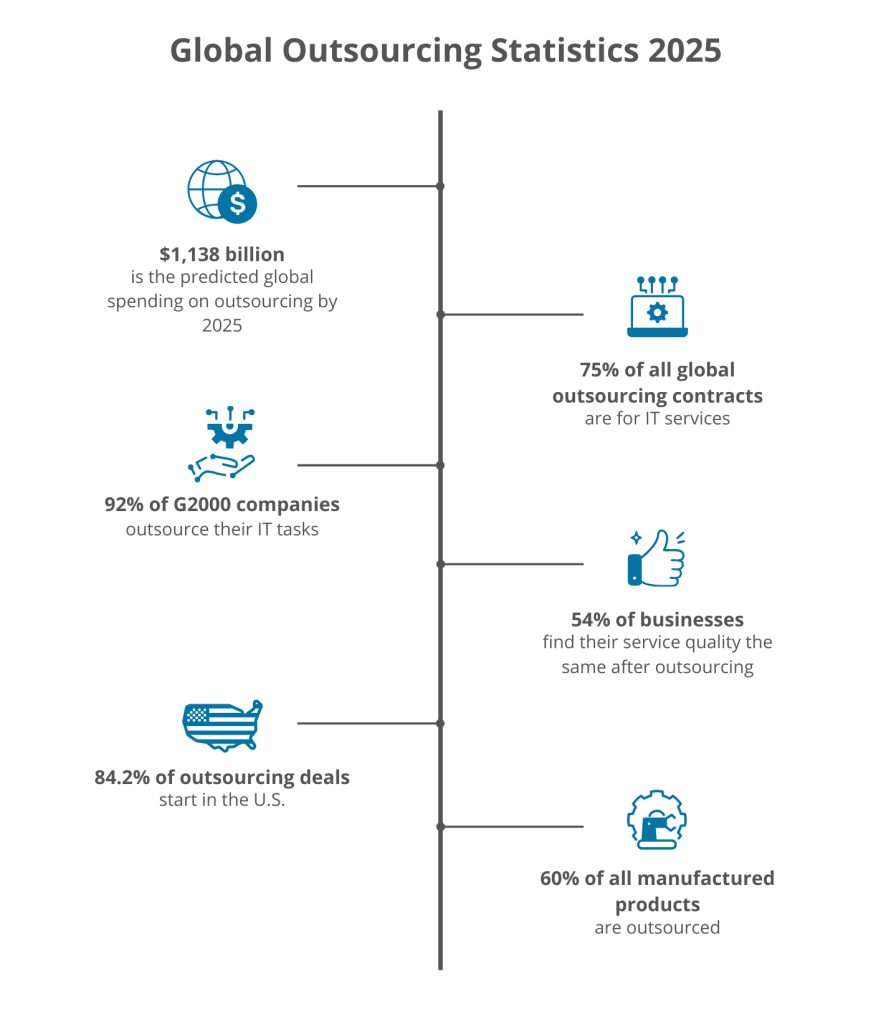
What IT Outsourcing Actually Means Today (vs. Old-School Outsourcing)
IT outsourcing has evolved from the simple offshore outsourcing of tasks to strategic partnerships. Today, outsourcing is about more than just cost-cutting; it's also about access to skills, flexibility, and technology. According to IDC, 77% of companies now expect an outsourcing partner to serve as a “single source of expertise” for their technology needs. By 2025, working with an IT outsourcing company will often mean integrating an external team - whether offshore, nearshore, or hybrid - that operates as an extension of your own team.
- Skills on demand: Modern providers offer specialized talent, such as cloud architects, AI experts, and DevOps engineers, that many SMBs cannot hire full-time. Rather than clipping coupons and shipping code, outsourcing today means getting highly trained teams to kickstart projects. As one expert notes, outsourcing is now "about access to skills, time, and technologies" rather than merely low labor costs.
- Flexible engagement: Unlike legacy models, which are tied to long-term contracts and rigid deliverables, today’s outsourcing supports agile methods. You can hire a dedicated software development team for ongoing feature work, a project team for a specific scope of work, or a managed service provider (MSP) for 24/7 operations. This flexibility allows you to pay only for what you need when you need it.
- Outcome focus: Rather than simply handing off tasks, modern outsourcing is often tied to strategic goals. For instance, an MSP will proactively monitor and optimize your IT environment as if they were an extension of your IT department, while a dedicated development team will collaborate closely with you on product roadmaps. Clients expect partners to understand their business outcomes, not just work by the clock or set it and forget it.
- Nearshoring preference: Many companies now prefer nearshore or onshore vendors to reduce time zone and communication barriers. Proximity, including cultural and time-zone alignment, is valued over simply the lowest price. This contrasts with the traditional offshoring model of working with distant providers without direct oversight.
In short, today outsourcing means partnership. It’s a way to quickly fill talent gaps and innovate while the vendor handles the details of execution. Unlike traditional outsourcing, which often involved transferring work overseas, modern outsourcing emphasizes collaboration, quality, and agility. Companies use outsourcing to accelerate projects or solve specific IT challenges rather than just to find an inexpensive labor rate.
When a Small Business Should Consider Outsourcing IT
Deciding whether to outsource is a strategic choice. Here are key signs and use cases indicating outsourcing is a good fit:
- Specialized Skills Needed: If your project requires expertise that you lack, such as AI/ML development, advanced cybersecurity, or mobile app development, outsourcing can instantly fill the gap. For instance, a small-to-medium-sized business (SMB) that wants to launch an AI-driven marketing app might not have data scientists on staff. Hiring an outsourced team of AI specialists can kickstart the project without the need for a lengthy hiring process.
- Capacity Constraints: When your internal team is busy with day-to-day tasks and cannot take on more work, outsourcing provides additional capacity. If you have urgent deadlines, such as launching a website before a sales season, or if you have fluctuating workloads, external teams can scale up quickly. Deloitte found that 57% of organizations outsource to cut costs and 40% do so to more easily scale resources up or down.
- Budget Control: Outsourcing turns fixed hires into variable costs. If you want to keep payroll lean, consider contracting work on a per-project or per-hour basis. For example, instead of hiring a full-time network admin, an SMB might outsource IT support to a managed service provider, paying a predictable monthly fee per user. This avoids benefits and training costs.
- Urgent or Time-Bound Projects: Tight timelines often make outsourcing attractive. Need an ecommerce site in three months? Building an in-house team and ramping up would be slow. An outsourced, project-based team can start immediately. Similarly, if you need to migrate to the cloud or update legacy systems quickly, external experts can accelerate deployment.
- Freeing Internal Team for Core Work: Many SMBs outsource routine IT functions so their small in-house team can focus on strategic business initiatives. For instance, a marketing firm may outsource network management and help desk support, enabling their small IT staff to develop new customer-facing tools. Use cases for outsourcing include IT support/help desk, infrastructure maintenance, and cloud migration. These allow internal teams to concentrate on revenue-generating projects.
Use Cases: Common scenarios in which SMBs use outsourcing include building custom software or mobile apps, migrating to cloud platforms, implementing e-commerce or CRM systems, developing AI or automation solutions, and securing networks. In each case, the "before" state usually involves a lack of necessary talent or time internally. The "after" state is a functioning solution delivered by an external team, enabling the SMB to compete and grow without increasing its payroll.
Check out a related article:
IT Outsourcing vs. Managed Services: A Comprehensive Guide for Tech Decision‑Makers
Checklist: Before you decide to outsource, clarify your goals. Determine what you need (skills, speed, cost savings) and why. Assess if the task is strategically central (keep in-house) or supportive (outsourcable). Evaluate internal constraints (skill gaps, budget limits, time pressures). If most indicators point to “not enough resources or expertise internally”, then outsourcing is likely worth exploring.
Outsourcing Models SMBs Can Use
Different outsourcing models suit different needs. Here are four common models, along with their descriptions and when to use them:
| Model | How It Works | Typical Use Case | Cost Structure |
| Project-Based Outsourcing | Vendor delivers a specific project or task with a defined scope (e.g. a website or app build). Client pays a fixed price or hourly/T&M for deliverables. | Ideal for one-off projects with clear requirements. | Fixed-price or time & materials. |
| Dedicated Development Team | A full-time, managed team (developers, designers, PM) works exclusively on your projects, often as an extension of your staff. The vendor handles hiring and management. | Best for long-term projects/products that need steady iteration and ongoing development. | Monthly retainer (T&M); usually one recurring fee. |
| Managed IT Services | Outsource continuous IT operations (network/admin, helpdesk, cloud management) to a provider. The MSP proactively monitors systems and provides support. | Suited for routine IT maintenance, 24/7 support, backups, security monitoring, etc. | Usually per-user/device or flat monthly fee. |
| Hybrid/Blended Model | A customized mix of models (e.g. in-house + outsourced team, or project + managed services) to fit complex needs. | Useful for large/complex initiatives where you might need a core in-house team plus external experts or varied arrangements. | Varies – could combine monthly fees and project-based fees. |
Each model has its pros and cons. For instance, a project-based contract provides certainty but less flexibility (it is more difficult to change the scope), whereas a dedicated team offers flexibility as project requirements evolve. Managed services can reduce your team's day-to-day burden but require you to trust the provider with ongoing IT control. Hybrid models allow you to customize the ideal combination for your business.
The table above summarizes each option. Consider your business goals when choosing: a short-term fixed project might favor project outsourcing; a growing product roadmap, a dedicated team; and ongoing support, an MSP. Hybrid solutions (e.g., staff augmentation plus an MSP) allow you to strike a balance.
The Real Business Benefits of IT Outsourcing for SMBs
Outsourcing IT can unlock several tangible advantages for a small company. The top benefits include:
- Lower Costs: Outsourcing often reduces expenses. Rather than paying full-time salaries, benefits, and overhead, you only pay for the work performed. Studies show that managed IT services typically cost up to 20% less than an equivalent in-house IT department. Deloitte found that 57% of businesses specifically outsource to reduce costs. For instance, hiring development teams in Eastern Europe or Latin America can result in 30–40% savings on labor costs compared to U.S. or Israeli rates.
- Faster Time to Market: Outsourcing partners can start working immediately. You avoid long recruitment and training cycles. An external team can often begin a project within days, accelerating delivery. In fact, a recent survey found that most outsourcing arrangements achieve the same or better speed and outcomes as in-house efforts. This means new features, products, or fixes are completed faster.
- Access to Expertise: Small businesses get instant access to specialized talent and modern tools. Need a cybersecurity expert or cloud architect? Rather than scrambling to hire one or train staff, you can simply engage a provider who already has those experts on board. Outsourcing essentially "borrows" skills that would otherwise be difficult to recruit. This allows SMBs to leverage cutting-edge technologies, such as AI, automation, and DevOps, without having to build deep internal teams.
- Focus on Core Business: By handing over routine IT operations or development tasks, your internal team can concentrate on your core competencies, such as marketing, product strategy, and customer service. This strategic focus drives growth. For example, a retailer might outsource IT support so that its small staff can focus on improving the shopping experience. In other words, outsourcing "frees up" key personnel to work on growth initiatives.
- Scalability and Flexibility: Outsourced teams can scale up or down much faster than in-house staff. If project needs increase, vendors can add resources. If needs decrease, you can simply reduce the scope of the contract. This flexibility is ideal for startups and seasonal businesses. You can have the right team size at the right time without layoffs or long-term commitments.
- Improved Reliability and Innovation: A quality outsourcing partner brings established processes and tools, such as continuous monitoring and agile development, that small companies may lack internally. Many providers offer 24/7 support and rigorous SLAs, improving uptime and security. With a strong partner, SMBs often experience higher service levels, tighter security, and continuous innovation. As one guide puts it, the right outsourcing partner can help you "accelerate development, tighten security, improve service levels, and drive innovation" while allowing you to focus on your core work.
In short, the cost efficiency, speed, expert skills, and focus that IT outsourcing provides make it an attractive growth lever for SMBs. Rather than treating outsourcing as a last resort, savvy companies proactively use it to scale and compete with larger companies.
The Risks of IT Outsourcing (and How to Avoid Them)
Although outsourcing offers many advantages, it also has potential drawbacks. Common risks and their mitigations include:
- Communication and Control Gaps: Communication and control gaps: Outsourced teams may be in different time zones or cultures, which can cause misunderstandings and delays. Handing off projects reduces your direct oversight.
Mitigation: Choose partners in compatible time zones (nearshoring can help). Establish clear communication channels and regular check-ins. Assign a dedicated project manager (either in-house or from the vendor) to maintain alignment. - Security and Compliance Concerns: Granting external providers access to sensitive data or systems raises cybersecurity and regulatory risks.
Mitigation: To avoid breaches or noncompliance, only outsource to firms with robust security measures. Verify their certifications (e.g., ISO 27001, SOC 2), request security audit reports, and confirm that they adhere to data protection laws. Include strict security clauses in contracts. - Variable Quality and Reliability: Not all vendors deliver the same quality. You may end up with inconsistent support or missed deadlines if a provider underperforms.
Mitigation: Thoroughly vet vendors. Look at case studies, references, and turnover rates. Start with a small pilot project to test their quality. Define clear SLAs and acceptance criteria so that underperformance can be identified early on. - Hidden Costs: Some providers may quote low rates but later add fees for things like knowledge transfer, documentation, or overtime.
Mitigation: Make sure your contract covers all expected services and includes a transparent fee breakdown. Ask about extra charges upfront (see our list of 20 questions below). Require the vendor to outline what’s included and what costs extra. - Vendor Lock-in/Dependency: Becoming reliant on a single provider may result in a loss of negotiating leverage and disruption if they fail.
Mitigation: Consider multi-vendor or hybrid models for critical systems. Maintain in-house knowledge of core architecture. Include exit clauses and IP ownership agreements. This way, you can switch providers if needed without crippling the business.
In general, due diligence is essential for avoiding outsourcing risks. Select a reputable partner with proven expertise and transparent practices. Establish clear governance by setting contractual terms, SLAs, and KPIs that align with your goals. Keep stakeholders informed and stay involved in project management. Finally, prioritize data security and compliance at every stage. With these safeguards in place, the benefits of outsourcing typically outweigh the risks for SMBs.
How to Choose the Right IT Outsourcing Partner
Selecting the best outsourcing company requires careful evaluation. Use a structured checklist and ask probing questions. Key points to consider include:
- Define Your Needs and Objectives: Clarify why you’re outsourcing (cost savings, speed, expertise, etc.) and what exactly needs to be done. A well-defined scope (specific tasks, technologies, timelines) will guide your choice.
- Industry Experience and Expertise: Look for vendors with proven experience in your field or with similar projects. Check case studies or ask for references. Verify their technical capabilities (Do they have the developers or specialists you need? Do they use modern tools like cloud and AI?). Also confirm relevant certifications (ISO, cybersecurity standards, etc.) if your industry requires compliance.
- Communication and Cultural Fit: Make sure the provider can communicate effectively in your language and operate during your business hours (or with sufficient overlap). Companies increasingly value proximity, and reliable partners will establish processes to keep you informed. Meet with potential partners via video call to assess their responsiveness and style.
- Pricing and Terms: Compare pricing models, such as fixed-price, time-and-materials, and per-user, and confirm what is included. Beware of bids that seem too low. A reputable vendor will justify their rates with quality work and efficient processes. Agree on clear SLAs (service level agreements) and reporting metrics. Review the contract terms to understand the payment schedules, notice periods, and exit/transition provisions.
- Security and Support: Verify the vendor’s security policies and support structure. Ask if they have a 24/7 help desk or on-call engineers, which is especially important if you need continuous operations. Ensure they have disaster recovery and backup processes in place.
- Long-Term Fit: Consider whether the partner shares your growth mindset. Outsourcing is often an ongoing collaboration. Look for a company that wants to understand your business goals, not just complete one project. The right partner will act more like a strategic ally than a commodity provider.
20 Key Interview Questions: When speaking with candidates, ask pointed questions, for example:
- What is your experience in our industry or with similar projects?
- Can you provide case studies or references from past clients?
- What technologies, frameworks, or tools do you use? (E.g., cloud platforms, programming languages)
- How do you handle security and data privacy? Are you certified (e.g. ISO 27001)?
- How do you plan to communicate and collaborate with our team? (tools, frequency of updates)
- What is your pricing model and what services are included? Are there any hidden fees?
- How do you manage changes or scope creep in a project?
- Who will be the project manager or main point of contact on your side?
- How do you handle staffing: are your developers full-time employees? What’s your turnover rate?
- How quickly can you scale up resources if the project scope increases?
- What is your typical response time for support issues or emergencies?
- Can you describe your quality assurance/testing processes?
- What is your strategy for knowledge transfer and documentation at project end?
- What are your standard contract length and termination clauses?
- How do you ensure continuity if a key team member leaves?
- What development methodology do you follow (Agile, Scrum, etc.)?
- How do you measure and report progress (e.g. KPIs, dashboards)?
- What tools do you use for project management, code repositories, and collaboration?
- How do you handle client data and intellectual property? (Who owns the code/IP?)
- What happens if we’re not satisfied with your work? (Can we replace a team member or cancel services?)

These questions, along with others relevant to your needs, will help you evaluate a potential partner's competence and professionalism. A good outsourcing partner will gladly answer them and may even ask some of their own.
Vendor Scoring Template: Create a scorecard to objectively compare options. List the criteria (e.g., expertise, communication, cost, security, scalability, and references) and assign a weight to each one based on its importance. Then, rate each vendor on a scale (e.g., 1–5) for each factor. This quantitative approach helps clarify trade-offs. For instance, if expertise is critical, you might weight "technical skill" higher than "location." Use the scores to guide your final decision rather than relying solely on gut feeling. Remember that the cheapest bid is not always the best; focus on overall value.
IT Outsourcing vs. Hiring In-House: A Realistic Comparison
| Aspect | In-House Hiring | Outsourcing |
| Cost | Fixed: salaries, benefits, training, overhead. Typically higher for equivalent talent. | Flexible: pay only for what you use. Often 20% cheaper than running an in-house IT department. Saves on benefits and facilities. |
| Productivity | Team is fully dedicated to your company, ensuring focus. Ramp-up is slow (recruiting/training). | Providers have ready teams and processes. Can achieve faster time-to-value (85% of firms find outsourcing equals or beats in-house outcomes). |
| Scalability | Limited: hiring/firing takes time and cost. Growth can be constrained by local labor supply. | High: Teams can be scaled up or down quickly. Ideal for handling spikes in workload without layoffs. |
| Talent Pool | Limited to local/national candidates. May face skills gaps. | Access to global talent (Eastern Europe, Asia, LATAM). Can tap niche experts not locally available. |
| Control & Culture | Complete control over priorities and processes. Deep cultural alignment. | Less direct control: requires strong governance. Cultural/language gaps possible (mitigated by choosing the right location/partner). |
| Flexibility | Rigid roles: changing responsibilities or tools may require re-training. | Flexible engagement models (project, team, MSP) can be adjusted as needs change. |
| Risk | Hiring risk on you (e.g. turnover, underperformance). You bear full legal/employment obligations. | Vendor risk on quality and delivery. Risks mitigated by contracts, but beware vendor lock-in if you over-rely on one partner. |
Cost Example: The local, fully loaded cost of a developer (salary plus benefits) may be 30–50% higher than an equivalent outsourced rate. Managed IT services, for instance, typically cost $150–$250 per user per month, whereas maintaining an in-house tech pro often exceeds this amount when extras are included. Small-to-medium businesses (SMBs) that have tried both often find that outsourcing ends up costing hundreds or thousands less per employee on a monthly basis.
Ultimately, outsourcing versus in-house is a trade-off. Outsourcing wins on cost flexibility and rapid scaling, while in-house teams win on control and company culture. Many SMBs use a hybrid approach, keeping a small core team for strategic projects and outsourcing specialized work or support. The table above highlights the key differences in cost, speed, and scale.
What SMBs Can Outsource in 2025
Virtually any IT function that is not part of your core competency can be outsourced. Below are some common examples from software development, IT operations, and emerging technology:
- Software Development: Many SMBs outsource the development of custom software and apps. Before: A small retail firm lacks in-house developers, so adding new features to its website takes time. After: The firm partners with an outsourced development team (e.g., in Eastern Europe) that continuously builds and updates the site. This allows for rapid feature rollout without the need to hire costly full-time engineers. Outsourcing can cover mobile apps, web portals, backend systems, or even entire product lines.
- IT Operations & Support: Managed services are ideal for day-to-day IT tasks. Before: A 15-person office had one overworked IT generalist who handled the help desk, network issues, and backups. After: They engage a managed service provider (MSP) to run a 24/7 help desk, manage patches, and monitor the network. With outsourced IT support, issues are resolved faster and internal staff can focus on growth instead of firefighting. Common outsourced operations include server administration, cloud hosting, help desk support, and backup and disaster recovery.
- Cloud Migration and DevOps: If moving systems to the cloud or setting up CI/CD pipelines, specialized skills are needed. Before: An SMB is uncertain about cloud configuration and security. After: A cloud consulting provider designs and executes the migration, then manages the cloud environment. Outsourcing DevOps/Cloud services brings expertise in automation and reliability (e.g. Terraform scripting, container orchestration) that most small businesses don’t have.
- Cybersecurity & Compliance: Security is a fast-growing outsourcing area. Before: A startup has no dedicated security team and is vulnerable to hacks. After: It contracts a Managed Security Services Provider (MSSP) for firewall management, intrusion monitoring, and compliance (many MSSPs serve 69%+ of companies). Outsourcing security means round-the-clock protection and expert incident response without needing in-house CISOs or analysts.
- AI/Automation: Cutting-edge AI projects can be outsourced. Before: A firm wants to leverage AI (e.g. chatbots or predictive analytics) but has no data scientists. After: It hires a specialized AI development team to build a chatbot or machine learning model. This is increasingly common as SMBs experiment with automation: the vendor brings AI frameworks and experience, enabling small businesses to “try out” AI at reasonable cost.
- Before vs. After (Example): Consider a small manufacturer. Before: They do inventory control manually, with repeated stockouts. After: They outsource to a software firm that implements an inventory management system using cloud databases and sensors. Stockouts drop dramatically, and the SMB never had to hire a full-time software engineer.
By outsourcing these and other functions, SMBs can achieve professional-grade solutions. For instance, teams in Latin America and Eastern Europe are renowned for their talented developers and usually charge 30–40% less than U.S. rates. This makes it feasible for small companies to acquire capabilities, such as custom app development or AI expertise, that would otherwise be out of reach. Real outcomes include faster time to market, improved service levels, and access to innovation - all of which are critical for competitiveness in 2025.
10. IT Outsourcing Costs for SMBs in 2025
Hourly and Monthly Rates: Outsourcing prices vary widely by region and skill level. The table below gives a general sense of developer rates in 2025:
| Region | Typical Developer Rate (USD/hr) |
| North America & Western Europe | $62 – $209 (high-end for top talent) |
| Central & Eastern Europe | $26 – $95 (depending on seniority) |
| Latin America | $34 – $96 |
| South/Southeast Asia | $18 – $80 |
| Israel | ~NIS 33,400/mo for a programmer (~$9,250) ≈ $55/hr |
For example, a mid-level software engineer in Poland might charge $35–50/hr (≈$5–8k per month), whereas a senior U.S. developer could be $120–150/hr. Specialized roles (e.g. AI engineers) tend to be higher: in Israel or Eastern Europe they might bill $60–100/hr, while in India or Vietnam similar skills could be $30–60/hr.
Managed Services Pricing: SMBs often pay MSPs on a per-user or per-device basis. Typical fully-managed packages range from about $150–$250 per user per month (including helpdesk, monitoring, and basic support). A small business with 20 users might thus budget roughly $3,000–$5,000 per month for comprehensive managed IT support.
Project Pricing: Custom projects (like building an app) are often quoted as fixed prices or scoped hourly. Small one-off projects might start in the low thousands; larger initiatives (e.g. a full ecommerce platform) can run tens of thousands or more, depending on complexity and duration. Because of variables, SMBs should get detailed estimates. Many providers offer blended pricing - for example, a hybrid fixed+T&M model to balance predictability and flexibility.
Budgeting Framework: As a rule of thumb, small businesses often allocate 2–7% of revenue to IT spending. In practice, an SMB might plan a fixed IT budget (including outsourcing costs) based on this percentage. A 10-person company with $1M revenue might spend ~$20k–$30k on IT annually (roughly $2k–$3k per month). This would need to cover all IT, so outsourcing costs must fit in.
Some guidance: consider budgeting about $125–$175 per user per month as a baseline for managed services. If you instead hire a dedicated outsourced developer, expect on the order of $3k–$10k per month (depending on region/skill). Always factor in extra (e.g. software licenses, cloud fees).
By comparing these rates, an SMB can make realistic estimates. For example, instead of hiring one local senior dev at $12k/mo, outsourcing an Eastern European equivalent might cost ~$6–8k/mo. Over time, that gap adds up. Transparency is key: insist on clear pricing models from vendors to avoid surprises. With good upfront planning (taking into account both hourly rates and fixed fees), SMBs can align outsourcing costs with their overall IT budget and growth plans.
How Intersog Helps Small Businesses Succeed with IT Outsourcing
Intersog helps small-to-medium-sized businesses (SMBs) quickly and cost-effectively scale their technology capabilities by combining local leadership with global engineering teams in Eastern Europe and Latin America.
- Tailored engagements: Whether you need a project-based team, staff augmentation, or managed IT services, Intersog will build the right model for your business, not a one-size-fits-all package.
- Local Presence, Global Talent: Israeli-based leadership ensures alignment, while proven teams abroad deliver development, combining cost savings with time zone and cultural compatibility.
- Proven Experience: Intersog supports startups and enterprise clients alike, offering reliable delivery processes and agile teams that can launch quickly or take over critical systems.
- Results-Driven Approach: The focus is on outcomes - speed, security, and uptime- not hours billed. Milestones and KPIs are clearly defined and tracked.
- Low-Risk Start: SMBs can start with a pilot and expand as needed. The engagement remains flexible as business needs evolve.
- Clear Communication: Clients work with a dedicated contact and receive regular updates. Transparent processes ensure accountability and control.
By outsourcing to Intersog, SMBs avoid the costs and delays of in-house hiring while gaining access to top-tier development and support. It's a practical, low-friction way to move faster, stay secure, and grow smart in 2025.
Conclusion: IT Outsourcing Is the SMB Growth Lever of 2025
For small and medium-sized businesses, outsourcing IT services in 2025 is not just a cost-cutting tactic - it's a strategic growth lever. Our survey of trends and data shows that SMBs can scale technology, access expertise, and accelerate innovation by leveraging outsourced and managed solutions without ballooning their internal costs.
Nearly every reason to outsource aligns with the realities SMBs face: expanding digital projects, tight hiring markets, and pressure on margins. Smart businesses move outsourcing from a "nice-to-have" to a "must-have." By partnering with the right IT outsourcing company, a small business can gain agility and punch above its weight.
In summary, the advantages - including cost efficiency, speed, and focus - far outweigh the challenges, provided you choose wisely and manage the engagement well. When done right, outsourcing becomes an engine for growth. As Kelly Ueoka, president of Pacxa, aptly said, teaming up with a skilled external provider can “supercharge your IT and business performance.”
By 2025, savvy SMB leaders will treat outsourcing as a core element of their technology strategy - the lever that allows them to scale up quickly, adapt to new opportunities, and remain competitive in a rapidly changing market. By combining lean in-house teams with outsourced talent, small businesses can control their budgets and access big-company capabilities. This balance is what makes IT outsourcing the true growth lever of 2025.
Leave a Comment