
If you want the short answer, here it is: this is not DevOps versus platform engineering. DevOps is the operating model. Platform engineering is a way to scale that model when repeated delivery friction, inconsistent controls, and rising cognitive load begin to slow teams down. Official guidance from Google Cloud, CNCF, DORA, AWS, and Microsoft is remarkably aligned on the core point: platform capabilities should be introduced in response to real internal demand and recurring workflows, not because a company has crossed an arbitrary headcount line or adopted a fashionable tool. DORA’s own research questions explicitly note that a dedicated platform engineering team is not required, while Google Cloud says the case for a platform depends on whether developer time lost to infrastructure toil outweighs the investment required to build and maintain one.
That matters for growing SaaS companies. An early-stage product team usually needs strong DevOps foundations and a few carefully chosen self-service capabilities, not a full internal developer platform. A later-stage SaaS organization with multiple teams, multiple services, heavier compliance demands, and repeated platform bottlenecks may need a dedicated platform team and a productized internal platform. Microsoft’s “thinnest viable platform” guidance, CNCF’s maturity model, and Google Cloud’s platform engineering guidance all make the same practical recommendation: start with the smallest solution that removes the highest-friction workflow, and do not advance to the next stage unless the organization actually needs it.
What DevOps actually means
DevOps is best understood as a sociotechnical operating model, not a job title. AWS defines DevOps as a combination of cultural philosophies, practices, and tools that increases an organization’s ability to deliver applications and services at high velocity. Microsoft frames DevOps as the union of people, processes, and technology that continuously delivers value. Azure’s Well-Architected guidance adds the operational substance many teams miss in practice: shared ownership, accountability, a blameless culture, end-to-end operational responsibility, and continuous learning across development and operations.
In a SaaS setting, that translates into a recognizable minimum set of capabilities: version control and code review, reliable CI/CD, infrastructure as code, automation of build and release steps, observability, incident response, security integrated into delivery rather than bolted on at the end, and continuous feedback from production. DORA’s continuous delivery guidance emphasizes that reliable releases require both technical practices and close collaboration across the delivery lifecycle. AWS Well-Architected recommends frequent, small, reversible changes because automated deployment and smaller increments reduce blast radius and make rollback faster. NIST’s Secure Software Development Framework adds an important reminder: secure practices must be integrated into the development lifecycle rather than treated as a separate track.
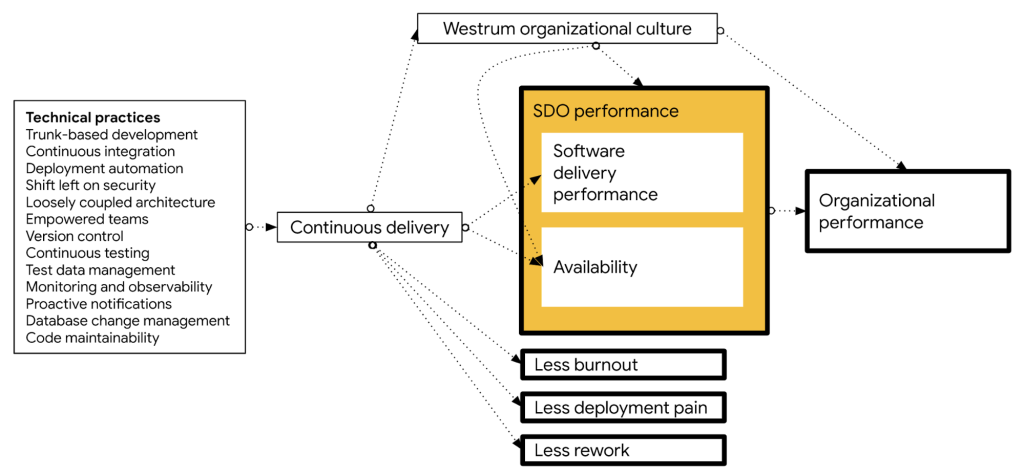
This is why “hire a DevOps engineer” is often an incomplete answer for a growing software company. You may need cloud engineering, release engineering, SRE, security engineering, or platform engineering skills. But none of those eliminate the need for DevOps as the underlying way teams work. DevOps is the shared responsibility model that keeps application teams connected to production reality. Without that cultural base, a platform simply becomes another silo.
What platform engineering actually means
Platform engineering is the practice of designing, building, and operating shared internal capabilities that make software delivery easier, safer, and more repeatable for internal users. DORA describes it as a sociotechnical discipline focused on automation, self-service, and repeatability. CNCF defines platform engineering as the practice of planning and providing computing platforms for developers and users, spanning people, process, policy, technology, and the business outcomes that drive them. Google Cloud defines it as designing and maintaining an internal developer platform to equip engineering teams with golden paths. AWS and Microsoft both treat the platform as an internal product whose customers are developers.
That gives us five terms worth separating clearly:
A platform team is the group responsible for building and improving shared capabilities, normally with a product mindset, a roadmap, and explicit internal customers. AWS’s prescriptive guidance says that team needs development, operations, automation/IaC, and security skills. DORA argues that a platform should be treated as an internal product, not an infrastructure ticket queue.
An internal developer platform is the set of tools, workflows, APIs, templates, and controls that abstract away repeated complexity so developers can self-serve. Google Cloud explicitly says an IDP is a set of tools and technologies that abstracts technical complexity so developers can self-service and reduce cognitive load. AWS describes the IDP as an internal product that helps developers independently manage environments, deployments, resources, and configurations.
An internal developer portal is one possible interface into that platform. Google Cloud says an IDP may or may not include a portal. Microsoft’s self-service foundation guidance makes the same point differently: the developer self-service experience can be composed of APIs, orchestrators, metadata, graphs, dashboards, and other components, and portal toolkits like Backstage are only one implementation pattern.
Golden paths or paved roads are the preferred, well-supported ways to perform common tasks. They encode best practices into templates, workflows, modules, or abstractions so teams start right and stay right. AWS explicitly describes golden paths as reusable building blocks that encapsulate best practices, and Microsoft describes start-right templates plus stay-right governance as a central mechanism for self-service with guardrails.
Developer self-service is the operating outcome. It is not self-service for its own sake. The point is that developers should not have to file tickets for common workflows such as creating a service, provisioning an environment, generating a CI/CD pipeline, requesting standard cloud infrastructure, or wiring logging and metrics. Microsoft is especially clear here: self-service matters most for tasks that are tedious, permission-constrained, or too complex for every product team to perform manually.
Platform engineering vs DevOps
Backstage is helpful in understanding the portal/platform distinction. Its own documentation describes Backstage as an open-source developer portal framework that includes a software catalog, software templates, and docs tooling. The Backstage software catalog centralizes ownership and metadata; software templates scaffold new components and standardize best practices; plugins integrate surrounding tools. That means Backstage can be an interface layer for platform engineering, but it is not synonymous with platform engineering itself. A company can do platform engineering without Backstage, and a company can install Backstage without actually solving platform problems.
The most useful distinction is this: DevOps optimizes how teams build and run software together; platform engineering packages repeated operational knowledge into reusable internal products. SRE then adds a reliability discipline around measurable service goals, operational risk, and production standards. Google’s SRE guidance explains that SRE starts with defining reliability goals and measuring them with SLOs, SLIs, and related practices. In many organizations, SRE teams either embed with products, provide consulting, maintain shared infrastructure, or codify reliability standards that can be adopted by product teams.
The comparison below is a synthesis of official guidance from DORA, CNCF, Google Cloud, AWS, Microsoft, and Google SRE.
| Dimension | DevOps | Platform engineering |
|---|---|---|
| Primary goal | Faster, safer software delivery through shared ownership and automation | Lower developer friction and cognitive load through reusable self-service capabilities |
| Primary users | Delivery teams, operations teams, security, QA, release, product | Internal developers and engineering teams as platform customers |
| Scope | Culture, collaboration, CI/CD, IaC, observability, security, feedback loops | Templates, golden paths, service catalogs, orchestration, policy integration, paved roads |
| Typical outputs | Working delivery practices and team behaviors | Productized workflows, templates, abstractions, APIs, portals, catalogs |
| Success signs | Better delivery speed and stability, healthier collaboration | Faster common workflows, lower toil, consistent controls, easier onboarding |
| Organizational model | Distributed responsibility shared across teams | Usually a focused enabling team with a product mindset |
| Best-fit stage | Every software organization needs some DevOps maturity | Only once repeated cross-team friction justifies shared abstractions |
| Common failure mode | Treating DevOps as a siloed role or tooling purchase | Building a portal without solving workflows, or becoming a ticket queue |
The practical coexistence model is simple. Application teams still own their services. DevOps practices still govern how software is built and run. SRE defines and improves reliability standards where needed. Platform engineering reduces repeated complexity by offering the easiest supported path to do the right thing. If those boundaries are clear, the disciplines reinforce one another. If they are vague, you get duplicated tooling, unclear ownership, and eventually a central team that everyone waits on but nobody loves.
Early-Stage SaaS Foundations and Scaling Triggers
What early-stage SaaS teams actually need
An early-stage SaaS company does not need a sophisticated internal developer platform to behave professionally. It needs an operationally credible baseline that lets a small team ship safely and recover quickly. The essentials are well established in DORA, AWS Well-Architected, NIST SSDF, and mainstream cloud guidance: a reliable CI/CD pipeline; infrastructure as code for repeatability; predictable environments; centralized logs, metrics, and alerting; secrets and access control handled through managed identity and secrets systems; tested backups and recovery procedures; security checks in the delivery pipeline; some form of cloud cost allocation or at least showback visibility; and unambiguous production ownership.
That baseline should usually be boring on purpose. For a small SaaS team, boring is a feature. Most of the leverage comes not from building internal abstractions but from making a handful of workflows dependable: commit code, run tests, deploy safely, observe the result, roll back if needed, and understand who owns what in production. DORA’s five current software delivery performance metrics - change lead time, deployment frequency, failed deployment recovery time, change fail rate, and deployment rework rate - exist precisely because teams need an outcome-oriented way to see whether this baseline is working.
The security and reliability basics should also be integrated early, even if lightly. NIST’s SSDF recommends integrating secure software development practices into each SDLC implementation rather than treating security as an add-on. AWS Well-Architected recommends automatic backups, encryption, and identifying all data that needs to be protected. For multi-tenant SaaS specifically, AWS’s SaaS Lens stresses tenant-aware operational health, including tenant context in logs and proactive alarms that let teams understand health by tenant and tenant tier.
This is also the stage where cloud cost visibility quietly matters more than many founders assume. The FinOps Foundation’s current framework treats allocation as the discipline of assigning costs using account structures, tags, labels, and derived metadata so engineers and product stakeholders understand the cost of the resources they own. It also notes that showback is foundational, while formal chargeback is optional and depends on accounting policy. For an early-stage SaaS team, that means simple tagging, environment labels, and service ownership metadata are usually enough to start.
Why simple managed services often win early
CNCF’s white paper advises platform teams to build the thinnest viable platform layer over managed providers. Microsoft says the lowest-effort solution that solves the problem is usually the right one to start with. Google Cloud is explicit that when applications are straightforward and teams can manage their own needs, simple CI/CD and strong DevOps practices are often enough. The point is not ideological minimalism. The point is preserving scarce engineering time for product learning and customer value.
That is why many startups are better served by managed databases, managed identity, managed secret stores, hosted CI/CD, managed observability, and straightforward infrastructure modules than by “building a platform.” Google Cloud’s guidance on managed infrastructure repeatedly emphasizes reduced operational overhead, and AWS Well-Architected is built around using cloud services to improve security, reliability, and cost effectiveness through repeatable architectures. In practice, that means a startup should be suspicious of any platform initiative that appears before it has even standardized basic delivery, observability, or security workflows.
The scaling problems that create platform demand
Platform demand usually appears when DevOps practices are no longer enough to keep complexity under control through team discipline alone. The most common triggers are not abstract. They are very observable: duplicated CI/CD pipelines; hand-rolled infrastructure per team; slow environment provisioning; ticket-based operations; inconsistent deployment methods; fragmented observability; hard onboarding; too much Kubernetes, network, or IAM knowledge required for everyday work; inconsistent security controls between teams; knowledge concentrated in a few engineers; a DevOps or cloud team that has become a bottleneck; and shadow tooling that creates drift and audit pain. Google Cloud, Microsoft, AWS, DORA, CNCF, and the John Lewis platform case study all describe versions of the same pattern.
The business consequence is what should get leadership attention. Duplicated pipelines are not just “messy”; they slow releases, increase maintenance load, and make security changes expensive to roll out. Slow environment creation is not just annoying; it extends experiment cycles and delays customer feedback. Ticket-based operations do not just irritate developers; they convert platform work into queueing theory, which means delivery throughput becomes bounded by the response time of a small enabling group. Fragmented observability does not just complicate debugging; it increases time to detect, time to resolve, and eventually the cost of incidents. Hard onboarding does not just create a bad first month; it slows hiring leverage exactly when a SaaS business is trying to grow output faster than headcount.
The table below maps common engineering symptoms to business consequences and the kind of platform capability that might actually help. It is a practical synthesis of AWS, Microsoft, Google Cloud, DORA, CNCF, and John Lewis guidance.
| Repeated symptom | What it costs the business | Platform capability that can help | Metric to validate the problem |
|---|---|---|---|
| Teams copy/paste pipelines and IaC | Slower changes, inconsistent controls, expensive maintenance | Reusable modules and pipeline templates | Duplicate pipeline count, change lead time |
| Environments take days or approvals | Slower experiments and customer feedback | Self-service provisioning with guardrails | Environment provisioning time |
| Ops work arrives as tickets | Queue delays and hidden toil | API/CLI/portal-based self-service | Ticket volume, fulfillment latency |
| Deployments differ by team | Higher failure risk and harder audits | Standardized deployment workflows | Change fail rate, rework rate |
| Logs and metrics are fragmented | More expensive incidents and slower recovery | Observability defaults and service metadata | Failed deployment recovery time, MTTR |
| Onboarding requires tribal knowledge | Slower hiring leverage and more context switching | Service templates, docs, catalog, examples | Time to first PR, time to first production deploy |
| Developers need deep cluster/IAM/network knowledge | High cognitive load and lower product focus | Golden paths that abstract complexity | DevEx survey, task success rate |
| Security controls vary by team | Greater audit, breach, and enterprise-sales risk | Policy as code, approved templates, scanning defaults | Exception count, audit findings, review cycle time |
| A small DevOps team gates every change | Throughput limited by one team | Platform product model instead of ticket ops | Waiting time on DevOps requests |
| Shadow tooling and drift appear | Higher support cost, inconsistent evidence for compliance | Catalog, ownership metadata, standard paths | % workloads using golden paths, drift findings |
A useful rule of thumb is that platform engineering becomes justified when the same category of work is being solved repeatedly by multiple teams and the cost of that repetition becomes visible in throughput, reliability, onboarding, security review time, or developer frustration. That is a better trigger than “we now have X engineers” or “we are using Kubernetes.”
Decision Framework and What to Build
A stage-based decision framework for growing SaaS teams
The most reliable way to avoid overengineering is to tie platform investment to the company’s real stage of complexity, not to vendor narratives. Microsoft’s platform engineering journey guidance recommends a common progression from discovery, to reusability and paved paths, to more sophisticated self-service experiences. It also clearly states that you do not need to progress unless your organization needs the next stage. CNCF’s maturity model adds a similar caution: greater maturity levels require more funding and people’s time, and the highest level is not a goal in itself. Google Cloud makes the same point even more bluntly: the decision to create a platform team is driven by the cost of friction, not by an arbitrary team-size threshold.
| Growth stage | Typical context | Recommended operating model | Introduce now | Do not build yet | Key metrics | Ready for next stage when… |
|---|---|---|---|---|---|---|
| MVP or early startup | One product, few services, founders and engineers close to production | Strong DevOps habits inside product team | CI/CD, IaC, observability basics, secrets, backups, ownership, basic cost tagging | Dedicated platform team, internal portal, custom orchestration | Deployment frequency, lead time, failed deployment recovery time, cost visibility | The same infra/security/release problem is solved repeatedly |
| Growing product team | More engineers, more environments, first compliance pressures | Shared cloud/DevOps enablement with lightweight self-service | Reusable templates, standard repos, environment automation, better docs | Big portal project, heavy abstractions, complex multi-runtime IDP | Provisioning time, onboarding time, ticket latency, adoption of templates | Multiple teams depend on the same shared workflows and face the same bottlenecks |
| Multiple teams and services | Rising service count, cognitive load, differing deployments, security variation | Small platform team with product mindset | Golden paths, service catalog, standardized CI/CD, policy integration, ownership metadata | One-size-fits-all architecture mandate | DORA metrics, task success, % repos on golden paths, support requests | Platform demand is consistent, self-service truly reduces wait time, and teams ask for more |
| SaaS scaleup or enterprise platform | Many teams, multiple app stacks, audit needs, regional growth, enterprise buyers | Dedicated platform team plus platform product management, with SRE and security partnerships | Multi-interface self-service, policy as code, cost allocation, regional templates, richer diagnostics, platform SLOs | Rewriting everything into one stack | Adoption and retention, platform availability, failed workflows, incident impact, time to launch new service/region | Shared platform becomes a business multiplier rather than just an internal utility |
The biggest strategic error at every stage is building for the next stage too early. Many teams jump from “we need better CI/CD” to “we need a portal, catalog, custom control plane, and platform PM.” Microsoft explicitly warns against building late-stage platform capabilities before they are justified, and DORA recommends starting with a minimum viable platform centered on the single most common workflow.
Signs it is time for platform engineering
You do not need a platform engineering initiative because platform engineering is “important.” You need one when you can observe repeated symptoms that have tractable shared solutions. The table below turns seven common signals into a decision lens. It synthesizes DORA, Google Cloud, AWS, Microsoft, CNCF, and John Lewis guidance.
| Symptom | Likely underlying cause | Engineering or business cost | Platform capability that helps | Metric to validate |
|---|---|---|---|---|
| New services take too long to stand up | Manual repo, pipeline, secrets, IaC, environment setup | Slower product expansion | Service templates and bootstrap automation | Service creation time |
| Developers wait on central teams for routine tasks | Ticket-based ops and permission bottlenecks | Lost throughput and context switching | Self-service workflows with policy controls | Request-to-fulfillment time |
| Teams implement security differently | No standard approved path | Greater audit and incident risk | Approved IaC modules, scanners, PaC | Security exceptions, review cycle time |
| Kubernetes or cloud primitives dominate delivery work | Complexity shifted onto product teams | Higher cognitive load, weaker product focus | Paved roads that hide non-differentiating complexity | DevEx survey, onboarding time |
| Observability is inconsistent | Missing shared defaults and ownership metadata | Longer outages and unclear accountability | Standard telemetry, service catalog, incident links | Recovery time, incident count |
| The DevOps team is a bottleneck | Shared expertise has not been converted into reusable systems | Queue growth and burnout | Platform productization of repeated requests | Ticket volume, queue age |
| New hires take too long to become effective | Tribal knowledge and scattered tooling | Slower scaling of headcount | Catalog, docs, templates, guided journeys | Time to first PR, time to first deploy |
What an internal developer platform should actually provide
A useful IDP is not a stack diagram; it is a set of workflows that developers choose because it is easier than doing everything from scratch. AWS says the platform should help developers independently manage environments, deployments, resources, and configurations. Microsoft’s self-service model emphasizes automation first, with data aggregation as support. Backstage shows how catalogs, templates, and docs can provide discovery and standardization, but those are interfaces to workflows, not the workflows themselves.
For a SaaS company, a credible internal developer platform usually provides some combination of the following:
Service templates for standard service types; repository creation with seeded policies and examples; reusable infrastructure modules; automated CI/CD workflows; environment provisioning; preview environments where justified; a service catalog with ownership metadata; identity and secrets integration; observability defaults; security scanning and software supply chain controls; policy-as-code gates; cost attribution by team, environment, or product; incident and runtime context; and feedback or diagnostics when workflows fail. These are consistent with AWS’s capability list, Microsoft’s self-service architecture, Google’s focus on self-service golden paths, and Backstage’s catalog/template model.
A simple conceptual architecture looks like this:
Developer interface → golden paths and templates → CI/CD and infrastructure orchestration → security, policy, observability, and cost controls → cloud runtime and data services
The important architectural point is that the interface can vary. It might be a portal, a CLI, an API, a Git-based workflow, or a combination. AWS explicitly says the interface can be a GUI, API, or CLI. Microsoft recommends reusing existing investments and supporting multiple interfaces over time behind a consistent API. Google Cloud says an IDP may or may not include a developer portal. So if a team is debating “Backstage or no platform,” it is asking the wrong question. The real question is which workflows deserve standardization and how developers should access them with the least friction.
Responsibilities and How to Implement
How DevOps, SRE, security, and platform responsibilities should fit together
The platform team should not replace application ownership. Azure’s DevOps culture guidance is very clear that the workload team owns operation end to end, even when outside teams provide support. Google’s SRE guidance is also useful here: infrastructure SRE teams may run shared services and define production standards as code, but product developers still maintain user-facing products without losing ownership. AWS’s preparation guidance shows the same split in platform-team skill design: development, operations, automation/IaC, and security are all built into the platform capability, but that does not erase application-team responsibility.
The matrix below is a practical operating model rather than a rigid org chart. It synthesizes Google SRE, Azure Well-Architected DevOps guidance, AWS IDP guidance, and Microsoft platform engineering principles.
| Role | Primary accountability | Shared areas | Anti-pattern to avoid |
|---|---|---|---|
| Application teams | Business logic, service ownership, on-call for owned services, using supported paths | Runtime tuning, reliability, security fixes | Outsourcing production ownership to “the platform team” |
| DevOps or cloud engineers | Cloud foundations, CI/CD enablement, core IaC, shared environment standards | Automation with platform team | Becoming a permanent ticket queue |
| Platform engineering | Internal product for reusable workflows, golden paths, self-service APIs/interfaces, templates, diagnostics | Security, SRE, FinOps, cloud enablement | Building abstractions nobody asked for |
| SRE | Reliability goals, SLOs/SLIs, incident practices, production standards, error-budget discipline | Observability defaults, resilience patterns | Owning everything or acting as pure auditors |
| Security | Baselines, policy requirements, identity, scanning, supply-chain controls | Policy as code, approved templates | Forcing every team to implement controls differently |
| FinOps | Allocation model, showback, cost governance, optimization practices | Tagging standards, platform cost metadata | Producing finance-only reports nobody engineering-relevant uses |
| Engineering leadership | Funding, org design, priority setting, adoption incentives, outcome measurement | All of the above | Treating platform work as invisible “overhead” without product goals |
How to prevent the platform team from becoming another ticket queue
This is the most common and most expensive failure mode. DORA explicitly warns against the “Ticket-Ops” trap. Google’s SRE guidance points out that adoption of standards can happen through influence or through mandates, but zero-configuration systems that save teams time are often the most effective bridge because teams adopt them voluntarily when the benefits are obvious. Microsoft’s self-service guidance similarly prioritizes automation over mere aggregation.
The lesson is simple: platform adoption should be earned through usability and value, not forced through organizational gravity alone.
In practice, that means the platform team should optimize for four things. First, common tasks should be self-service by default. Second, the easiest path should be the safest supported path. Third, failures need clear and actionable feedback, because DORA’s 2025 platform guidance found that the platform capability most associated with a positive user experience is clear feedback on task outcomes. Fourth, extensibility matters: a central team cannot and should not build everything, so contribution models, APIs, and standardized extension points matter if the platform is going to scale without centralizing all work.
Start with a thinnest viable platform
This is where most good platform stories begin. Microsoft recommends identifying the thinnest viable platform, piloting it with willing teams, capturing key metrics, and letting measured value justify future investment. AWS recommends starting by identifying cognitive load, inventorying tools and processes, selecting a single golden path, automating security guardrails into that path, and then wrapping it in a self-service interface. DORA says to start with a minimum viable platform centered on the most common workflow.
A practical first implementation sequence looks like this:
- Interview developers. Do not ask which tool they want. Ask which jobs are slow, repetitive, confusing, or blocked by permissions. Microsoft recommends interviewing developers about the jobs to be done and identifying their biggest problems before feature selection.
- Map developer journeys. Use journeys such as “create a service,” “deploy a change,” “spin up an environment,” or “debug production” to locate the highest-friction moments. DORA and Microsoft both explicitly recommend mapping critical user journeys.
- Establish baseline metrics. Capture current provisioning time, ticket latency, time to first PR, time to first deploy, or support-request volume so improvement can be proven later. AWS, Microsoft, and John Lewis all stress baseline metrics.
- Choose one repeated high-friction workflow. AWS recommends identifying a single golden path. CNCF recommends smallest viable effort.
- Build one useful golden path. Make it opinionated, secure, and documented, but narrow in scope. DORA’s guidance is to build only enough to make a common journey demonstrably better.
- Pilot with one or two teams. Microsoft explicitly recommends piloting with teams willing to provide feedback.
- Measure adoption and task success. Look at completion rate, time saved, support requests, and satisfaction—not just sign-ups. DORA recommends measuring task success, adoption, retention, and developer satisfaction.
- Improve before expanding. If the path is hard to use or hard to debug, expansion will only amplify the pain.
Build, buy, or assemble
There is no single correct answer here. Microsoft explicitly says a self-service experience can be built from a mix of home-grown, off-the-shelf, and open-source products. It also recommends focusing custom effort on the glue and experience unique to your business rather than building everything from scratch. CNCF recommends a thin platform layer over managed providers, and Google emphasizes that there is no one-size-fits-all platform solution.
| Option | Best when | Strengths | Trade-offs |
|---|---|---|---|
| Custom internal development | Your workflows are truly differentiating, and you have strong internal product/engineering capacity | Deep fit, maximum control, can encode unique governance and domain workflows | Highest maintenance burden, slower time to value, harder staffing |
| Open-source and cloud-native assembly | You want flexibility and have engineering capacity to integrate components | Good balance of control and speed, broad ecosystem, avoids all-in single-vendor dependence | Integration and upgrade work do not disappear; requires clear ownership |
| Commercial platform products | You need faster time to value and are willing to adapt to product boundaries | Faster rollout, packaged workflows, analytics, vendor support | License cost, product limits, integration choices constrained by vendor |
| Managed cloud services without formal IDP | Your main problem is reliable delivery and standardized cloud operations, not internal product experience | Fastest route to operational maturity, reduced overhead, lower cognitive load early | May not solve cross-team discoverability or internal workflow orchestration later |
For most growing SaaS teams, the answer is “assemble gradually.” Use managed services for undifferentiated heavy lifting. Add open-source or vendor components where they accelerate self-service. Write custom glue only where the workflow itself matters to your organization. The biggest mistake is assuming that “platform” means “we must build our own everything.” The second biggest mistake is assuming a commercial portal magically equals a usable platform.
Security, FinOps, AI, and Measurement
Security, compliance, and FinOps without magical thinking
A good platform can make security and compliance more consistent, but it does not make a company compliant by itself. NIST’s SSDF is useful here because it frames secure software development as a set of practices integrated into the SDLC, with the goal of reducing vulnerabilities and addressing root causes. Policy as code on AWS and Azure similarly treats compliance controls as executable checks embedded in delivery and deployment workflows rather than separate manual review rituals. Google Cloud’s software supply chain security guidance adds provenance, vulnerability insight, and SLSA maturity signals to the discussion.
For SaaS teams, especially those moving upmarket into enterprise accounts or regulated sectors, platform capabilities can standardize important controls: IAM patterns, secret management, baseline encryption, audit logging, approved IaC modules, pre-deployment policy checks, software provenance, environment isolation, regional deployment patterns, and backup standards. AWS’s policy-as-code guidance emphasizes consistent automated enforcement of enterprise standards while minimizing manual processes. Google Cloud’s supply chain security documentation highlights build provenance and SLSA build levels. Microsoft’s IaC security guidance recommends integrating scanning and Azure Policy into delivery workflows so noncompliant resources never reach production.
Multi-tenant SaaS introduces another layer of platform value. AWS’s SaaS Lens recommends tenant-aware operational views, including tenant context in application logs and proactive management by tenant and tier. That matters when enterprise customers expect tenant isolation answers, incident evidence, recovery plans, and region-specific deployment options. Likewise, Well-Architected backup guidance stresses automatic, encrypted backups and deliberate recovery planning. These are exactly the categories of control that benefit from centralized reusable workflows rather than one-off team interpretation.
FinOps belongs in the same conversation. If the platform provisions environments, clusters, databases, previews, or customer-specific workloads, it should emit the metadata needed for cost allocation. The FinOps Foundation’s current guidance defines allocation in terms of accounts, tags, labels, and derived metadata that let engineers and product managers understand ownership and cost. It also notes that showback is foundational, while chargeback is optional depending on accounting policy. That is especially useful in platform contexts because many platform costs are shared. The platform should therefore make cost ownership visible, but leaders should not assume formal chargeback is required on day one.
How to measure platform engineering success
One of the strongest current signals from official guidance is that platform engineering should be measured like a product and like an operations system. DORA recommends a balanced scorecard that combines software delivery performance, developer satisfaction, adoption/retention, and task success. AWS recommends DORA metrics and application health/SLO views. Microsoft recommends measuring speed to business value, software quality, platform ease of use, and ecosystem health. CNCF recommends metrics in user satisfaction, organizational efficiency, and product delivery. John Lewis adds an especially practical warning from real-world platform work: high activity does not necessarily mean high value.
A balanced scorecard for a SaaS platform program should include the following categories:
| Outcome area | Metrics that matter | Why they matter |
|---|---|---|
| Delivery performance | DORA’s five current metrics: change lead time, deployment frequency, failed deployment recovery time, change fail rate, deployment rework rate | Measures whether the platform is improving safe delivery rather than just centralizing tooling |
| Workflow efficiency | Service creation time, environment provisioning time, time to first production deploy, time to launch a new region or customer environment | Exposes whether self-service actually reduces latency in common tasks |
| Developer effectiveness | Task success rate, onboarding time, time to first PR, developer satisfaction, perceived cognitive load | Shows whether the platform is easier to use, not merely more powerful |
| Adoption quality | % workloads using golden paths, active teams, retention, drop-off between onboarding and continued use | Distinguishes real value from curiosity or mandated usage |
| Platform reliability | Platform availability, failed workflow rate, mean time to diagnose failed workflows | A broken platform is a multiplier of failure, not a multiplier of speed |
| Support load | Ticket volume, escalation rate, repeat questions, docs/search success | Captures whether the platform is replacing toil or creating new forms of it |
| Risk reduction | Incident reduction, policy exceptions, audit preparation time, vulnerability remediation time | Connects platform work to enterprise readiness and operational resilience |
| Cost and efficiency | Infra cost per workload, unused environment spend, shared service allocation coverage, engineering hours saved | Prevents the platform from becoming a black box of hidden cost |
Two points deserve emphasis. First, portal logins are not success. John Lewis explicitly moved beyond activity-based metrics because usage alone does not prove value. Second, feature output is not success either. Shipping more templates or workflow steps means little if service creation time, onboarding time, task success, and developer confidence do not improve. The platform is succeeding when it compresses the distance between intent and safe production reality.
Common platform engineering mistakes
Official guidance and case studies are consistent about the traps:
- building before researching developer needs;
- launching a big-bang platform instead of a thin, validated slice;
- choosing tools before defining workflows;
- confusing a portal with a platform;
- turning golden paths into a “golden cage”;
- forcing all workloads onto one architecture;
- centralizing operations without creating self-service;
- underinvesting in product management, documentation, and error messages;
- measuring outputs instead of outcomes;
- underestimating maintenance;
- adopting Kubernetes simply because it seems like the natural destination.
Kubernetes deserves its own caution. John Lewis’s case study is instructive because it does not say “use Kubernetes and your platform problem is solved.” It says almost the opposite: as more teams joined the platform, Kubernetes created a learning curve, and the platform had to introduce a custom abstraction to reduce that complexity. That is a powerful reminder that Kubernetes may be a foundation for platform engineering in some organizations, but it is not a synonym for platform engineering and should not be adopted without a clear operational reason.
A practical 90-day roadmap
A realistic first 90 days looks like this:
| Time window | What to do | Deliverables |
|---|---|---|
| Days 1–30 | Interview developers, map journeys, inventory current tools and repeated tickets, identify top friction point, baseline metrics | Problem statement, workflow map, current-state inventory, baseline dashboard |
| Days 31–60 | Build one golden path for one repeated workflow, encode basic security guardrails, document it, pilot with one or two teams | Pilot capability, docs, usage instrumentation, support model |
| Days 61–90 | Measure task success and cycle-time improvement, refine usability, define ownership and roadmap, decide whether to extend, buy, or stop | Outcome review, adoption report, staffing recommendation, next-quarter roadmap |
What should not be attempted in the first 90 days? A company-wide portal rollout, a wholesale migration of all workloads, a platform rewrite of every team’s delivery stack, or a mandate that every team adopt the new path immediately. Microsoft explicitly recommends starting with newer applications of reasonable size and avoiding large replatforming projects as early validation targets. AWS says to select a single golden path. DORA recommends resisting the all-at-once build.
Platform engineering and AI-assisted development
AI has changed the urgency of the platform conversation, but not the fundamentals. DORA’s 2025 report says AI acts as an amplifier of an organization’s existing strengths and weaknesses. Its 2026 analysis of that report adds a key technical tension: time saved in creation is frequently reallocated to auditing and verification, and higher AI adoption is associated with increases in both throughput and instability. On the platform engineering side, DORA warns that individual productivity gains are often lost to downstream disorder in testing, security review, and deployment if the broader system is weak.
AWS’s AI SDLC guidance arrives at a compatible conclusion from a different angle. It recommends an integrated end-to-end toolchain, DevSecOps pipelines, operations optimization, knowledge management, and a platform-based approach so AI can be used across the SDLC without creating disconnected handoffs or new governance gaps. That is exactly where platform engineering becomes useful: not because it guarantees AI code quality, but because it gives AI-generated work a standardized path through testing, policy checks, deployment controls, observability, and feedback loops.
So the right claim is not “platform engineering solves AI risk.” It does not. The right claim is that AI-assisted development increases pressure on testing, code review, software supply chain controls, documentation, deployment workflows, and runtime observability. A well-designed platform can standardize those paths and make good practice easier to follow at speed. A weak platform - or no platform, where one is needed - simply lets AI generate more change than the organization can safely absorb.
Final decision checklist
If your answer is “yes” mostly to the first group, improve DevOps foundations first. If it is “yes” mostly to the second group, introduce lightweight platform capabilities. If it is “yes” mostly to the third group, you likely have a justified case for a dedicated platform team.
| Improve DevOps foundations first | Add lightweight platform capabilities | Create a dedicated platform team |
|---|---|---|
| CI/CD is still unreliable | A few workflows repeat across teams | Multiple teams depend on the same abstractions |
| IaC and observability are inconsistent | Developers repeatedly wait on cloud/DevOps for routine work | A central enablement team is now a visible bottleneck |
| Production ownership is unclear | Provisioning/onboarding delays are measurable | Security, compliance, and runtime controls are inconsistent across many services |
| Few services and low coordination overhead | One or two paved roads would remove obvious toil | Platform demand is constant and internally recognized |
| Managed services can still solve most needs directly | Early self-service can be piloted with limited scope | Self-service needs span environments, policies, catalogs, and operational standards |
The strategic takeaway is simple: begin with validated delivery problems rather than team labels. If you solve the right repeated problems, your platform strategy will emerge naturally from DevOps maturity instead of becoming a distraction from it.
For SaaS companies that need help deciding whether to strengthen DevOps foundations, introduce lightweight platform capabilities, or design a dedicated internal platform, Intersog’s current service stack is aligned with the work described in this guide: Custom SaaS Dev & Cloud Services for architecture and cloud operating models, Software Support and Hosting Services for DevOps and operational enablement, and Custom Software Development Services for product engineering and delivery execution. The right engagement is not “build a platform because everyone else is doing it.” It is diagnosing the real source of delivery friction, setting outcome metrics, and implementing only the level of automation, observability, governance, and self-service that the product and team structure can actually use.
Leave a Comment